Apply Fermat's principle to a Concave mirror

Click For Summary
SUMMARY

The discussion focuses on applying Fermat's principle to concave mirrors within the context of optics. It highlights that while the principle suggests light follows the shortest path, in the case of a concave mirror, the actual path taken can be longer due to the nature of the mirror's curvature. The conversation emphasizes that according to the calculus of variations, the path of light represents a local extremum rather than an absolute minimum. This means that slight deviations in the light's path result in minimal changes in path length, reinforcing the principle's application to infinitesimally small adjustments.

PREREQUISITES
  • Understanding of Fermat's principle in optics
  • Basic knowledge of concave mirrors and their properties
  • Familiarity with calculus of variations
  • Concept of local extrema in mathematical analysis
NEXT STEPS
  • Study the application of Fermat's principle in different optical systems
  • Explore the calculus of variations in greater depth
  • Investigate the behavior of light in various types of mirrors
  • Learn about local extremum concepts in physics and mathematics
USEFUL FOR

Students of optics, physics educators, and anyone interested in the mathematical principles governing light behavior in concave mirrors.

KT KIM
Messages
24
Reaction score
0
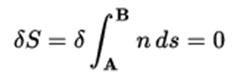
I am now taking optics class at my school. Fermat principle can be applied on mirror of course.
Fermat.png

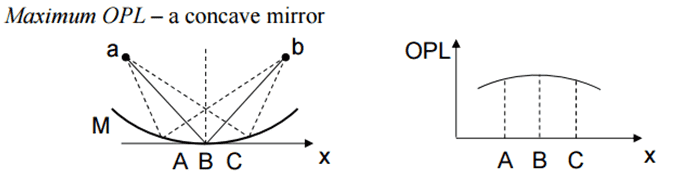
Then what about Concave mirror? According to the calculus of variation. the optimized path(actual path of the light) should be the shortest path. but in the concave mirror case, it goes through the longest path.
Fermat2.png

Like above.

How can I apply Fermat's principle on concave mirror?
 
Science news on Phys.org
KT KIM said:
I am now taking optics class at my school. Fermat principle can be applied on mirror of course.
Fermat.png

Then what about Concave mirror? According to the calculus of variation. the optimized path(actual path of the light) should be the shortest path. but in the concave mirror case, it goes through the longest path.
Fermat2.png

Like above.

How can I apply Fermat's principle on concave mirror?

With variational principles, the path is not the absolute minimum (or maximum) it is only a local extremum. What this means is the following: If you shift the path slightly to the dotted path shown in the figure below, by shifting the location where the light ray hits the mirror by \Delta x, then the change in the path length will be of order (\Delta x)^2. That's a statement about the limit as \Delta x \rightarrow 0. Fermat's principle doesn't say anything about paths that are very different from the given path, it only applies to infinitesimally different paths.

fermat.jpg
 

Similar threads

  • · Replies 4 ·
Replies
4
Views
2K
  • · Replies 11 ·
Replies
11
Views
3K
  • · Replies 4 ·
Replies
4
Views
2K
  • · Replies 18 ·
Replies
18
Views
6K
  • · Replies 42 ·
2
Replies
42
Views
5K
  • · Replies 17 ·
Replies
17
Views
4K
  • · Replies 20 ·
Replies
20
Views
5K
  • · Replies 12 ·
Replies
12
Views
2K
  • · Replies 8 ·
Replies
8
Views
1K
  • · Replies 10 ·
Replies
10
Views
3K