Discussion Overview
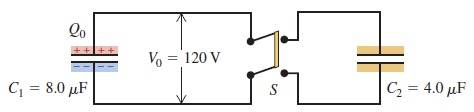
The discussion revolves around the classification of capacitors as being in series or parallel after a voltage source is disconnected and a switch is closed. Participants explore the implications of this configuration on charge distribution and potential differences, with references to definitions and circuit analysis methods.
Discussion Character
- Debate/contested
- Technical explanation
- Mathematical reasoning
Main Points Raised
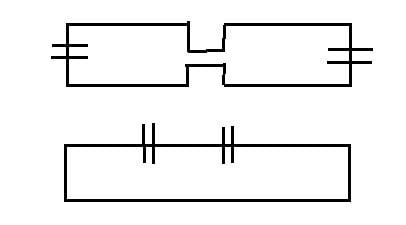
- Some participants assert that after disconnecting the voltage source, the capacitors should be considered in parallel due to the equal potential across them, while others argue they are in series based on charge transfer dynamics.
- A participant explains that when capacitors are in series, the charge is the same on both, which is not the case in the described scenario, suggesting a parallel configuration instead.
- Another viewpoint suggests that the circuit can be analyzed as both series and parallel, depending on the perspective taken, and that both approaches yield the same results in this specific case.
- Some participants emphasize the importance of definitions for series and parallel connections, questioning how the initial conditions affect the classification.
- There is a discussion about the implications of current and voltage measurements in determining the nature of the connection, with some suggesting that both conditions can coexist in this scenario.
- One participant highlights that the equivalent capacitance can be calculated as the sum of the individual capacitances, which aligns with the parallel configuration, while others challenge this interpretation.
- Another participant provides a mathematical analysis showing how charge flows through the capacitors, reinforcing the argument for treating them as series in certain calculations.
Areas of Agreement / Disagreement
Participants do not reach a consensus on whether the capacitors are in series or parallel after the voltage source is disconnected. Multiple competing views remain, with some arguing for parallel and others for series, and some suggesting that both perspectives can be valid depending on the analysis approach.
Contextual Notes
Participants note that the definitions of series and parallel connections may depend on the specific circuit configuration and initial conditions, leading to ambiguity in classification. The discussion also highlights the importance of charge conservation and potential differences in analyzing the circuit.