Best way to connect 8 wires together?

  • Thread starter Thread starter TechTree
  • Start date Start date
  • Tags Tags
    Wires
Click For Summary

Discussion Overview

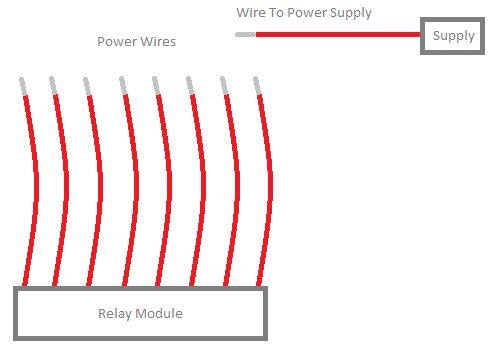
The discussion centers around the best methods for connecting 8 wires to a single wire in a 24VDC system. Participants explore various techniques and considerations related to wire connections, including soldering, terminal blocks, and other alternatives.

Discussion Character

  • Technical explanation
  • Debate/contested
  • Exploratory

Main Points Raised

  • One participant suggests soldering the wires together as a potential solution.
  • Another proposes using terminal blocks, indicating that wires can be attached to one side and daisy-chained to another wire.
  • A participant mentions using terminal strips with jumpers as a common and cost-effective method for such connections.
  • Concerns are raised about the importance of mechanical soundness in connections, especially with higher current supplies, to prevent hazards like sparks or melting wires.
  • There is a suggestion to consider the use of a buss bar or fuse block for added protection, depending on the application.
  • One participant shares a historical perspective, describing a homemade buss bar setup from the 1960s using insulated mounts and house wire.
  • Several questions are posed regarding environmental conditions, current limits, and implications of failure, indicating that these factors could influence the choice of connection method.
  • A later reply humorously corrects the initial query, stating the need to connect 9 wires instead of 8, and reiterates the terminal block solution with jumpers.

Areas of Agreement / Disagreement

Participants express various methods for connecting wires, but there is no consensus on a single best approach. Multiple competing views and considerations remain unresolved.

Contextual Notes

Participants highlight the importance of factors such as current limits, environmental conditions, and the implications of connection failure, which may affect the suitability of different methods.

TechTree
Messages
32
Reaction score
10
Okay this may seem like a basic question. I was wondering what would be the best way to connect 8 wires to a single wire. Here's a simple diagram that shows what I'm trying to do:
Diogram.jpg


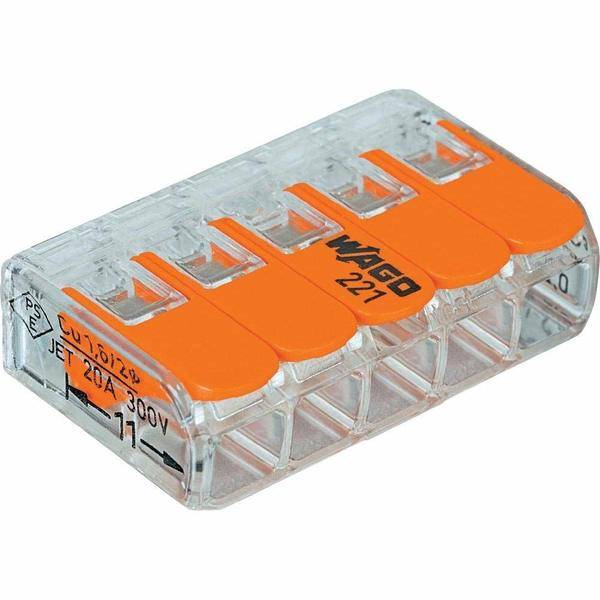
I've been looking around and I've found things like this:
61xMoczrGjL._SL1000_.jpg


Although it seems that there is no larger one that can support 8 wires. What is the correct way to attach multiple wires together? Should I just daisy chain multiple of these, or is there a better way?

Thanks! :wink:

Moderator's note: Addtional information, the question pertains to 24VDC systems.
 

Attachments

  • Diogram.jpg
    Diogram.jpg
    15.1 KB · Views: 5,235
  • 61xMoczrGjL._SL1000_.jpg
    61xMoczrGjL._SL1000_.jpg
    32.6 KB · Views: 4,911
Last edited by a moderator:
Engineering news on Phys.org
Can you not just solder them together? If not, why not?
 
Terminal blocks are another solution:
upload_2018-9-25_12-49-17.png


Attach the wires to one side, daisy chain a wire to the other side.
 

Attachments

  • upload_2018-9-25_12-49-17.png
    upload_2018-9-25_12-49-17.png
    27.2 KB · Views: 4,757
Without knowing the voltages and current involved no one can really give an accurate answer.
Edit: I now see this is a 24 volt system. DC I assume?
 
I've usually used the terminal strips with jumpers on one side for stuff like this, as they are cheap and available.

Another alternative is a buss bar.
61lw9EHX50L._SL1200_.jpg
Or a terminal block
JB1_R_8_sm.gif
Or a fuse block, if you need to protect the relay parts.
61Wc4ryF%2BpL._SL1000_.jpg
 

Attachments

  • 61lw9EHX50L._SL1200_.jpg
    61lw9EHX50L._SL1200_.jpg
    15.7 KB · Views: 4,309
  • JB1_R_8_sm.gif
    JB1_R_8_sm.gif
    11.8 KB · Views: 4,177
  • 61Wc4ryF%2BpL._SL1000_.jpg
    61Wc4ryF%2BpL._SL1000_.jpg
    33.2 KB · Views: 3,972
  • Like
Likes   Reactions: TechTree
If current is limited at the source to a safe value, most anything can work safely. But, the higher the amps that the supply is able to source, the more critical it is to have the connections be mechanically sound so as to not dislodge and touch something that can cause sparks, heat, melting wires, etc.
 
ChemAir said:
I've usually used the terminal strips with jumpers on one side for stuff like this, as they are cheap and available.
Ditto, very convenient, and reliable as long as you do a good job crimping on the spade lugs or lug rings (and optionally solder after crimping).

You can also look at some of the connector systems from Wago. We use their spring-locking splices (like 222-415) for a lot of our AC Mains prototype quick-connects:

upload_2018-9-25_13-49-47.png
 

Attachments

  • upload_2018-9-25_13-49-47.png
    upload_2018-9-25_13-49-47.png
    66.4 KB · Views: 4,028
In vacuum tube days of the 60's we'd make a home-brew buss bar.
Mount two insulated mounts , like ChemAir's terminal block, a few inches apart.
Strip some #12 house wire and string it between them.
Solder as many wires as you like to that.

old jim
 
  • Like
Likes   Reactions: TechTree
1. Clean environment or chemically corrosive atmosphere?
2. In an electrical housing, or in the roof or wall space of a house?
3. Motor vehicle or boat, quiet or with vibration from a motor?
4. Implications of failure; Is it a survival critical circuit?

5. What forms the ground return side of the circuit?
6. What is maximum current from supply?
7. What is maximum current to anyone load?
 
  • #10
  • Nevermind, you want to connect 9 wires, not 8. Go with a terminal block solution. Just use jumpers on the line side.
 

Similar threads

Replies
3
Views
2K
  • · Replies 4 ·
Replies
4
Views
2K
  • · Replies 9 ·
Replies
9
Views
5K
  • · Replies 15 ·
Replies
15
Views
3K
  • · Replies 72 ·
3
Replies
72
Views
21K
Replies
12
Views
2K
  • · Replies 13 ·
Replies
13
Views
7K
  • · Replies 11 ·
Replies
11
Views
2K
  • · Replies 16 ·
Replies
16
Views
5K
Replies
7
Views
8K