Discussion Overview
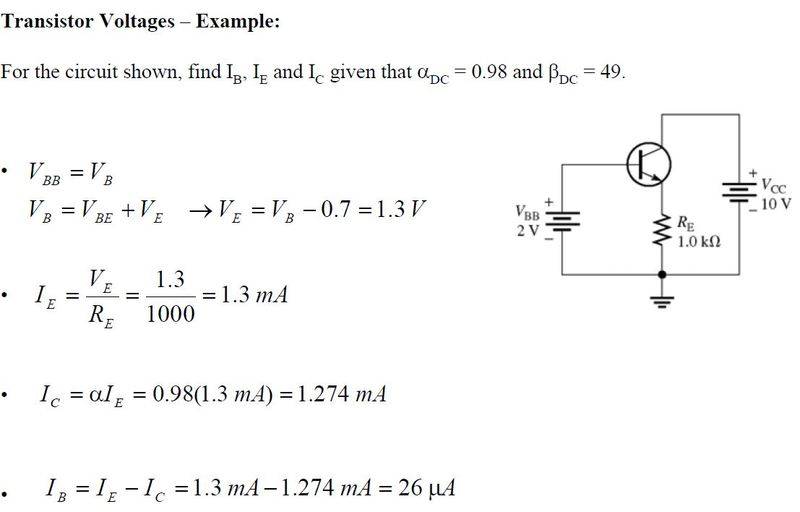
The discussion revolves around understanding the voltage at the emitter (Ve) in a BJT circuit, particularly how it relates to the base voltage (Vb) and collector voltage (Vc). Participants explore the relationships between these voltages and the operation of the transistor, focusing on the calculation of Ve and the role of Vcc and Vbb in the circuit.
Discussion Character
- Technical explanation
- Conceptual clarification
- Debate/contested
- Homework-related
Main Points Raised
- One participant questions why Vc is ignored in the calculation of Ve, suggesting it should be included in the formula as (Vc + Vb) - 0.7V.
- Another participant clarifies that Vcc is not in series with Vbb in the circuit diagram, indicating that the actual value of Vcc is not critical as long as it can supply the necessary current.
- A further explanation is provided about how the base current influences the collector current and the resulting voltage across the emitter resistor, leading to a steady state where the sum of the emitter voltage and the base-emitter voltage equals Vbb.
- One participant expresses understanding after the explanation, indicating that the clarification helped resolve their confusion.
Areas of Agreement / Disagreement
Participants do not reach a consensus on the role of Vc in the calculation of Ve, with differing views on its relevance. The discussion remains unresolved regarding the inclusion of Vc in the voltage calculations.
Contextual Notes
There are assumptions about the circuit configuration that may not be fully articulated, particularly regarding the relationships between Vcc, Vbb, and the transistor operation. The discussion does not resolve the mathematical steps involved in the voltage calculations.