Boost converter output voltage spike on startup

Click For Summary

Discussion Overview

The discussion revolves around the behavior of a boost converter during startup, specifically addressing the output voltage spike observed in simulations. Participants explore potential causes for this phenomenon, including inrush current and the effects of circuit configuration. The conversation includes technical aspects of simulation setups and feedback control mechanisms.

Discussion Character

  • Exploratory
  • Technical explanation
  • Debate/contested
  • Mathematical reasoning

Main Points Raised

  • Some participants suggest that the initial voltage spike may be due to inrush current caused by charging the DC bus capacitor.
  • Others question the absence of a complete startup waveform, noting that it should typically rise gradually from 0V to the target voltage over several cycles.
  • One participant points out that the measurement may be AC coupled, which could obscure the startup waveform.
  • There are discussions about the lack of closed-loop regulation in the circuit and its implications for voltage stability and overshoot.
  • Some participants express skepticism about using a microcontroller for feedback control, suggesting that it may not be suitable for beginners without a solid understanding of control theory.
  • Participants discuss the potential for using analog PWM control methods as an alternative to microcontroller-based solutions.
  • One participant raises the question of whether the frequency observed in the transient response corresponds to the calculated resonance of the inductor and capacitor.

Areas of Agreement / Disagreement

Participants express a range of views on the causes of the voltage spike and the effectiveness of different control strategies. There is no consensus on the best approach to manage the startup behavior of the boost converter or the appropriateness of using a microcontroller for control.

Contextual Notes

Some participants note that the components used in the simulation are ideal, which may not reflect real-world behavior. Additionally, there are concerns about the tolerances of electrolytic capacitors affecting resonance calculations.

Who May Find This Useful

This discussion may be of interest to individuals working on power electronics, specifically those involved in designing or simulating boost converters and exploring control strategies for voltage regulation.

TheRedDevil18
Messages
406
Reaction score
2
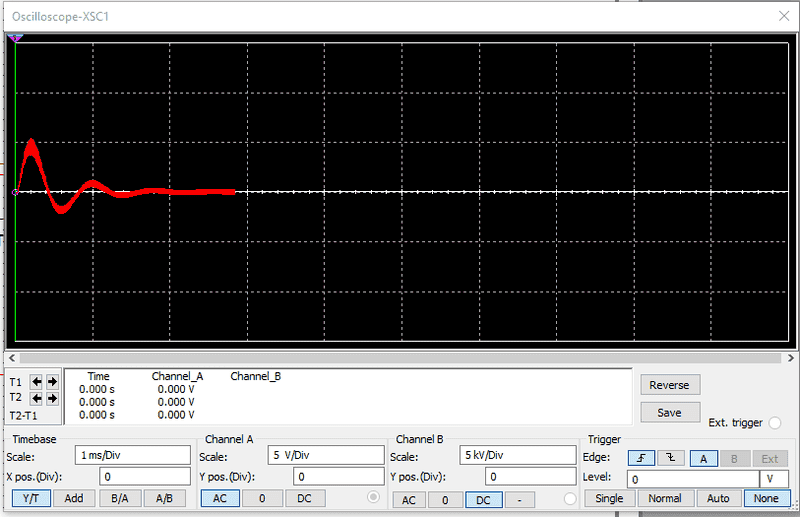
I'm trying to simulate a boost converter using multisim. I get this waveform
upload_2017-3-6_22-41-39.png


Why does it spike like that at the start ?, is it because of the inrush current ?
 
Engineering news on Phys.org
TheRedDevil18 said:
I'm trying to simulate a boost converter using multisim. I get this waveform
View attachment 114189

Why does it spike like that at the start ?, is it because of the inrush current ?
Could you post the schematic and where your probe point is? Can you also post your full startup simulation waveforms? I'm still trying to figure out what that is that you posted.
 
It's the output voltage waveform from the oscilloscope
upload_2017-3-6_23-52-53.png
 
TheRedDevil18 said:
It's the output voltage waveform from the oscilloscope
View attachment 114194
I don't see any startup waveform there. It should go vrom 0V up to whatever your target voltage is, and it should take dozens of cycles at least to get there. Can you show the whole waveform from t=0 and V=0?
 
berkeman said:
I don't see any startup waveform there. It should go vrom 0V up to whatever your target voltage is, and it should take dozens of cycles at least to get there. Can you show the whole waveform from t=0 and V=0?

His measurement is ac coupled, but as you say, it's odd that the initial rise is missing.

OP, what you are seeing is typical of the inrush current caused by charging the dc bus capacitor. For this reason, most boost converters have a controlled startup sequence. You can find plenty of application notes about solutions.
 
Last edited:
  • Like
Likes   Reactions: berkeman
Also, you don't show any closed-loop regulation control of the output voltage. Is that on purpose? You want to run this circuit open-loop and expect no overshoot or line regulation or load regulation issues?

EDIT/ADD -- @TheRedDevil18 -- I didn't mean that to sound aggressive. I'm just trying to understand what you are wanting to do. :smile:
 
Set your 'oscilloscope' in DC mode.
As the converter starts, the output voltage moves from 0 to ??V. This move has an AC component: with the oscilloscope in AC mode you can measure only this.
In DC mode you will see something like Berkeman linked in #7.
 
Last edited:
Thanks for the replies, this is my startup waveform with oscilloscope in DC mode
upload_2017-3-7_14-1-39.png


It rises from 8.2 V (not sure how, maybe its the simulator) to 38 V and then stabilizes to roughly 29.5 V. This converter is a 9 to 30 volt. I am planning on adding feedback using an mcu. Will that help ?
 

Attachments

  • upload_2017-3-7_14-0-30.png
    upload_2017-3-7_14-0-30.png
    20.6 KB · Views: 695
  • #10
TheRedDevil18 said:
It rises from 8.2 V (not sure how, maybe its the simulator) to 38 V and then stabilizes to roughly 29.5 V. This converter is a 9 to 30 volt. I am planning on adding feedback using an mcu. Will that help ?
Check the schematics: if no control for the FET, then you have closed current loop for the 9V source. It's expected to have a DC current => voltage drop on the resistor.

About the 29.5V: I think you forgot to design for the forward voltage of the diode.

To design an acceptable feedback is not easy.
 
  • #11
TheRedDevil18 said:
I am planning on adding feedback using an mcu. Will that help ?
That should help, but as Rive says, it's not trivial. Still, it's very fun to learn about and use in practical circuits.

What is the switching frequency of the FET, BTW?
 
  • #12
berkeman said:
That should help, but as Rive says, it's not trivial. Still, it's very fun to learn about and use in practical circuits.

What is the switching frequency of the FET, BTW?

Its 200kHz

What would be the simplest way to control the duty cycle ?, I am thinking of using a microcontroller as I think this would be much easier
 
  • #13
TheRedDevil18 said:
What would be the simplest way to control the duty cycle ?, I am thinking of using a microcontroller as I think this would be much easier
I think it's more like a nightmare than fun, but Berkeman is right, you have to see it for yourself.
Since it's already a simulation, why don't you give a try to a classic sawtooth-and-comparator style analog PWM control? You can check the whole thing with that oscilloscope. Quite demonstrative.
Also, it's a good experience to modify the load while it's still running and see what it does.

Using a microcontroller for control is jut no good for beginners. You have to be familiar with applied control theory first.
 
  • Like
Likes   Reactions: berkeman
  • #14
TheRedDevil18 said:
Why does it spike like that at the start ?, is it because of the inrush current ?
Is the frequency you see in this transient equal to the calculated resonance of your L and C? (Maybe only roughly equal, because the capacitance of ordinary electrolytics has a very high tolerance, possibly a factor of 2.)
 
  • #15
NascentOxygen said:
Is the frequency you see in this transient equal to the calculated resonance of your L and C? (Maybe only roughly equal, because the capacitance of ordinary electrolytics has a very high tolerance, possibly a factor of 2.)

Not too sure. I didnt calculate any resonance values. The inductor and capacitor in the simulation are ideal
 
  • #16
Rive said:
I think it's more like a nightmare than fun, but Berkeman is right, you have to see it for yourself.
Since it's already a simulation, why don't you give a try to a classic sawtooth-and-comparator style analog PWM control? You can check the whole thing with that oscilloscope. Quite demonstrative.
Also, it's a good experience to modify the load while it's still running and see what it does.

Using a microcontroller for control is jut no good for beginners. You have to be familiar with applied control theory first.

I was thinking the microcontroller would be much easier. I am familiar with coding, so I would just use the MCU to generate a PWM and then use the ADC to sense the voltage and if this voltage goes above or below 30V then it would increase or decrease the duty cycle ?
 
  • #17
TheRedDevil18 said:
I was thinking the microcontroller would be much easier. I am familiar with coding, so I would just use the MCU to generate a PWM and then use the ADC to sense the voltage and if this voltage goes above or below 30V then it would increase or decrease the duty cycle ?
Or use a specialized power controller like the one documented here: http://www.linear.com/product/LT3757.
 

Similar threads

Replies
55
Views
7K
  • · Replies 23 ·
Replies
23
Views
6K
  • · Replies 8 ·
Replies
8
Views
3K
  • · Replies 16 ·
Replies
16
Views
2K
  • · Replies 21 ·
Replies
21
Views
9K
  • · Replies 9 ·
Replies
9
Views
4K
  • · Replies 4 ·
Replies
4
Views
2K
  • · Replies 27 ·
Replies
27
Views
1K
  • · Replies 13 ·
Replies
13
Views
4K
  • · Replies 14 ·
Replies
14
Views
2K