SUMMARY
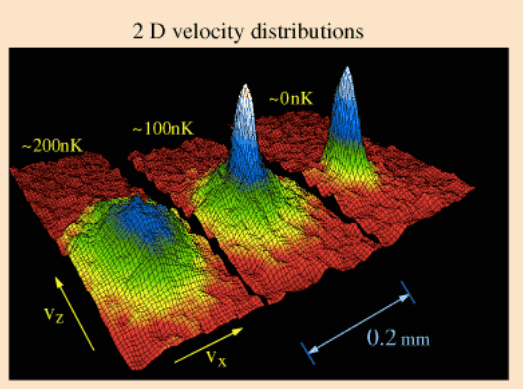
The discussion centers on the interpretation of Bose-Einstein condensate diagrams, specifically focusing on the axes, colors, and their physical meanings. The diagrams represent particle velocities, with color indicating the density of particles at specific velocities (vx, vy). As temperature decreases, more particles occupy the same quantum mechanical ground state, leading to a higher density of particles with zero velocity. The reference provided is "Observation of Bose-Einstein Condensation in a Dilute Atomic Vapor" by Anderson et al., published in Science in 1995.
PREREQUISITES
- Understanding of quantum mechanics, specifically Bose-Einstein statistics
- Familiarity with particle velocity distributions
- Knowledge of color mapping in scientific visualization
- Basic principles of thermodynamics related to temperature and particle behavior
NEXT STEPS
- Study the principles of Bose-Einstein condensation in detail
- Explore the significance of velocity distribution in quantum gases
- Learn about color mapping techniques in scientific data visualization
- Investigate the original research paper by Anderson et al. for deeper insights
USEFUL FOR
Physicists, researchers in quantum mechanics, and students studying condensed matter physics will benefit from this discussion, particularly those interested in the visualization and interpretation of Bose-Einstein condensate phenomena.