Discussion Overview
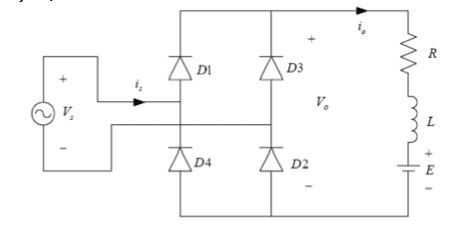
The discussion centers on the output voltage waveform of a bridge rectifier circuit, specifically addressing the presence or absence of a DC offset and the comparison of this circuit with one using thyristors. Participants explore the implications of circuit components, such as inductors and resistors, on the output characteristics.
Discussion Character
- Technical explanation
- Debate/contested
- Conceptual clarification
Main Points Raised
- One participant questions why the output voltage waveform does not include a DC offset of E, suggesting that D1 should conduct when Vs > E, while noting that typical waveform drawings start conduction at 0 volts.
- Another participant mentions the role of the inductor, indicating that at Vs close to 0, rapid voltage changes can induce current changes in the resistor, affecting the output.
- A participant asks for clarification on the nodes from which the output voltage is taken, implying that this is crucial for understanding the waveform.
- Another participant proposes that removing the inductor results in a diode clipping circuit, where conduction occurs only when Vs > Vd + E, and emphasizes the importance of specifying output connections for accurate waveform identification.
- It is noted that the presence of another diode (D2) adds a voltage drop, but does not contribute to a DC bias in the clipping circuit unless additional components, like a capacitor, are included.
Areas of Agreement / Disagreement
Participants express differing views on the output voltage characteristics and the role of circuit components, indicating that multiple competing perspectives exist without a clear consensus.
Contextual Notes
Participants have not fully analyzed the circuit details, and there are unresolved aspects regarding the specific nodes for output voltage measurement and the effects of different components on the waveform.