Building an IR Modulator: Troubleshooting Low Voltage Output

Click For Summary

Discussion Overview

The discussion revolves around troubleshooting a low voltage output issue in an infrared (IR) modulator design. Participants explore circuit configurations and component choices related to the modulation process, focusing on the use of transistors and LEDs within the circuit.

Discussion Character

  • Technical explanation
  • Debate/contested
  • Mathematical reasoning

Main Points Raised

  • John describes a problem with his IR modulator where the output voltage from the transistor is low despite switching at 38kHz.
  • One participant suggests that the common collector configuration of the transistor does not provide voltage gain, proposing a change to a PNP transistor or a different connection for the LEDs.
  • John seeks clarification on the proposed configuration, asking if he should connect the LEDs from +5V to the collector and ground the emitter, expressing concern about the maximum current and potential damage to the LEDs.
  • Another participant confirms John's understanding of the connection and warns about the need for a current limiting resistor to protect the LEDs from excessive current.
  • A further suggestion is made to consider a specific circuit design referenced in a previous post, emphasizing the importance of not connecting semiconductors directly across a power source without current limiting components.

Areas of Agreement / Disagreement

Participants generally agree on the need for a current limiting resistor and the proposed changes to the circuit configuration, but there is no consensus on the best approach to resolve the low voltage output issue.

Contextual Notes

Participants express uncertainty regarding the implications of the proposed changes on maximum current and the potential for damaging the LEDs, indicating that further testing and consideration of component specifications may be necessary.

Who May Find This Useful

Individuals interested in circuit design, particularly those working with IR modulators, transistors, and LED applications, may find this discussion relevant.

jbord39
Messages
74
Reaction score
0
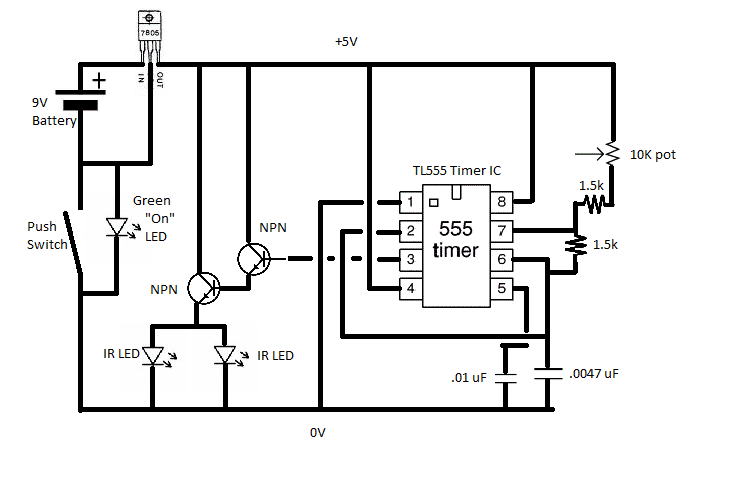
Hey all. I am building an IR modulator but seem to have a small kink in the design. Here is my schematic:
Toyschematic.png


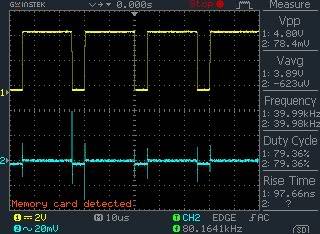
Here is a picture of the oscilloscope, connected between ground and the output of the TL555 timer and the output of the second transistor (the output pulse going into the LED's).
DS0004.jpg


The problem is that the transistor looks like it IS switching at 38kHz, but the off voltage is only in the low mV range. How could I make it so that this is actually modulating on/off?

Thanks for any help,

John
 
Engineering news on Phys.org
The transistor is hooked in a common collector configuration which doesn't have any voltage gain.

You could replace the second transistor with a PNP, or move the LEDs up across Vcc and collector while grounding the emitter.
 
So instead of putting the LED's between the second transistors emitter and ground, I would connect it from +5V to the collector, and connect the emitter to ground?

Thanks, I just want to be sure. Also, do you think this would increase the maximum current (Should I be careful to not burn out my LED's when switching)?

John
 
jbord39 said:
So instead of putting the LED's between the second transistors emitter and ground, I would connect it from +5V to the collector, and connect the emitter to ground?

yes

Also, do you think this would increase the maximum current (Should I be careful to not burn out my LED's when switching)?

Yeah it would. One may place a current limiting resistor between 5V and the LEDs.
 
You probably need a circuit like the one in this post:


https://www.physicsforums.com/showpost.php?p=2612341&postcount=35"

As a general rule, never put semiconductors directly across a source of power either on their own or in series. They are quite capable of destroying themselves if you do that.
You always need a resistor in series with them to limit the possible current.
 
Last edited by a moderator:

Similar threads

  • · Replies 14 ·
Replies
14
Views
2K
  • · Replies 34 ·
2
Replies
34
Views
3K
  • · Replies 10 ·
Replies
10
Views
3K
  • · Replies 58 ·
2
Replies
58
Views
12K
  • · Replies 22 ·
Replies
22
Views
7K
  • · Replies 18 ·
Replies
18
Views
5K
  • · Replies 41 ·
2
Replies
41
Views
8K
  • · Replies 11 ·
Replies
11
Views
3K
  • · Replies 5 ·
Replies
5
Views
2K
Replies
18
Views
9K