Calculate R1 and R2 given equivalent resistance

Click For Summary

Discussion Overview

The discussion revolves around determining the values of resistors R1 and R2 given a specific equivalent resistance (Rin = 200k). Participants explore different approaches to solving the problem, referencing a textbook solution and their own methods. The scope includes homework-related problem-solving and technical reasoning involving circuit analysis.

Discussion Character

  • Homework-related
  • Technical explanation
  • Debate/contested

Main Points Raised

  • One participant expresses confusion about the textbook solution, particularly regarding the use of conductance and Thevenin resistance to calculate R1.
  • Another participant claims to have found a different approach that yields the same answer, seeking clarification on the textbook method.
  • Several participants suggest writing equations for the gate potential and Rin, looking for commonalities to exploit in their solutions.
  • There is mention of a current divider approach in the textbook solution, leading to speculation about the assumption of an AC signal and small signal analysis.
  • One participant notes the similarity in their approaches, emphasizing the limited options available given the problem's parameters.
  • Another participant highlights the common term ##\frac{R_2}{R_1 + R_2}## found in both the voltage divider and input resistance equations, suggesting it can be substituted to simplify the problem.

Areas of Agreement / Disagreement

Participants do not reach a consensus on the best approach to the problem, as multiple methods are discussed, and confusion about the textbook solution persists.

Contextual Notes

Participants express uncertainty about the assumptions made in the textbook solution, particularly regarding the use of conductance and the nature of the signal (AC vs. DC). There is also a lack of clarity on how the equations relate to each other in the context of the problem.

SuperCat
Messages
26
Reaction score
1
Note: I have come up with a solution myself, but I am trying to understand a different approach to the problem. My textbook solves it in a different manner, and I am having trouble following along.

Homework Statement


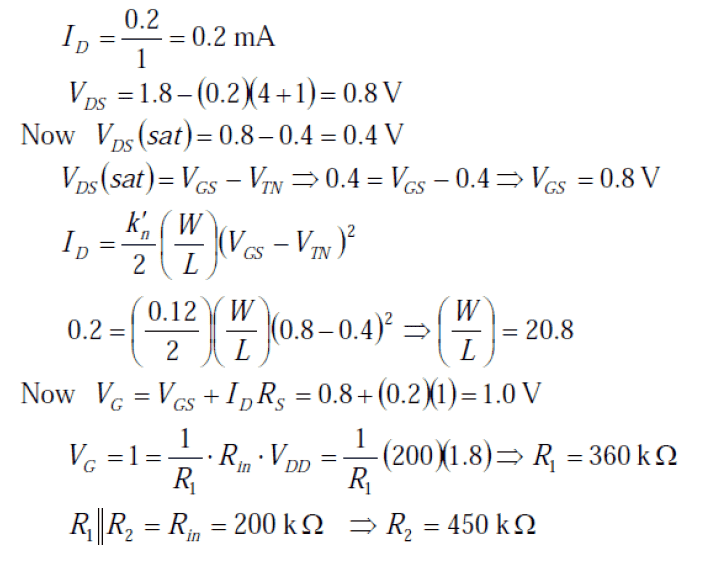
The last part of the problem "determine R1 and R2 such that Rin = 200k". I am having trouble understanding the solution for it. Note the graph for the problem is on the left.
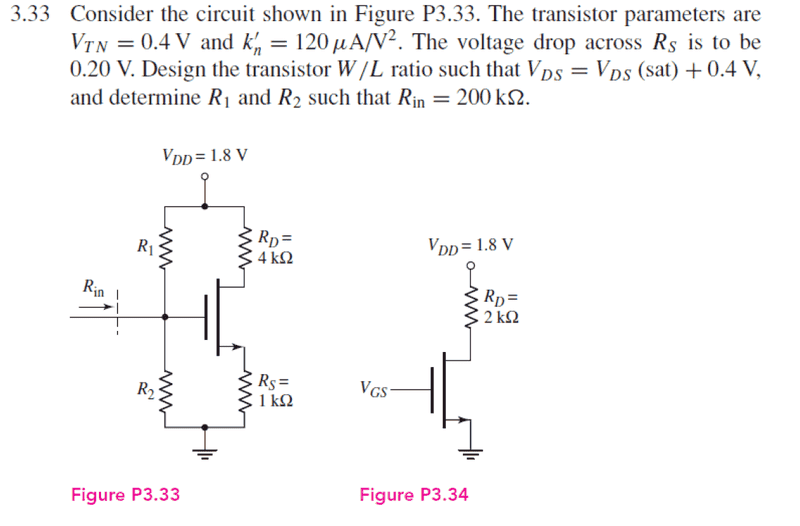
5c6db0e3b46eafad9b26f130c72d4fdc.png


Homework Equations


Ohm's law and KVL.

The Attempt at a Solution


Solution provided to me:
7c9f13e0ba2ff972f0f2f2521767cf3a.png

The solution for the resistance starts towards the bottom, once the gate voltage has been calculated. I do not understand why that formula is used to solve for the first resistor. To me it looks like conductance of the first resistor is being used with the Vdd to get a current. That current is being multiplied by the equivalent thevinin resistance of the two resistors. I just don't understand why that would be useful/how that would lead to calculating the resistance.
 
Last edited:
Physics news on Phys.org
I have just come up with a solution myself. I took a very different approach but received the same answer.
Here is my approach:
9b4f352da704a20f4d22e538156ac405.png


I receive the correct answer, and I found this to be more straightforward. But I would appreciate if someone could explain to me how the textbook solution goes along.
 
Write two equations that involve R1 and R2:

1. The expression for the gate potential (voltage divider)
2. The expression for Rin

Look for commonalities in the two expressions that you can exploit.
 
gneill said:
Write two equations that involve R1 and R2:

1. The expression for the gate potential (voltage divider)
2. The expression for Rin

Look for commonalities in the two expressions that you can exploit.
Isn't that similar to what I have in the post above? I think my textbook does it with a current divider. Which gives me the impression that they had decided to assume there an AC signal, and decide to do small signal analysis.
 
SuperCat said:
Isn't that similar to what I have in the post above?
Yup. But then it's bound to be similar since there's not much leeway as to what are the "givens".

What I picked out and exploited was the fact that the term ##\frac{R_2}{R_1 + R_2}## occurs in both equations, and its occurrence in the voltage divider equation can be replaced with its value from the input resistance equation.
 

Similar threads

Replies
5
Views
4K
  • · Replies 2 ·
Replies
2
Views
2K
  • · Replies 4 ·
Replies
4
Views
2K
  • · Replies 11 ·
Replies
11
Views
8K
  • · Replies 18 ·
Replies
18
Views
3K
  • · Replies 8 ·
Replies
8
Views
2K
  • · Replies 14 ·
Replies
14
Views
6K
  • · Replies 8 ·
Replies
8
Views
3K
  • · Replies 5 ·
Replies
5
Views
2K
  • · Replies 9 ·
Replies
9
Views
7K