Can anyone make a differential equation from the below eg:

Click For Summary

Homework Help Overview

The discussion revolves around deriving a differential equation related to the concept of light intensity and darkness in a hypothetical scenario involving a burning candle. Participants explore the relationship between distance from the candle and the perceived intensity of light or darkness.

Discussion Character

  • Exploratory, Conceptual clarification, Assumption checking

Approaches and Questions Raised

  • Participants question the definitions of darkness and brightness, discussing how light intensity changes with distance. There are attempts to establish a relationship between distance and light intensity, with some suggesting that darkness decreases linearly with distance, while others challenge this assumption.

Discussion Status

The discussion is ongoing, with various interpretations of the problem being explored. Some participants have offered algebraic relationships based on the scenario, while others have pointed out the limitations of the assumptions made regarding linearity and the nature of brightness and darkness.

Contextual Notes

There is a mention of imposed homework rules and the need for a relevant example that demonstrates the usefulness of differential equations in practical situations. Participants express concerns about the realism of the scenario presented.

abhijath
Messages
4
Reaction score
0
[ NOTE ] Thread moved to homework forums by mentor

suppose in a dark room a candle is burning, so darkness increases as we move away from the candle. from the below diagram can anyone derive a differential example to show the rate of change of darkness from candle to point B.
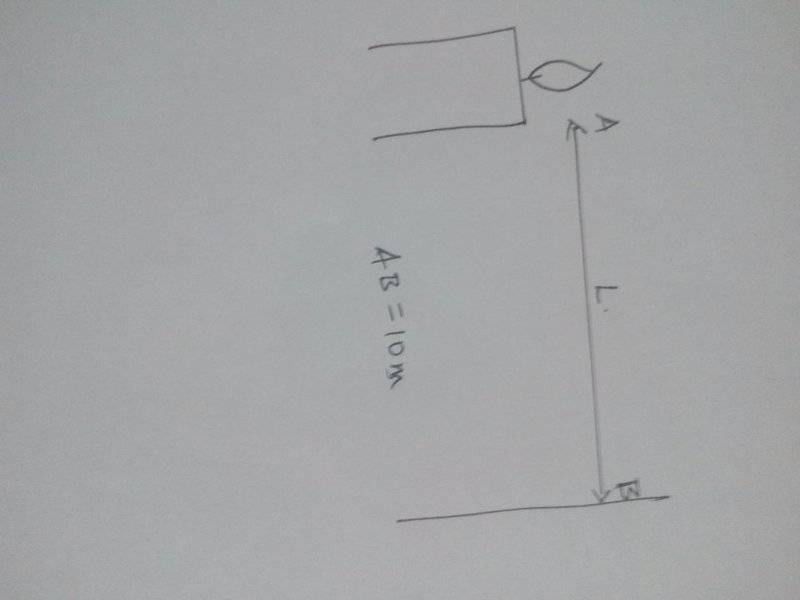
IMG_20151103_235023.jpg


supposing darkness decreases by one unit for every meter and AB is 10 meter.
 
Last edited by a moderator:
Physics news on Phys.org
What do you know about the light intensity at some point from the light source?
 
Take light intensity as 10 at point A
 
abhijath said:
Take light intensity as 10 at point A
jedishrfu means at some arbitrary point at a given distance from the source.
 
It decreases by 1 unit for every metre from A to B
 
So light intensity will be zero at point B
 
abhijath said:
supposing darkness decreases by one unit for every meter and AB is 10 meter
First, you don't mean that. Brightness will decrease from A to B.
And "darkness" is not a measurable, brightness is.
But is this statement part of the problem as given to you? Word for word? It's very strange because brightness will not change linearly with distance.
abhijath said:
So light intensity will be zero at point B
Again, that doesn't fit with reality.
 
Forget about reality, Iam just giving a concept so that someone can tell me how is differential equation useful in practical cases.
 
In any case, a diff. eq. is not relevant unless you consider an algebraic equation a diff. eq. of zero order:
brightness = 10(1 - x/10), x in meters.
Of course, this assumption is nonsense as others here have pointed out.
 
  • #10
abhijath said:
Forget about reality, Iam just giving a concept so that someone can tell me how is differential equation useful in practical cases.
Ok, but your example is not going to demonstrate differential equations being useful. In your example, you can just write down the algebraic relationship of brightness to distance from the given information. (As rudeman has done.). You could then differentiate it to obtain a differential equation, but this doesn't demonstrate any usefulness because you already know the solution.
You would need an example in which the equations you write down initially involve rates of change. Try an object falling, subject to drag which varies as either v or v2.
 

Similar threads

  • · Replies 8 ·
Replies
8
Views
2K
Replies
41
Views
5K
Replies
11
Views
3K
Replies
17
Views
3K
Replies
9
Views
3K
  • · Replies 3 ·
Replies
3
Views
1K
  • · Replies 1 ·
Replies
1
Views
1K
  • · Replies 5 ·
Replies
5
Views
2K
  • · Replies 1 ·
Replies
1
Views
2K
Replies
17
Views
2K