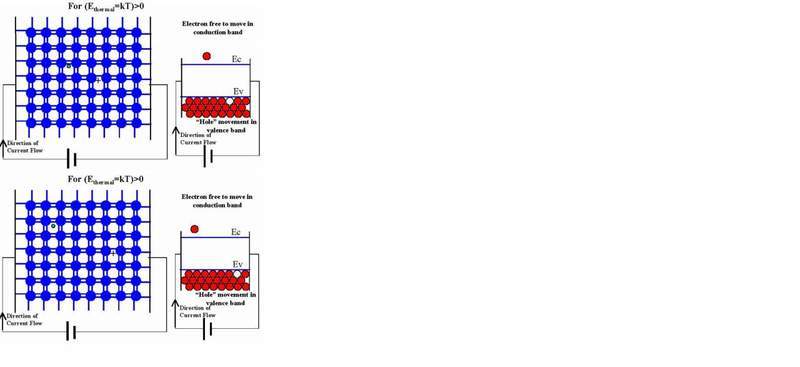
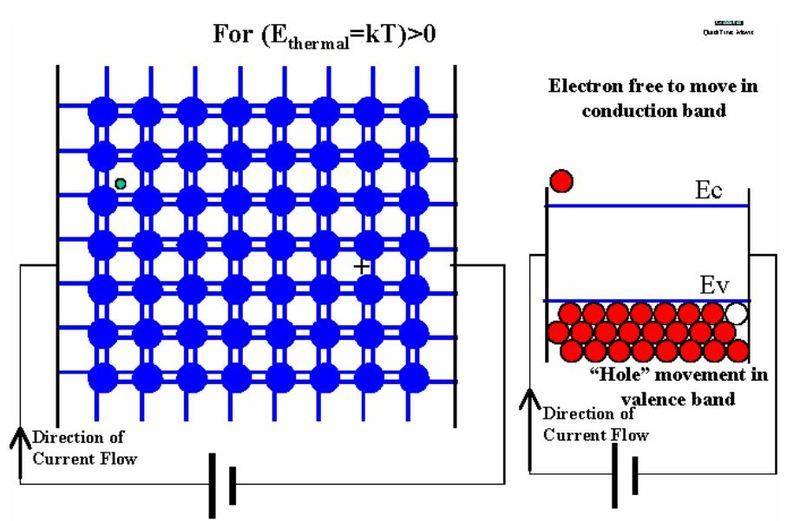
Can anyone tell me how the hole will move after this?

  • Thread starter Thread starter anhnha
  • Start date Start date
  • Tags Tags
    Hole
Click For Summary

Homework Help Overview

The discussion revolves around the movement of holes and electrons in a semiconductor material under the influence of an electric field, particularly focusing on the implications of filling holes with electrons and the conditions affecting conductivity.

Discussion Character

  • Exploratory, Conceptual clarification, Assumption checking

Approaches and Questions Raised

  • Participants explore how holes move after being filled by electrons and question the implications for conductivity in semiconductors. There is discussion about the role of excitations in creating electron-hole pairs and the effects of applying a battery to a P-type material.

Discussion Status

The discussion is active, with participants raising questions about the nature of excitations, the behavior of holes in response to electric fields, and the conditions under which semiconductors conduct electricity. Some guidance has been offered regarding the continuous creation of holes through doping and the equilibrium between recombination and thermal excitation.

Contextual Notes

Participants are considering the effects of thermal energy and external electric fields on the behavior of charge carriers in semiconductors. There is an ongoing examination of assumptions regarding the behavior of pure versus doped semiconductors and the conditions necessary for sustained conductivity.

anhnha
Messages
179
Reaction score
1
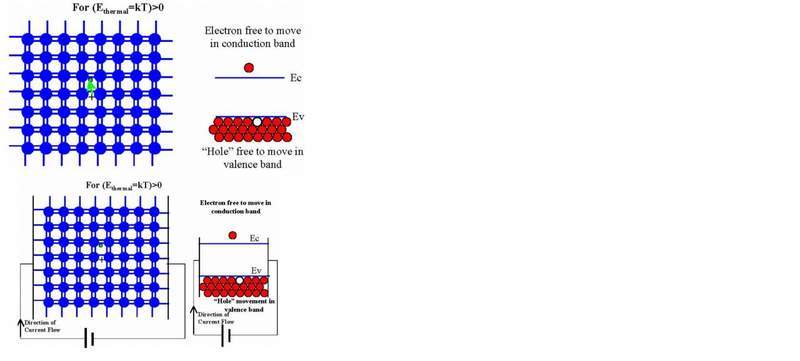
Here is a set of pictures showing the ways electrons and hole move under electric field.
Can anyone tell me how the hole will move after this? I mean that where the hole will move after the final image.
attachment.php?attachmentid=59552&stc=1&d=1371273349.jpg

attachment.php?attachmentid=59553&stc=1&d=1371273349.jpg

attachment.php?attachmentid=59554&stc=1&d=1371273349.jpg
 

Attachments

  • Hole11.jpg
    Hole11.jpg
    23.6 KB · Views: 540
  • Hole22.jpg
    Hole22.jpg
    21.8 KB · Views: 483
  • Hole5.JPG
    Hole5.JPG
    55.6 KB · Views: 539
Physics news on Phys.org
It will get filled with an electron from the wire.
The wire is probably not a semiconductor, it does not have a gap between valence and conductance band and you have a lot of electrons (filled energy states) and a lot of empty energy states to conduct current.
 
Thanks mfb,
But then the hole will disappear and valence band doesn't have any hole left?
It can't conduct in valence anymore?
 
But then the hole will disappear and valence band doesn't have any hole left?
It can't conduct in valence anymore?
Unless you get new excitations: right.
Well, usually you have many electron/hole pairs in the material at the same time, and some new pairs are created all the time. This leads to the (bad) conductivity of pure semiconductors.
 
Unless you get new excitations: right.
Well, usually you have many electron/hole pairs in the material at the same time, and some new pairs are created all the time. This leads to the (bad) conductivity of pure semiconductors.
Hi, I don't understand that. Can you tell me what do you mean "excitation". Can I consider battery as an excitation? And how pairs of electron and hole are create?
 
Excitation is the process that lead to picture 1: thermal energy, light or whatever kicked an electron out of the valence band into the conduction band.
 
Hi,
For example, I have a P material and I apply it with a battery like the figure above.
Assume that there is no thermal energy, light or whatever kicked an electron out of the valence band into the conduction band. Then the current only flow in the circuit for a short time. Then it ceases.
Is this right?
I always think that when negative pole of battery put an electron into the hole ( in the final image above) then at the same time positive pole has to pull an valence electron into wire to positive pole and a new hole is created on the left.
Is this wrong?
 
With doping, the material will continue to conduct - at the positive side, holes are created all the time, they flow to the negative side and get filled.
 
mfb said:
With doping, the material will continue to conduct - at the positive side, holes are created all the time, they flow to the negative side and get filled.

Do you mean that holes are created at the positive side by electric field from the battery pulling valence electrons and leaving holes?
 
  • #11
mfb said:
Unless you get new excitations: right.
Well, usually you have many electron/hole pairs in the material at the same time, and some new pairs are created all the time. This leads to the (bad) conductivity of pure semiconductors.

I would like to ask some more questions.
In pure semiconductor, thermal energy will create electron-hole pairs all the time. If there is not recombination ( I mean electrons go from conduction band to valance band) then the current will continue forever and the pure semiconductor will become a good conductor.

For example, at t=t0, thermal energy creates 1000 electron-hole pairs. From that time there is no recombination at all. This means that the pure semiconductor will always have 1000 holes or more.
Therefore, the semiconductor will act as a p type? Is that right?
 
  • #12
Of course there is recombination. The small number of electrons and holes is "always"* in an equilibrium between recombination and thermal excitation.

*in all relevant cases
 

Similar threads

  • · Replies 1 ·
Replies
1
Views
2K
  • · Replies 1 ·
Replies
1
Views
2K
  • · Replies 22 ·
Replies
22
Views
4K
Replies
2
Views
1K
  • · Replies 22 ·
Replies
22
Views
2K
  • · Replies 12 ·
Replies
12
Views
1K
  • · Replies 10 ·
Replies
10
Views
2K
  • · Replies 29 ·
Replies
29
Views
4K
  • · Replies 20 ·
Replies
20
Views
3K
  • · Replies 17 ·
Replies
17
Views
4K