SUMMARY
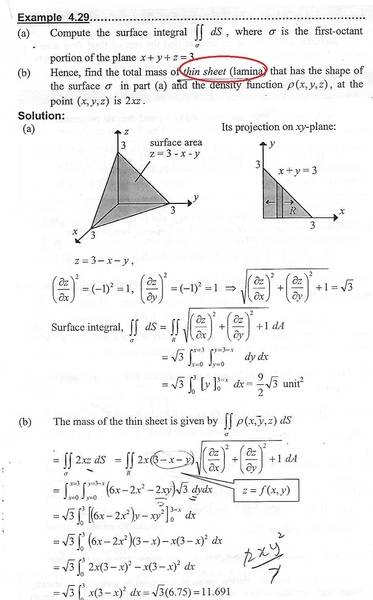
The discussion centers on the calculation of mass using surface integrals and density functions. It is established that the density function, represented as ρ(x,y), is dependent on two variables and provides mass per unit area rather than mass per unit volume. The thickness of the plate is not ignored; instead, the density function is specifically designed for two-dimensional analysis, confirming that mass can be derived from the product of density and area.
PREREQUISITES
- Understanding of surface integrals in calculus
- Familiarity with density functions in physics
- Knowledge of two-variable functions
- Basic principles of mass and area relationships
NEXT STEPS
- Study the application of surface integrals in calculating mass
- Explore the properties of two-variable density functions
- Learn about the implications of dimensional analysis in physics
- Investigate the relationship between mass, area, and density in different contexts
USEFUL FOR
Students and professionals in mathematics, physics, and engineering who are involved in applications of calculus, particularly in calculating mass from surface integrals and density functions.