Can Mass be Found Using Surface Integral and Density?

Click For Summary

Discussion Overview

The discussion revolves around the method of finding mass using surface integrals and density, specifically in the context of a thin plate. Participants explore the implications of using a density function that depends on two variables and whether the thickness of the plate can be disregarded in calculations.

Discussion Character

  • Technical explanation, Conceptual clarification, Debate/contested

Main Points Raised

  • One participant suggests that mass can be found by multiplying density by area, questioning if the thickness of the plate can be ignored due to its thin nature.
  • Another participant argues that thickness cannot be ignored, stating that the density function is dependent on two variables, which implies it provides mass per area rather than mass per volume.
  • A later reply reiterates the previous point about the density function being a function of only two variables, emphasizing that it results in mass per area.
  • One participant confirms that the density function can be expressed as a function of two variables, indicating that it is multiplied by a length squared term, thus reinforcing that density has dimensions of mass per area.

Areas of Agreement / Disagreement

Participants do not reach a consensus; there is disagreement regarding the treatment of thickness in the calculations and the implications of the density function's dependence on two variables.

Contextual Notes

The discussion highlights the limitations in understanding how the density function applies to the problem, particularly regarding the assumptions about thickness and the dimensional analysis of density.

chetzread
Messages
798
Reaction score
1
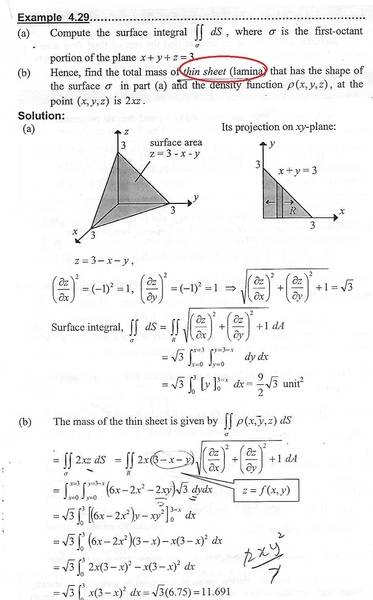
in part b , we can find mass by density x area ?
is it because of the thin plate, so, the thickness of plate can be ignored?
N7jdECp.jpg
 
Physics news on Phys.org
There is no ignoring the thickness going on. The density function is a function of only two variables (*), so it provides mass/area, not mass/volume.

(*) as pointed out with the z=f(x,y) callout
 
  • Like
Likes   Reactions: chetzread
BvU said:
There is no ignoring the thickness going on. The density function is a function of only two variables (*), so it provides mass/area, not mass/volume.
BvU said:
There is no ignoring the thickness going on. The density function is a function of only two variables (*), so it provides mass/area, not mass/volume.

(*) as pointed out with the z=f(x,y) callout

(*) as pointed out with the z=f(x,y) callout
BvU said:
There is no ignoring the thickness going on. The density function is a function of only two variables (*), so it provides mass/area, not mass/volume.

(*) as pointed out with the z=f(x,y) callout
BvU said:
There is no ignoring the thickness going on. The density function is a function of only two variables (*), so it provides mass/area, not mass/volume.

(*) as pointed out with the z=f(x,y) callout
so, z=f(x,y) provide info that density depends on 2 variables only?
 
Yes $$\rho(x,y,z) = \rho(x,y,3-x-y) = \rho(x,y) $$it is multiplied with something of dimension length2 so ##\rho## has the dimension mass/area
 
  • Like
Likes   Reactions: chetzread

Similar threads

  • · Replies 1 ·
Replies
1
Views
3K
  • · Replies 5 ·
Replies
5
Views
4K
  • · Replies 2 ·
Replies
2
Views
3K
  • · Replies 33 ·
2
Replies
33
Views
7K
  • · Replies 12 ·
Replies
12
Views
3K
  • · Replies 6 ·
Replies
6
Views
3K
  • · Replies 3 ·
Replies
3
Views
2K
  • · Replies 6 ·
Replies
6
Views
2K
  • · Replies 1 ·
Replies
1
Views
3K
  • · Replies 3 ·
Replies
3
Views
2K