Can we take the partial derivatives of φ and ψ here?

Click For Summary
SUMMARY

The discussion centers on the calculation of partial derivatives for the functions φ and ψ in the context of coordinate transformations. Participants emphasize the importance of applying the chain rule to derive expressions for ∂φ/∂x and ∂ψ/∂x, particularly in relation to the variables xy and y/x. The conversation highlights the necessity of understanding these functions as dependent on their respective variables, with specific examples provided to illustrate the calculations. The final conclusion stresses the relationship between the functions and their derivatives, guiding users to apply the chain rule effectively.

PREREQUISITES
  • Understanding of partial derivatives and their notation
  • Familiarity with the chain rule in calculus
  • Knowledge of coordinate transformations in multivariable calculus
  • Basic proficiency in functions and their derivatives
NEXT STEPS
  • Study the application of the chain rule in multivariable calculus
  • Learn how to compute partial derivatives of composite functions
  • Explore coordinate transformations and their implications in calculus
  • Practice problems involving the differentiation of functions with multiple variables
USEFUL FOR

Students and educators in mathematics, particularly those focusing on calculus, differential equations, and multivariable functions. This discussion is beneficial for anyone seeking to deepen their understanding of partial derivatives and their applications in coordinate transformations.

requied
Messages
98
Reaction score
3
Homework Statement
Show that the function u=φ(xy) +√xy ψ(y/x)provides the following equation.
Relevant Equations
u=φ(xy) +√xy ψ(y/x)
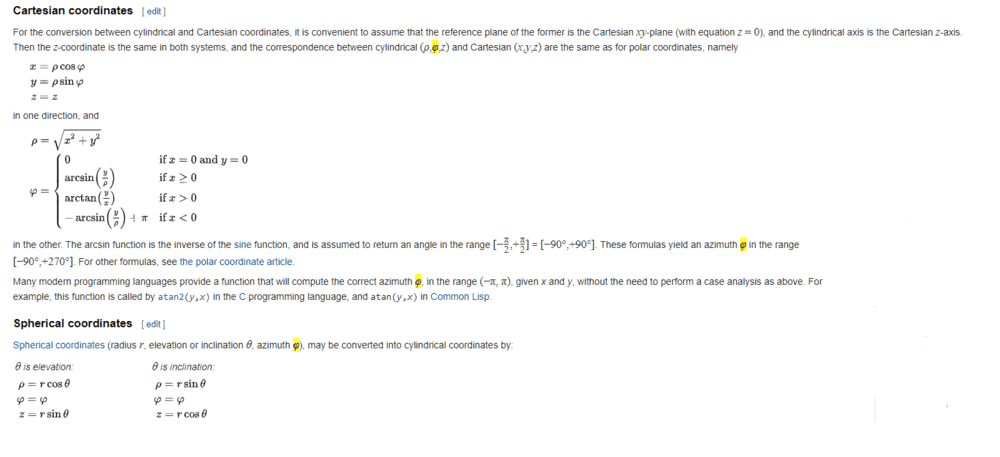
I research about coordinate systems and I found the following informations about transformation.
1590492979586.png

Now, if I replace arctan (x/y) (according to the picture above) to φ, I think I can solve. But if I can do this, then what will be replaced to ψ? I mean, I know just taking partial derative about this question and I guess this symbols can look familiar someone who spend some times about the topic. I left below a clear picture of question. Thanks for now.

1590493384718.png
 
Physics news on Phys.org
requied said:
Now, if I replace arctan (x/y) (according to the picture above) to φ
Why do you think there is a relationship between the ##\phi## in the illegible picture and ##\phi(xy) ## ?
And what about ##\psi## ?

What does your textbook mean if it asks to 'provide' something ?

##\ ##

My strong impression :smile: is that you are supposed to work out the partial derivatives. Do you know how to do that ?
 
Last edited:
BvU said:
Why do you think there is a relationship between the ϕϕ\phi in the illegible picture and ϕ(xy)ϕ(xy)\phi(xy) ?
And what about ψψ\psi ?
I have told you that I have had no idea about these two symbols.
BvU said:
What does your textbook mean if it asks to 'provide' something ?
It is expected to prove if you're talking about it. Actually I don't get what you said.
 
BvU said:
My strong impression :smile: is that you are suppsoed to work out the partial derivatives. Do you know how to do that ?
Yea I know how to do but I can't take derivative if I am not sure whether one each these symbols are equations. If these are constants, then there is no problem. I wondered if these are constant or not.
 
requied said:
whether one each these symbols are equations
They are functions. Start working out ##\partial \phi\over \partial x## and post your work.
 
requied said:
Actually I don't get what you said.
A more understandable wording would be "Show that ##u = ...\ ## satisfies the equation ..."
 
BvU said:
A more understandable wording would be "Show that ##u = ...\ ## satisfies the equation ..."
Yea, he don't like speaking understandably :/
 
BvU said:
They are functions. Start working out ##\partial \phi\over \partial x## and post your work.
Could you want to say ##\partial \ u\over \partial x## ?
 
requied said:
Could you want to say ##\partial \ u\over \partial x## ?
No. You have to start somewhere. Function ##u = \phi\ + ... \ ##, so ##{\partial \ u\over \partial x} = {\partial \phi \over \partial x} \;+ ... ##​
 
  • #10
I was so eager to give you the easiest possible start with this assignment that I overlooked that it might still be unclear to you. What I meant may become clear when I hand you the first step as an example:

$${\partial \phi \over \partial x} = {\partial \phi(xy) \over \partial (xy)} \ {\partial (xy) \over \partial x} = \phi' \;y $$Now, this one is easy and you already see some possible cancelling come up in the second derivatives .

##\sqrt{xy}\;\psi(y/x)\ ## is a little :rolleyes: more work but the idea is the same (cross fingers...)
 
  • Like
Likes   Reactions: Delta2
  • #11
I would have write ∂ϕ like that;
∂ϕ = ∂(u /(xy) +√xy ψ(y/x) )
Where did
BvU said:
(xy)
and

BvU said:
∂(xy)
come from?
 
  • #12
This is quite tricky problem. The "long and hard" way for this problem would be to set ##z=xy,w=\frac{y}{x}## and then to consider the function $$u(z,w)=\phi(z)+\sqrt{z}\psi(w)$$ and then calculate the derivatives ##\frac{\partial u}{\partial z},\frac{\partial u}{\partial w}## and then calculate the partial derivatives ##\frac{\partial u}{\partial x},\frac{\partial u}{\partial y}## using the 2-variable chain rule (for example $$\frac{\partial u}{\partial x}=\frac{\partial u}{\partial z}\frac{\partial z}{\partial x}+\frac{\partial u}{\partial w}\frac{\partial w}{\partial x}$$.

But this is the long , hard and painful way, the way @BvU suggests at post #10 is a clever shortcut. According to BvU's way you just have to know how to cleverly use the 1-variable chain rule.
 
  • #13
requied said:
I would have write ∂ϕ like that;
∂ϕ = ∂(u /(xy) +√xy ψ(y/x) )
That is not correct.
Where did ##(xy)## and ##\partial \over\partial(xy)## come from?
From your post #1:
1590514209480.png

##xy## is the (single) argument of the function ##\phi##. If I give you the value of ##xy##, then you can give the value of ##\phi(xy)## if you know the function (which you don't).

My writing ##{\partial\phi(xy)\over \partial(xy)}\equiv \phi'## is just a sloppy physicist's way of avoiding to introduce a new variable, e.g. ##z(x,y) = xy\ ##, but it comes down to the same thing:$${\partial \phi \over \partial x} = {\partial \phi \over \partial z} \ {\partial z \over \partial x} = \phi' \;y$$ -- the chain rule, as @Delta2 already said.

---

requied said:
Yea I know how to
Can you give us an example that demonstrates that ? Not to be obnoxious, but to understand what assistance is most effective.
 
  • #14
I can't give an example because of it doesn't make sense to me.
BvU said:
I was so eager to give you the easiest possible start with this assignment that I overlooked that it might still be unclear to you. What I meant may become clear when I hand you the first step as an example:

$${\partial \phi \over \partial x} = {\partial \phi(xy) \over \partial (xy)} \ {\partial (xy) \over \partial x} = \phi' \;y $$Now, this one is easy and you already see some possible cancelling come up in the second derivatives .

##\sqrt{xy}\;\psi(y/x)\ ## is a little :rolleyes: more work but the idea is the same (cross fingers...)

I guess I found ## \partial Ψ##/ ## \partial \ y##. But I don't get why we are doing these calculations somehow. The question asks for ## \partial \ u##/ ## \partial \ x## etc.
1591645952108.png
 
  • #15
1591646450676.png

Why we don't study on the calculation like that?
 
  • #16
We do: ##\ u = \phi + \psi\ ##, so your first factor is a ##\;1\;##.

But in your post #15 you have completely forgotten ##\;{\partial \psi\over \partial x}\;## ?!
 
  • #17
BvU said:
We do: ##\ u = \phi + \psi\ ##, so your first factor is a ##\;1\;##.

But in your post #15 you have completely forgotten ##\;{\partial \psi\over \partial x}\;## ?!
I'll be hanged if I understand! Pardon but I'm just not be able to do these calculations. I'll glance at chain rule of partial derivatives. I guess we couldn't make progress.
 
  • #18
requied said:
I'll be hanged if I understand! Pardon but I'm just not be able to do these calculations.
Don't give up. We'll switch gear and try again. Since $$u = \phi + \sqrt{xy}\;\psi $$ we get $$
{\partial u\over \partial x} = {\partial\phi \over \partial x} + {\partial \sqrt{xy}\;\psi \over \partial x}$$
so ##{\partial u\over \partial x} ## has two terms and we started with the first:$$
{\partial u\over \partial x} = {\partial\phi \over \partial x} + ...$$

There are a few simple rules underlying all this. Hang on a little more and you'll be allright.
Sloppy physicist's notation (consult calculus textbook for more):

Simple derivative: $$f(x)\quad\Rightarrow\quad df = {\partial f\over\partial x} \;dx $$

Two variables: $$f(x,y)\quad\Rightarrow\quad df = {\partial f\over\partial x} \;dx + {\partial f\over\partial y} \;dy $$

Change in sum = sum of changes:
$$\ u = \phi + \chi\quad
\Rightarrow \quad du = d\phi + d\chi\ $$
Clear enough, right ?

Product rule:
$$\ y = ab\quad\Rightarrow\quad dy = a\; db + b \; da$$
Also clear enough, right ?

Chain rule:
$$\ y = f\bigl (g(x)\bigr ) \quad\Rightarrow\quad dy = {\partial f\over\partial g} \;dg $$

A little more abstract! Example:
$$\ f = 1/g \quad\Rightarrow\quad df = {\partial f\over\partial g} \;dg \ = \ -{1\over g^2}\; dg$$

requied said:
I'll be hanged if I understand!
Doesn't help me to help you. More useful to indicate where and how you get stuck: give an example of what you (just) understand and what about the next step you do not understand -- and why not.

(Easy to say for me, I grant you; not so easy for you -- but you are the asking party at this point :wink: )

If the above are sufficiently clear, we can go back to pick up at the point where we were before. OK ?
 
  • Like
Likes   Reactions: sysprog and requied
  • #19
I was studying on partial derivatives, chain rule etc uptill now. Deadline of the homework is tomorrow night. I guess I will not be able to complete the homework. If someone would give me the solution I really appreciate it. Else I will quit the question. I know that here is not a question solving site but I have to ask for it please forgive me. By the way, thanks a lot to @BvU and @Delta2. They supported me a lot.
 
  • #20
requied said:
If someone would give me the solution I really appreciate it
PF isn't in favour of just giving solutions -- our rules forbid it and it isn't very helpful for the receivers either. Pity about the deadline -- perhaps you get some help on Tuesday -- but if you don't get enough from teacher we can always continue unraveling the exercise with you.
 
  • #21
A way of doing it I thought was nice was to set up a path diagram between your initial function and the variables against which you differentiate.
 
  • #22
requied said:
No.
Think of ##\psi## as a function of z, where z happens to equal xy always.
So ##\psi## is a function of only one variable, and ##\psi'## means the (normal, not partial) derivative of ##\psi## wrt that variable.
To get the partial derivative wrt x we use the chain rule:
##\frac{\partial \psi}{\partial x}=\frac{d\psi}{dz}\frac{\partial z}{\partial x}=\psi'\frac{\partial z}{\partial x}=\psi'\frac{\partial (xy)}{\partial x}=\psi'y##

The result to be proved in this thread is interesting. The general form that satisfies it is ##u=x^ay^b\psi(x^cy^d)## where either {a=b and c=d} or {a+b=1 and c=+/-d}.
 
  • #23
I think @haruspex means ##\phi##, not ##\psi## .

We had (in post #1) $$u(x,y)\equiv \phi(xy) + \sqrt{xy} \; \psi\left (y\over x\right )$$

On the other hand I did use partials in #10: $${\partial \phi \over \partial x} = {\partial \phi(xy) \over \partial (xy)} \ {\partial (xy) \over \partial x} = \phi' \;y $$ where I should (could ?) have used ##\displaystyle {{\text d} \phi(xy) \over {\text d}xy}## as @haruspex noted. That would have been more clear.
 
  • Like
Likes   Reactions: haruspex

Similar threads

Replies
4
Views
1K
  • · Replies 8 ·
Replies
8
Views
6K
Replies
2
Views
2K
  • · Replies 1 ·
Replies
1
Views
3K
  • · Replies 2 ·
Replies
2
Views
2K
  • · Replies 1 ·
Replies
1
Views
2K
  • · Replies 4 ·
Replies
4
Views
2K
  • · Replies 1 ·
Replies
1
Views
1K
  • · Replies 1 ·
Replies
1
Views
2K
  • · Replies 8 ·
Replies
8
Views
2K