Change of variable for Jacobian: is there a method?

Click For Summary
SUMMARY

The discussion centers on determining the correct change of variables for a region in the x-y plane using the Jacobian method. The correct choice is identified as option a), with the transformation defined as ##x = -(y+1) + u(y+1)##. Participants explore systematic approaches to selecting appropriate substitutions, emphasizing the importance of analyzing the boundaries defined by the new variables. The conversation highlights the utility of familiar substitutions and the significance of understanding the geometric implications of the transformations.

PREREQUISITES
  • Understanding of Jacobian transformations in multivariable calculus
  • Familiarity with parametric equations and their geometric interpretations
  • Knowledge of boundary conditions in the context of variable transformations
  • Experience with common substitutions such as polar coordinates and linear transformations
NEXT STEPS
  • Study the method of Jacobians in detail, focusing on practical applications in multivariable calculus
  • Learn about common variable substitutions and their geometric interpretations
  • Explore examples of boundary analysis in variable transformations to solidify understanding
  • Investigate additional resources such as Schaum's Outline on change of variables for further practice
USEFUL FOR

Students and educators in mathematics, particularly those studying multivariable calculus and seeking to master the technique of variable substitution using Jacobians.

fatpotato
Homework Statement
Choose the correct change of variables among the three possible choices to map ##\Sigma## to a rectangular region.
Relevant Equations
None for now
Hello,

This problem comes just prior to introducing change of variables with Jacobian.

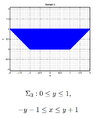
Given the following region in the x-y plane, I have to choose (with justification) the correct change of variables associated, for ##u\in [0,2]## and ##v \in [0,1]##.

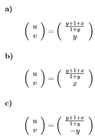
The correct choice here is a), but I do not understand why...Solution only mentions that a possible change of variable for x would be ##x = -(y+1) + u(y+1)##, so we get to solution a).

Here is my question: is there a systematic way of finding the appropriate change of variables? How did the instructor suddenly decide that choosing the previous substition would be a good idea to solve the problem? I have no idea where to begin.

Thank you very much for your help.
 

Attachments

  • 1648999187706.png
    1648999187706.png
    7.4 KB · Views: 168
  • 1648999375243.png
    1648999375243.png
    4.3 KB · Views: 168
Physics news on Phys.org
fatpotato said:
Homework Statement:: Choose the correct change of variables among the three possible choices to map ##\Sigma## to a rectangular region.
Relevant Equations:: None for now

Hello,

This problem comes just prior to introducing change of variables with Jacobian.

Given the following region in the x-y plane, I have to choose (with justification) the correct change of variables associated, for ##u\in [0,2]## and ##v \in [0,1]##.

The correct choice here is a), but I do not understand why...Solution only mentions that a possible change of variable for x would be ##x = -(y+1) + u(y+1)##, so we get to solution a).
You can at least verify that ##u=0## and ##u=2## correspond to the left-hand boundary and the right-hand boundary, respectively, for the region in the x-y plane.
Also, ##u=1## corresponds to the vertical line, ##x=0## which passed through the middle of the region.

Here is my question: is there a systematic way of finding the appropriate change of variables? How did the instructor suddenly decide that choosing the previous substitution would be a good idea to solve the problem? I have no idea where to begin.

Thank you very much for your help.
It's hard to guess how the instructor decided on that substitution (whether it was sudden or not). It's also difficult to guess the reason for choosing that particular region for the new variables, except to observe that the new region is in the 1st Quadrant.

Let's examine choice a), with emphasis on the defined mapping for new variable, ##u##. - The mapping for variable ##v## is trivial.

Rewrite
##\displaystyle u=\frac{ x+y+1 }{ y+1 } ##

##\quad \displaystyle=\frac{ x }{ y+1 } + \frac{ 1 }{ y+1 } ##

##\quad \displaystyle=\frac{ x }{ y+1 } +1 ##

The effect of that final term of 1 is to shift the rectangle 1 unit in the positive ##u## direction.

Let's drop that final ## + 1 ## and change the variable name from ##u## to ##n## so as to avoid confusion. We now have:
## \displaystyle n=\frac{ x }{ y+1 } ##.

Solving for ##x## gives : ## \displaystyle x=n\left(y+1 \right) ##.

If you think of the rather unusual practice of graphing ##x## as a function of ##y##, we have that this gives a line with slope ##n## and ##y## intercept of ##-1## .

Any such line with slope ## n \in [ -1,~1]## will intersect the trapezoid at all values of ##y \in [0,~1]## and nowhere else.
 
  • Like
Likes   Reactions: fatpotato
Hello,

Thank you for your answer. I did not think about formulating ##u## as a parameter ##n##! This gives a nice parametric linear equation and indeed gives insight on the area's border.

SammyS said:
It's hard to guess how the instructor decided on that substitution (whether it was sudden or not).
I guess that there are usual tricks to know and to try on typical problems...Going through a Schaum on change of variables with Jacobian matrices, I noticed the prevalence of certain substitutions, like ##x=u+v##, ##y=u-v## and the classical polar coordinates substitution.
 
You might begin by noting that ##u## is the same in all three options so all that we must do is to choose the appropriate ##v##, since ##x## is bounded by functions of ##y## we know (b) is incorrect. The remaining two give ##v=\pm y## and being as it is given that ##v\in \left[ 0,1\right]## and ##0\le y\le 1## we must have ##v=y## (throwing out the negative) or change of variables (a).
 
  • Like
Likes   Reactions: fatpotato
benorin said:
You might begin by noting that ##u## is the same in all three options so all that we must do is to choose the appropriate ##v##, since ##x## is bounded by functions of ##y## we know (b) is incorrect. The remaining two give ##v=\pm y## and being as it is given that ##v\in \left[ 0,1\right]## and ##0\le y\le 1## we must have ##v=y## (throwing out the negative) or change of variables (a).
This is indeed clever, however there is a twist.

I cropped the solution picture: there should be an additional answer d) for "None of the above". I cropped the last choice because it was not in english. But I still agree with you, it is more efficient to only check for the substitution for ##v## in this case.
 
  • Like
Likes   Reactions: benorin
In that case you need only narrow it down to (a) or (d) and then draw out the transformed boundaries to see which of the two options is correct.
 
  • Like
Likes   Reactions: fatpotato

Similar threads

Replies
21
Views
2K
  • · Replies 3 ·
Replies
3
Views
2K
  • · Replies 16 ·
Replies
16
Views
3K
  • · Replies 10 ·
Replies
10
Views
2K
  • · Replies 1 ·
Replies
1
Views
2K
  • · Replies 3 ·
Replies
3
Views
1K
  • · Replies 3 ·
Replies
3
Views
2K
  • · Replies 3 ·
Replies
3
Views
2K
  • · Replies 4 ·
Replies
4
Views
2K
Replies
5
Views
4K