Circuit to change the current and voltage of a dc circuit?

Click For Summary

Discussion Overview

The discussion revolves around understanding a circuit that changes the current and voltage in a DC circuit. Participants express confusion about specific parts of the circuit, particularly regarding the purpose of 0V terminals and how to approach the problem effectively. The context includes coursework and potential connections to previous topics like two-port networks and Thevenin/Norton theorems.

Discussion Character

  • Homework-related
  • Exploratory
  • Debate/contested
  • Technical explanation

Main Points Raised

  • One participant expresses uncertainty about how to change the potential difference (pd) and current in the circuit and questions the purpose of the 0V terminals.
  • Another participant suggests that the question is context-dependent and may relate to recent coursework.
  • A different participant inquires whether the concept of "two-port" networks has been covered, recommending looking at examples that include voltage sources.
  • One participant mentions the importance of breaking down questions into parts and encourages experimentation, suggesting that a simple two-element circuit could be a starting point.
  • Another participant references a past paper from an olympiad, indicating that the question may be intentionally vague to test students' problem-solving skills.
  • One participant argues that the wording of part (ii) is designed to confuse those who do not read carefully, as it mixes concepts of constant current and voltage sources.

Areas of Agreement / Disagreement

Participants do not reach a consensus on how to approach the circuit problem, with multiple competing views on the interpretation of the question and the relevance of previous topics. The discussion remains unresolved.

Contextual Notes

There are limitations in the clarity of the question, as it may depend on prior knowledge of specific topics like two-port networks and Thevenin/Norton theorems. Additionally, the vagueness of the question could lead to various interpretations.

21joanna12
Messages
126
Reaction score
2
I wasn't sure whether to post this here or in the 'homework' section... technically it is not a homework question, but I will be happy to move it...

I am really struggling with this circuit:
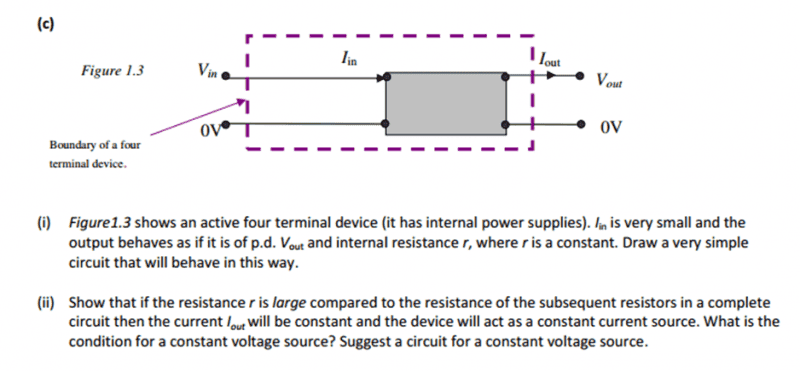
upload_2015-1-25_14-16-29.png

:'(
At the moment, I have no clue what to do for part i). I am sure that I will get part ii) afterwards, but I just don't know how to change the pd and current, and I don't really understand the purpose of the 0V terminals..

Thank you in advance for any help!
 
Physics news on Phys.org
This question seems to be context related.
It will be testing the coursework just done, so we need to know what that was and what questions came earlier.
 
21joanna12 said:
I am really struggling with this circuit:

Have you been studying "two port" networks or was this question asked before that topic was mentioned ?

You could look at examples of two port networks that have voltage sources in them to get some ideas.
There are lots of notes about two port networks online. e.g. http://ocw.nthu.edu.tw/ocw/upload/12/237/05handout.pdf
 
Have you studied Thevenin and Norton yet?

If so you know the answer already and just need the courage to risk making a mistake or two.

Always parse questions to break them into individual parts.
False starts are just experiments . You have to go down a lot of blind alleys to learn any neighbvorhood...

What's simplest two element circuit you can think of that containss a voltage(p.d.) and resistance ?
Now - if we take them at their word and give Iin a small constant value,
i think you can answer (i) with one component.

That should lead you into answer for (ii).
 
This question comes from olympiad past papers, Page 3, so there is no history to help identify "very simple crcuit".
http://www.physics.ox.ac.uk/olympiad/Downloads/PastPapers/BPhO_Round_2_Paper_2012_Final.pdf

The question may be deliberately vague so as to see how students handle the challenge. The simplest circuit that I can see is Vin through a voltage follower with a series resistor, R, to Vout. There may be no right answer.
 
Interesting set of questions.

Vin and Iin are irrelevant
(i) is a voltage source of Vout in series with r, or a current source of Vout/r in parallel with r.

(ii) is worded to trip up those who do not read carefully. It mixes constant current and voltage sources, to make it hard for beginners.
 

Similar threads

  • · Replies 3 ·
Replies
3
Views
4K
  • · Replies 1 ·
Replies
1
Views
2K
  • · Replies 5 ·
Replies
5
Views
2K
  • · Replies 7 ·
Replies
7
Views
3K
  • · Replies 8 ·
Replies
8
Views
8K
  • · Replies 8 ·
Replies
8
Views
2K
  • · Replies 5 ·
Replies
5
Views
3K
  • · Replies 7 ·
Replies
7
Views
3K
  • · Replies 4 ·
Replies
4
Views
6K
  • · Replies 2 ·
Replies
2
Views
2K