Design Circuit to Convert Current to Voltage | LTSpice Also

Click For Summary

Discussion Overview

The discussion revolves around designing a circuit to convert current to voltage using LTSpice, specifically involving a diode and an operational amplifier (opamp). Participants are addressing homework-related questions, exploring circuit design, and discussing the implications of using ideal versus real opamps in simulations.

Discussion Character

  • Homework-related
  • Technical explanation
  • Exploratory
  • Debate/contested

Main Points Raised

  • One participant expresses confusion about the homework requirements and circuit design in LTSpice, indicating a lack of understanding of the question.
  • Another participant suggests modeling the bias voltage source and photodiode as a variable current source and recommends sweeping the current across a specified range.
  • There is a discussion about the absence of a simple photodiode model in LTSpice, with a focus on using a current source instead.
  • Participants debate the choice between using real opamps versus ideal opamps, raising questions about input bias current and the implications for circuit performance.
  • One participant proposes that bipolar opamps may be better for less noise and offset, while FET opamps may be advantageous for area and power considerations.
  • Another participant emphasizes the importance of understanding the differences between ideal and real opamps for practical applications.

Areas of Agreement / Disagreement

Participants do not reach a consensus on the best type of opamp to use in the circuit design, with differing opinions on the advantages of bipolar versus FET opamps. The discussion remains unresolved regarding the optimal approach to the homework problem.

Contextual Notes

Participants mention the need to consider input bias current in real opamps, which is not represented in ideal opamps. There is also a caution against sweeping the current source over an excessively large range.

Who May Find This Useful

This discussion may be useful for students and practitioners interested in circuit design, specifically those working with opamps and current-to-voltage conversion in simulation environments like LTSpice.

Lapse
Messages
49
Reaction score
4
Hello,

We just finished up midterms and I actually did well--got an A. However, somehow between the midterm (class before last) and last class we jumped to creating a circuit with a diode. I am pretty lost.

1. Homework Statement
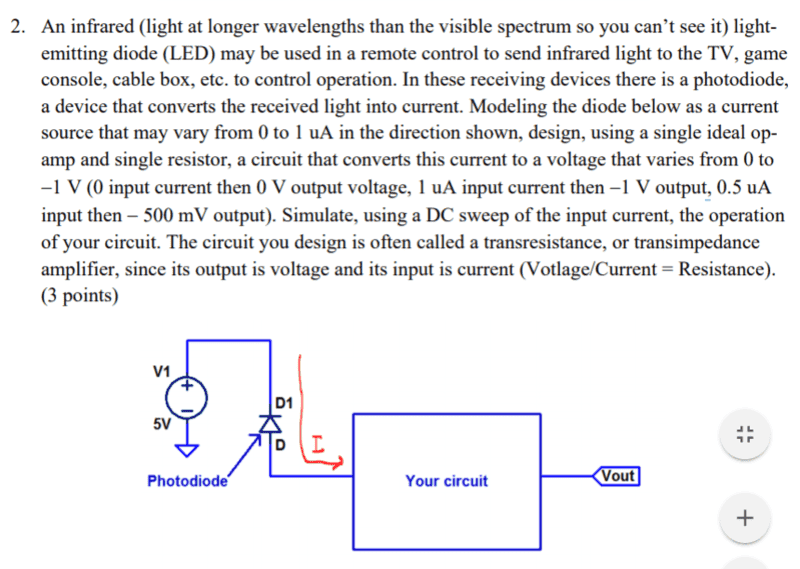
upload_2018-10-19_13-12-50.png


Homework Equations


Voltage / Current = Resistance

The Attempt at a Solution


[/B]
Here is how I designed it in LTSpice:
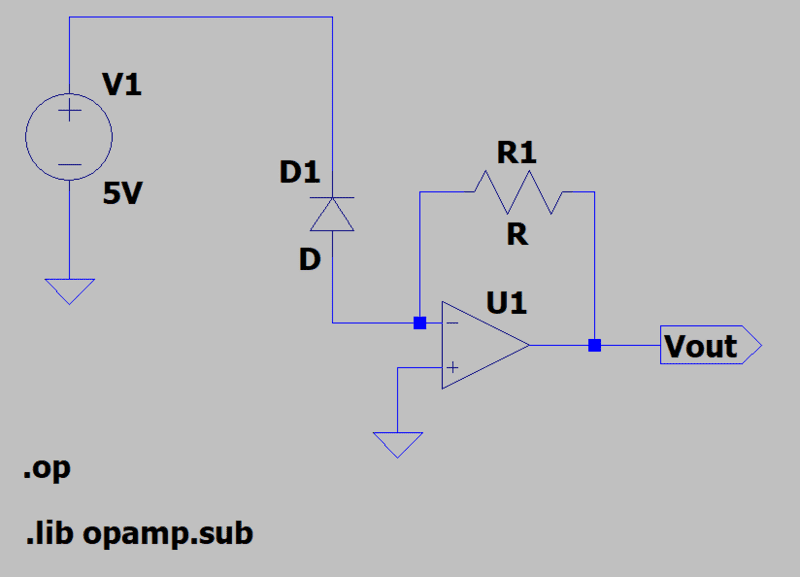
upload_2018-10-19_13-19-23.png


Ultimately, not only do I not know what the question is asking, but I don't know how to design it on paper nor in LTSpice. I am guessing I use a DC Sweep from the 5-volt source for part of it:
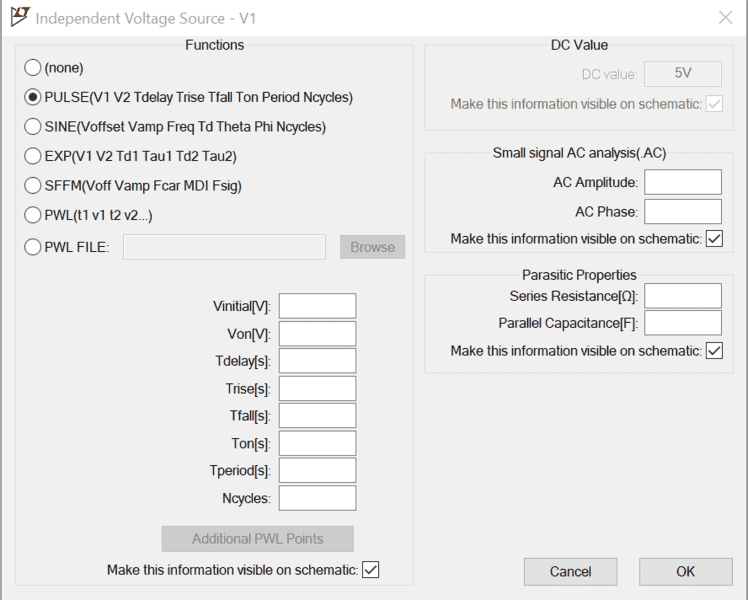
upload_2018-10-19_13-20-41.png


I really hate feeling this lost.

Hopefully you guys can help me through this.
 

Attachments

  • upload_2018-10-19_13-12-50.png
    upload_2018-10-19_13-12-50.png
    58.2 KB · Views: 1,029
  • upload_2018-10-19_13-18-47.png
    upload_2018-10-19_13-18-47.png
    9.9 KB · Views: 863
  • upload_2018-10-19_13-19-23.png
    upload_2018-10-19_13-19-23.png
    9.9 KB · Views: 1,233
  • upload_2018-10-19_13-20-41.png
    upload_2018-10-19_13-20-41.png
    28.3 KB · Views: 964
Physics news on Phys.org
It sounds like they want you to model the bias voltage source and photodiode as a variable current source. So just change out the voltage source and vanilla diode in your LTSPICE circuit for a current source, and sweep it across the range they specify. At the max current that they list (still small), you need to drop 1V across the feedback resistor, right?

I don't think there is a simple photodiode model in SPICE (other than a current source).

Do you generally use real opamps in your simulations now, or super-ideal ones? I ask because of issues like input bias current and input offset current/voltage issues in a circuit like this that is dealing with very small currents. If you are using real models, which type of opamp would be better for this (Bipolar or FET input) and why?

EDIT -- I see now they say to use an ideal opamp. I'd still be interested in your answer about which type of real opamp to use for such a circuit.
 
Last edited:
  • Like
Likes   Reactions: gneill
Oh, and congrats on the midterms! :smile:
 
This is just HW for lecture, so I am unsure of which type of real opamp should normally be used.

Here is the circuit I've got so far:
upload_2018-10-19_17-48-1.png


Do you think this is the answer the professor might be looking for?

Here is the DC Sweep of the current source:
upload_2018-10-19_17-49-55.png
 

Attachments

  • upload_2018-10-19_17-48-1.png
    upload_2018-10-19_17-48-1.png
    16.1 KB · Views: 910
  • upload_2018-10-19_17-49-55.png
    upload_2018-10-19_17-49-55.png
    12.3 KB · Views: 891
berkeman said:
Oh, and congrats on the midterms! :smile:
Thank you. :)
 
Looks good, but I would only sweep the current source over the range of interest of the problem (0A to 1uA), not all the way to 1A (boom!). :smile:

Oh, and you want to plot Vout as a function of Iin -- that would be a good plot to supply as your answer.

I'll let you get to my quiz question when you have some spare time. Just Google tradeoffs between bipolar and FET opamps and enjoy some interesting reading. :smile:
 
Ahh, okay. Something more like this?
upload_2018-10-19_18-7-16.png
Your question: I had to figure out what input bias current was first. If my understanding is correct, it is the small amounts of current in the inverting and non-inverting inputs of an opamp. Counterly, an ideal opamp doesn't represent this input bias current--which is why we call it "ideal".
It looks like one would use a bipolar for less noise and offset, and a FET for more area and power.
 

Attachments

  • upload_2018-10-19_18-7-16.png
    upload_2018-10-19_18-7-16.png
    14.1 KB · Views: 761
Great plot, IMO. Good work! :smile:
Lapse said:
Your question: I had to figure out what input bias current was first. If my understanding is correct, it is the small amounts of current in the inverting and non-inverting inputs of an opamp. Counterly, an ideal opamp doesn't represent this input bias current--which is why we call it "ideal".
Correct. The problem is, when you get to the real world (either in your hobby projects, or your labs, or your first job), you're required to use "real" opamps and other circuitry. That's why it's good to start asking questions about the differences between "ideal" and "real" circuits early. :smile:
Lapse said:
It looks like one would use a bipolar for less noise and offset, and a FET for more area and power.
Those may be true, but I think of FET input amps when I don't want to have to take input bias currents into my first-order calcs. There are "low-noise" versions of both types of opamps, and I'd have to check out some of the more recent datasheets to see which version is winning the low-noise war currently.

Good job!
 
  • Like
Likes   Reactions: Lapse

Similar threads

  • · Replies 6 ·
Replies
6
Views
4K
  • · Replies 13 ·
Replies
13
Views
4K
  • · Replies 9 ·
Replies
9
Views
800
  • · Replies 1 ·
Replies
1
Views
2K
  • · Replies 1 ·
Replies
1
Views
2K
  • · Replies 4 ·
Replies
4
Views
2K
Replies
15
Views
3K
Replies
7
Views
3K
  • · Replies 5 ·
Replies
5
Views
2K
  • · Replies 12 ·
Replies
12
Views
3K