Circuit with dependent voltage source

Click For Summary

Discussion Overview

The discussion revolves around solving for the voltage \( v_a \) in a circuit that includes a current-controlled voltage source. Participants explore various methods for analyzing the circuit, including writing loop equations and considering the relationships between currents and voltages in the circuit components. The scope includes technical explanations and mathematical reasoning related to circuit analysis.

Discussion Character

  • Technical explanation
  • Mathematical reasoning
  • Debate/contested

Main Points Raised

  • One participant suggests writing either one equation with one unknown (\( v_a \)) or two equations with two unknowns (\( v_a \) and \( i_2 \)), indicating that the latter is a safer approach.
  • Another participant questions the relationship between currents at node \( v_a \), suggesting that \( i_1 \) should account for additional currents through other components.
  • There is a discussion about the correct expression for \( i_1 \) in terms of \( v_a \) and the impedance \( Z \), with participants providing different formulations and questioning each other's reasoning.
  • Some participants express confusion regarding the application of differential equations versus Laplace transforms in their analysis.
  • One participant emphasizes the importance of correctly identifying the voltage across components and how it relates to the currents in the circuit.
  • Advice is given to treat components as admittances rather than impedances for simplification, particularly when the network is initially inactive.
  • There are multiple expressions for \( Z(s) \) and discussions about how to handle the current-controlled voltage source in the context of the circuit analysis.

Areas of Agreement / Disagreement

Participants do not reach a consensus on the best method for solving the circuit. There are competing views on whether to use differential equations or Laplace transforms, and there is ongoing confusion regarding the relationships between the currents and voltages in the circuit.

Contextual Notes

Participants express uncertainty about the correct formulations for currents and voltages, and there are unresolved questions about the definitions of variables and the relationships between components in the circuit.

magnifik
Messages
350
Reaction score
0
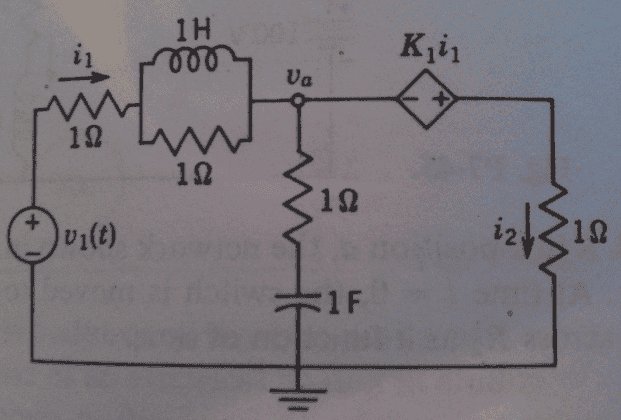
I am trying to solve for va in the circuit below, which has a current controlled voltage source:
281u7bk.png

Given: v1 = 5u(t), K1 = -3, the circuit is not energized at t = 0

I began by writing loop equations for each of the three parts of the circuit. Then I realized I am not quite sure how to get va from the currents. I am wondering is there a better way to approach this problem? Or if I continue with the method I started with, how do I solve for va with the currents?
 
Physics news on Phys.org
You can write just 1 equation with 1 unknown, Va, or 2 equations with 2 unknowns, Va and i2. The second approach is a bit safer. The result is exactly the same.

Just sum currents at node Va.
 
rude man said:
You can write just 1 equation with 1 unknown, Va, or 2 equations with 2 unknowns, Va and i2. The second approach is a bit safer. The result is exactly the same.

Just sum currents at node Va.

at node va is it correct that i1 = i2
i am still a little confused. after i solve for the currents (there are three of them in my method), how do i relate this to va?
 
No. What about the current going thru the 1 ohm & the 1F? i1 = that current plus i2.

OK I'll give it to you: i1 = Va/Z + i2. Now, what is Z?
 
rude man said:
No. What about the current going thru the 1 ohm & the 1F? i1 = that current plus i2.

OK I'll give it to you: i1 = Va/Z + i2. Now, what is Z?

Z is for the 1Ω resistor and 1F capacitor
 
Absolutely right. What is Z(s)?
 
rude man said:
Absolutely right. What is Z(s)?

Z(s) = (s+1)/s
 
rude man said:
Correct. What is i1(V1, Va)?

(va - v1) / (1 + (s || 1)) + va/((s+1)/s) ?
i1 = (va - v1)/1
not quite sure about this one
 
  • #10
magnifik said:
(va - v1) / (1 + (s || 1)) + va/((s+1)/s) ?
i1 = (va - v1)/1
not quite sure about this one

Your first equation: since i1 = -(Va - V1)/Z1, it can't be right, can it?
where Z1 = 1 + s||1

Your 2nd equation: how on Earth did you get that?
 
  • #11
rude man said:
Your first equation: since i1 = -(Va - V1)/Z1, it can't be right, can it?
where Z1 = 1 + s||1

Your 2nd equation: how on Earth did you get that?

i thought i1 was the current going through the resistor only, but then i realized it also goes through the parallel inductor/resistor. or is i1 = v1/R ? yup I'm confused. i meant to set va-v1/Z1 + va/((s+1)/s) = 0, but i am still failing to see the connection to i1
 
  • #12
First, get i1(V1,Va) right. Until you get that right and understand it we can't go on.

Then: remember a ways back I gave you
i1 = Va/Z + i2?

What about i2? Look at the voltage across the right-hand 1 ohm, what is the voltage there?
 
  • #13
rude man said:
First, get i1(V1,Va) right. Until you get that right and understand it we can't go on.

Then: remember a ways back I gave you
i1 = Va/Z + i2?

What about i2? Look at the voltage across the right-hand 1 ohm, what is the voltage there?

can i just do what i did originally - solve for the currents in each of the three loops. then use i1 = Va/Z + i2 to get the final answer?

my three loop equations were:
for the left loop
5 = 3ia - ib - ic + ∫(ia - ic) dt
for the top loop
0 = ib - ia + dib/dt
for the right loop
-3ia = 2ic - ia + ∫(ic - ia) dt
 
  • #14
I'm real surprised you are using diff. eq's instead of Laplace. Are you supposed to do it purely using d.e.'s or do you go from the d.e.'s to the Laplace? BTW that's a good way to do it.

If you will tell me what ia, ib and ic are I can look further at it. I'm having a tough time trying to second-guess the loops. Please label the resistors R1, R2, R3 and R4 from left to right, and use L and C. Thanks.

In case you've lost interest by now: if your loop equations are correct, the answer is yes.
If you want me to check your final answer, I can.
 
Last edited:
  • #15
rude man said:
I'm real surprised you are using diff. eq's instead of Laplace. Are you supposed to do it purely using d.e.'s or do you go from the d.e.'s to the Laplace? BTW that's a good way to do it.

If you will tell me what ia, ib and ic are I can look further at it. I'm having a tough time trying to second-guess the loops. Please label the resistors R1, R2, R3 and R4 from left to right, and use L and C. Thanks.

In case you've lost interest by now: if your loop equations are correct, the answer is yes.
If you want me to check your final answer, I can.

I start with diff eqs then convert to laplace. I will put my final answer once I do the work to find it.

EDIT: In my equations, i1 = ia, i2 = ic, ib is the loop current for the inductor/resistor in parallel
 
Last edited:
  • #16
Just a tip, if the network is initially inactive (no capacitor charge or inductor current) then it's usually more straight-forward to just treat the components as Z(s) or Y(s).

For example, commponents in parallel are much more easily handled as admittances [ Y(s) ] than impedances. E.g. a capacitor and resistor in parallel is Y = G + sC where G = 1/R.

A voltage divider is equally well written as Y2/(Y1 + Y2) as Z1/(Z1 + Z2).

Etc. Idea is to make life as simple as possible. Avoid more mistakes that way too.


OK I'll see what you come up with.
 
  • #17
rude man said:
Just a tip, if the network is initially inactive (no capacitor charge or inductor current) then it's usually more straight-forward to just treat the components as Z(s) or Y(s).

For example, commponents in parallel are much more easily handled as admittances [ Y(s) ] than impedances. E.g. a capacitor and resistor in parallel is Y = G + sC where G = 1/R.

A voltage divider is equally well written as Y2/(Y1 + Y2) as Z1/(Z1 + Z2).

Etc. Idea is to make life as simple as possible. Avoid more mistakes that way too.


OK I'll see what you come up with.

I'm trying to solve using your advice, though I used impedance rather than admittance. Is this a correct simplification?
2h7ez2e.png
 
  • #18
Excellent! You're on your way. Now let's see you handle the current-controlled voltage source, and remember K = -3, not +3.

[Here's what I meant about Y vs. Z: the way I got the parallel impedance of the L and R is as follows: Y = G + 1/sL = (sLG+1)/sL where G = 1/R.

Z = 1/Y = sL/(sLG + 1).

That's easier, for me at least, than 1/Z = 1/R + sL etc. If L had been a C it would have been even nicer to go Y rather than Z. Then, get Z = 1/Y at the end. Don't be afraid to keep G's running around in your expressions rather than R's if it makes the math go easier.]
 
Last edited:

Similar threads

  • · Replies 10 ·
Replies
10
Views
4K
Replies
15
Views
3K
  • · Replies 3 ·
Replies
3
Views
2K
  • · Replies 9 ·
Replies
9
Views
6K
  • · Replies 7 ·
Replies
7
Views
3K
  • · Replies 11 ·
Replies
11
Views
5K
  • · Replies 5 ·
Replies
5
Views
2K
Replies
1
Views
2K
  • · Replies 2 ·
Replies
2
Views
988
Replies
3
Views
3K