Confused about plane wave and skin effect in conductor wire.

Click For Summary

Discussion Overview

The discussion revolves around the concepts of skin effect and plane waves in conducting wires, focusing on the behavior of electric and magnetic fields within the wire and their implications for current flow. Participants explore theoretical aspects, practical interpretations, and potential misconceptions related to these phenomena.

Discussion Character

  • Exploratory
  • Technical explanation
  • Debate/contested
  • Conceptual clarification

Main Points Raised

  • One participant questions whether the skin depth can be understood by considering the voltage applied across the wire and the resulting current density, suggesting that the plane wave propagates towards the center of the wire.
  • Another participant introduces the idea that skin effect is typically discussed in the context of electromagnetic wave reflection and transmission, noting the damping of amplitude and questioning the application of this concept to a conducting wire with current.
  • Concerns are raised about the interpretation of electric fields inside the conductor, with one participant noting that books often state the electric field is zero inside the conductor, yet there is an electric field at the surface.
  • Some participants express confusion over the direction of the electric field propagation, questioning why it is considered to start at the surface rather than the center of the wire.
  • There is a discussion about the boundary conditions for electric fields at the surface of the conductor and how these relate to the skin effect, with references to the normal component of the electric field.
  • One participant emphasizes that the literature does not clarify the origin of the plane wave, leading to uncertainty about its relationship with the skin effect in AC currents.

Areas of Agreement / Disagreement

Participants express various viewpoints on the relationship between skin effect and plane waves, with no consensus reached on the interpretation of electric field behavior within the wire or the applicability of traditional skin effect concepts to the scenario presented. Multiple competing views remain regarding the propagation of fields and the implications for current flow.

Contextual Notes

Participants note limitations in the existing literature regarding the origin of the plane wave and its connection to skin effect, as well as the assumptions made about electric fields in static versus AC conditions. The discussion highlights the complexity of these concepts and the potential for differing interpretations.

yungman
Messages
5,741
Reaction score
291
I want to verify my understanding about skin effect and plane wave of conductor wire.

2u43nzn.jpg


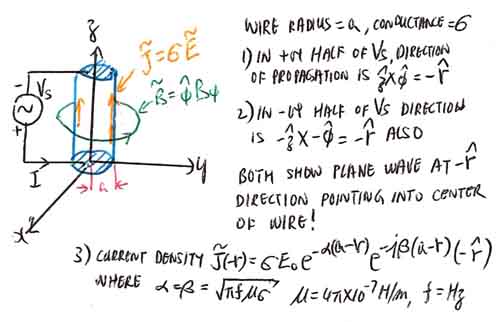
In the diagram, assume long straight on z axis. Wire with radius = a and conductance = \sigma. Accouding to the equation shown, the plane wave is going towards the center of the wire only regardless of the instantaneous polarity of the Vs. My questions are:

1) Is this how to look at the skin depth? By putting a voltage across the wire that generate the current density \tilde J = \sigma \tilde E in say +ve z direction according to the drawing. As noted, \tilde B = \hat \phi B_{\phi}. The direction of propagation is \hat z X \hat {\phi} = -\hat r. Are my drawing and description correct?

2) You can see in both polarity of Vs, the propagation is towards the center of the wire. But we know there is a plane wave propagate out of the wire into the space and is perpendicular to the wire in \hat r direction. How come I don't see it in the equation?

3) This is the most confusing question. Why is the E field started at the surface and propagate into the wire. When you apply voltage across the wire, the E at the center of the wire should be the same as right underneath the surface of the wire. You can look at it as the E start at the center and decay when traveling outward since the voltage across the wire is same at the center of the wire as right below the surface.

In another words, why we start considering the E on the surface only and calculate the plane wave instead of starting at the center of the wire and calculate outwards. What make the E on the surface only? From the book, it is almost like they start the E right above the surface of the wire in the space, and then use boundary condition that tangential E = \hat z E_0 is continuous cross the boundary so the E right below the surface of the wire is the same E = \hat z E_0!
 
Physics news on Phys.org
I've always thought of the skin effect in the context of reflection/transmission of em waves. That is, when an em wave is transmitted into a conducting medium a damping of the amplitude will occur, the skin depth is where the amplitude has decreased by a factor e. But you probably know this.

I'm not sure you can just apply this straightforward to a conducting wire. As i recall, one of the boundary conditions used when deriving the skin depth at simple transmission at a conducting surfaces is that there is no free current. Since we definitely have a current in a circuit I'm not sure how to derive the skin depth. But I think there is something occurring similar to what you're describing.
 
It sure seems that if a plane wave with E in z direction and H in \phi direction, current will also be generated as show in the diagram.

BUT all the books talking about AC current travels on the surface of the wire and the plane wave pointing into the center of the wire. In order to create current through the wire, a voltage source is needed like in my drawing. So this is definitely not talking about an external plane wave hitting the wire ( surface of the conductor ).

This is the exact point I want to verify in my post also. I think this is confussing.

I have another question:

Books always claimed E is zero inside the conductor. So why is there an E on the surface? Surface supposed to be equal potential for the same reason as inside the conductor that any E exist will cause electrons to move to neutralize the E? Is that the reason why books always talk about E right above the conductor surface and the continuity of tangential E to imply same E right below the surface to set up the skin effect?
 
No, I can see that this is definitely not a situation where an external wave is transmitted into the conducting medium. That is the case where I am familiar with the skin effect though. I don't know very much about AC currents and wave phenomena in circuits so I'm not sure I can be of very much help there. Though I've heard something of the current flowing on the surface and waves traveling perpendicualr to the current direction.

Regarding your last question: Remember that E=0 is true only in the static case. In this case, the boundary condition for the normal component of the E-field implies an electric field directed normal to the surface with magnitude \sigma/\epsilon_0. I'm not really sure what your last question is, what do you mean with "set up the skin effect"?
 
kloptok said:
No, I can see that this is definitely not a situation where an external wave is transmitted into the conducting medium. That is the case where I am familiar with the skin effect though. I don't know very much about AC currents and wave phenomena in circuits so I'm not sure I can be of very much help there. Though I've heard something of the current flowing on the surface and waves traveling perpendicualr to the current direction.

Regarding your last question: Remember that E=0 is true only in the static case. In this case, the boundary condition for the normal component of the E-field implies an electric field directed normal to the surface with magnitude \sigma/\epsilon_0. I'm not really sure what your last question is, what do you mean with "set up the skin effect"?

That make sense that E is not zero in AC case.

By "set up the skin effect", I meant the external Vs across the wire generate the E field from J=\sigma E . According to my diagram, E is in z direction and B in \phi direction. The plane wave generated by the E propagates in \hat z X \phi = -\hat r direction. The attenuation is what we call the skin effect.
 
Last edited:
Okay, I think I'm following you now. Your question is why the E-field is seen as beginning at the wire surface and propagating inwards, rather than beginning at the center and propagating outwards?

As far as I can see your sketch seems correct. A current flowing in the \widehat{z}-direction seems to imply an em wave propagating inwards, towards the center of the wire. Is this not in accordance with what is written in literature?
 
kloptok said:
Okay, I think I'm following you now. Your question is why the E-field is seen as beginning at the wire surface and propagating inwards, rather than beginning at the center and propagating outwards?
This is the latest part of my question. Like you said, E is not necessary zero in AC condition. So it is just a plausable for E to start in the middle of the wire as on the surface.
As far as I can see your sketch seems correct. A current flowing in the \widehat{z}-direction seems to imply an em wave propagating inwards, towards the center of the wire. Is this not in accordance with what is written in literature?

Yes, that seems to be what the books said. The only difference is none of the books mentioned where the origin of the plane wave is. They all just said the plane wave on the surface suffer attenuation as it penetrate the surface into the conductor. That does not say anything about the where the plane wave come from. It can well be an external plane wave perpendicular to the surface hitting the surface of the conductor. IF that is the case, then that has nothing to do with skin effect of the AC current conducting through the wire.

The fact that skin effect happen when an AC current pass through the wire indicate my drawing has to be the interpretation of where the plane wave come from.

See such an easy theory can become so confusing. I have 8 books on EM and I cannot find the answer.
 

Similar threads

  • · Replies 1 ·
Replies
1
Views
2K
  • · Replies 4 ·
Replies
4
Views
3K
  • · Replies 7 ·
Replies
7
Views
7K
  • · Replies 5 ·
Replies
5
Views
476
  • · Replies 3 ·
Replies
3
Views
2K
  • · Replies 4 ·
Replies
4
Views
2K
  • · Replies 3 ·
Replies
3
Views
5K
  • · Replies 3 ·
Replies
3
Views
5K
Replies
8
Views
2K
  • · Replies 1 ·
Replies
1
Views
2K