Controlling output light power by constructive/destructive interference

Click For Summary
In optical communications, controlling optical power through modulation is achieved using a Mach-Zehnder modulator (MZ modulator), which splits light into two paths. By applying a voltage to one path, a phase difference is created, allowing for constructive or destructive interference when the light is recombined. Constructive interference results in maximum output power (bit 1), while destructive interference leads to minimal output power (bit 0). Concerns about energy conservation arise when destructive interference seemingly results in no light output, prompting discussion on how energy is redistributed in different directions. The use of beam splitters and proper path length adjustments is essential for effective light combination and modulation.
Mayan Fung
Messages
131
Reaction score
14
In optical communications, one of the modulation methods is to control the optical power (Simplest case, for example, bright = bit 1, dim = bit 0). I learned that we can achieve this by a Mach-Zehnder modulator (MZ modulator).

Simply speaking, the principle of MZ modulator is to split the input light into two, traveling in two waveguides. By applying a voltage across one of the two arms, we can alter the refractive index of it and thus inducing a phase difference between the two split lights. Then, when they are combined as one output light signal, if they constructively interfere, then the output power is maximum (bit 1). Otherwise, if they destructively interfere, then the output power is minimum (bit 0).

It sounds good till here. Yet, I am puzzled about energy conservation. Let's say we split the input light into two with the same amplitude. When they combined with destructive interference, there is no light. How come we have optical power input but no power output?
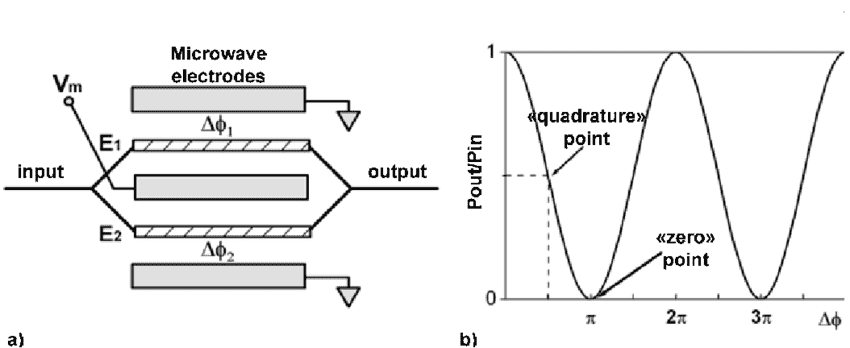
1596513844585.png
 
Science news on Phys.org
The two point sources are combined so as to get cancellation in one direction.
There will be other directions in which the energy is summed.
 
Baluncore said:
The two point sources are combined so as to get cancellation in one direction.
There will be other directions in which the energy is summed.

But in the above schematic, seems that there is only one output direction. Can the light escape the wavelength?
 
Chan Pok Fung said:
But in the above schematic, seems that there is only one output direction.
The diagram is symbolic.
It is not shown how light is split into two channels.
It is not shown how light is recombined into one line.
 
  • Like
Likes sophiecentaur
Baluncore said:
The diagram is symbolic.
It is not shown how light is split into two channels.
It is not shown how light is recombined into one line.
One possibility is to split and combine with half silvered mirrors. The diagram of a beam splitter is on this Wiki page. There are two input ports and two output ports. When combining your two beams, one port will let through the sum and the other will let through the difference resultants. You 'just' need to get the path lengths right to achieve that.
 
I see your points. That makes sense if there are two outputs. Thanks
 

Similar threads

  • · Replies 4 ·
Replies
4
Views
3K
  • · Replies 3 ·
Replies
3
Views
13K
Replies
2
Views
2K
  • · Replies 6 ·
Replies
6
Views
3K
Replies
4
Views
2K
  • · Replies 1 ·
Replies
1
Views
1K
  • · Replies 24 ·
Replies
24
Views
3K
  • · Replies 2 ·
Replies
2
Views
3K
  • · Replies 25 ·
Replies
25
Views
4K
  • · Replies 1 ·
Replies
1
Views
2K