Yalanhar
- 39
- 2
Thread moved from the technical forums, so no Homework Template is shown.
##x[n] = (\frac{1}{2})^{-2} u[n-4]##
##h[n] = 4^{n} u[2-n]##
So I plotted x[k] and h[n-k] in picture
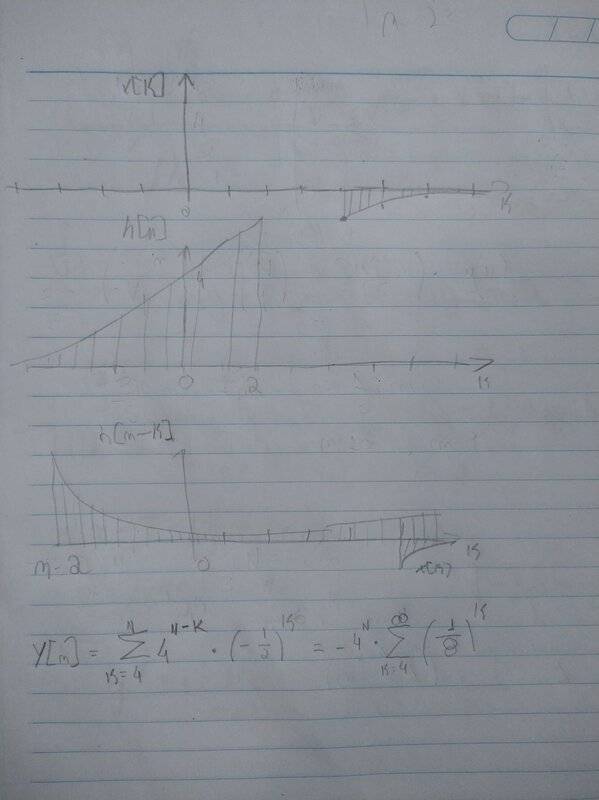
but x[n] is 0 for n < 4, therefore ##y[n]## only has value for n >= 4. Therefore my sum is like that:
##y[n]=\sum_{k=4}^{\infty} 4^{n-k} (-\frac{1}{2})^k##
##y[n]=-4^{n} \sum_{k=4}^{\infty} (\frac{1}{8})^k##
however, the answer is
for n <= 6,
##y[n]=4^{n}( \sum_{k=0}^{\infty} (-\frac{1}{8})^k - \sum_{k=0}^{3} (-\frac{1}{8})^k) ##
for n > 6,
##y[n]=4^{n} (\sum_{k=0}^{\infty} (-\frac{1}{8})^k - \sum_{k=0}^{n-1} (-\frac{1}{8})^k )##
What is my mistake? I'm having difficulties with this subject and I am not sure when I use k as limits or n. Also, if both signals extend to ##+\inf##, does that means that y[n] always has a value?
##h[n] = 4^{n} u[2-n]##
So I plotted x[k] and h[n-k] in picture
but x[n] is 0 for n < 4, therefore ##y[n]## only has value for n >= 4. Therefore my sum is like that:
##y[n]=\sum_{k=4}^{\infty} 4^{n-k} (-\frac{1}{2})^k##
##y[n]=-4^{n} \sum_{k=4}^{\infty} (\frac{1}{8})^k##
however, the answer is
for n <= 6,
##y[n]=4^{n}( \sum_{k=0}^{\infty} (-\frac{1}{8})^k - \sum_{k=0}^{3} (-\frac{1}{8})^k) ##
for n > 6,
##y[n]=4^{n} (\sum_{k=0}^{\infty} (-\frac{1}{8})^k - \sum_{k=0}^{n-1} (-\frac{1}{8})^k )##
What is my mistake? I'm having difficulties with this subject and I am not sure when I use k as limits or n. Also, if both signals extend to ##+\inf##, does that means that y[n] always has a value?