Crystal-Bravis Lattice Definitions

Click For Summary

Discussion Overview

The discussion revolves around the definitions and characteristics of crystal lattices, specifically focusing on the orthorhombic body-centered lattice and the nature of lattice points. Participants explore the symmetry of unit cells and the implications of choosing different unit cells in the context of Bravais lattices.

Discussion Character

  • Exploratory, Technical explanation, Debate/contested

Main Points Raised

  • One participant questions the symmetry of the red unit cell compared to the green shape, suggesting that the red unit cell has a higher symmetry due to its 90-degree rotational symmetry.
  • Another participant asserts that all atoms are identical, referencing the blue atom from a neighboring unit cell.
  • A later reply clarifies that while centered lattices can be chosen to contain one lattice point, the distinction between the 14 Bravais lattices is mathematically complex and not straightforward.
  • One participant challenges the terminology used, indicating that "atom" may not be appropriate and raises the question of whether all lattice points are equivalent, particularly in ionic crystals where nodes may be occupied by different objects.

Areas of Agreement / Disagreement

Participants express differing views on the symmetry of unit cells and the equivalence of lattice points, indicating that multiple competing perspectives remain unresolved.

Contextual Notes

Participants note the complexity in defining the differences among the 14 Bravais lattices and the implications of choosing different unit cells, which may not always represent the entire crystal accurately.

SpartanG345
Messages
69
Reaction score
1
There is such thing as a orthorhombic body centered crystal lattice. I am wondering why this is the case

see the image bellow, we can find a repeating pattern which has a smaller area.
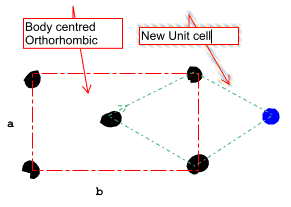
Orthorombic.png


A unit cell
- must be selected such that it has the highest symmetry and the smallest area, however i do not see how the red unit cell has a higher symmetry. According to our lecture the red unit cell has a higher symmetry by 90 degrees, therefore a orthorhombic cubic has a body centered from

The green shape can be reflected vertically and horizontally, however the point of reflection where the axis of symmetry passes through is not the same is this why there is a higher symmetry for the red ( default) unit cell?

The blue atom is from a neighboring unit cell
 
Last edited:
Chemistry news on Phys.org
Are all atoms identical?
 
yes all atoms are identical, the blue one is from a neighboring unit cell
 
As you observed correctly, even in centered lattices it is always possible to chose a unit cell which only contains one lattice point.
The choice of the centered cells is mainly convention. I was astonished to find that it is quite involved to define mathematically in what sense the 14 Bravais lattices are different.
See, e.g., S. Sternberg, Group theory and physics.

I would only speak of lattice points and not of an atom as "crystal=lattice+cell". Hence the cell can be very complicated, e.g. a protein. Nevertheless the lattice is made up of simple points.
 
Yes, atom was a wrong word. What I was asking about was whether all lattice points are equivalent. In ionic crystal nodes are occupied by different objects, so it can (?) be possible that the cell smallest in geometrical terms is not representative to whole crystal.
 

Similar threads

  • · Replies 3 ·
Replies
3
Views
3K
  • · Replies 4 ·
Replies
4
Views
4K
Replies
1
Views
3K
  • · Replies 2 ·
Replies
2
Views
2K
Replies
3
Views
6K
  • · Replies 1 ·
Replies
1
Views
3K
  • · Replies 1 ·
Replies
1
Views
31K
  • · Replies 6 ·
Replies
6
Views
5K
  • · Replies 1 ·
Replies
1
Views
3K