Crystal Radios - Understanding The Tuning Mechanism

Click For Summary

Discussion Overview

The discussion revolves around the tuning mechanism of crystal radios, specifically focusing on how changing the position of a ferrite rod within a coil affects the tuning process. Participants explore the underlying principles of resonance, inductance, and the role of circuit components in tuning, while also considering how to explain these concepts to a younger audience.

Discussion Character

  • Exploratory
  • Technical explanation
  • Conceptual clarification
  • Debate/contested
  • Homework-related

Main Points Raised

  • One participant seeks to understand the tuning mechanism of a crystal radio to explain it to a child, noting the setup involves a ferrite rod and a coil.
  • Another participant suggests an analogy comparing radio waves to wind gusts affecting a swing, introducing the concept of resonance and how it relates to tuning.
  • Some participants propose that changing the position of the ferrite rod alters the inductance of the coil, thereby changing the resonance frequency of the circuit.
  • There is a mention of the importance of having only one variable component in the tuning process.
  • A participant introduces the term "PTO" (Permeability Tuned Oscillator) and discusses its historical significance and complexity in home experiments.
  • Concerns are raised about the cluttered nature of airwaves in the Medium Frequency region and the challenges of receiving clear signals.
  • One participant reflects on the excitement of hearing faint signals and compares it to the magic of developing photographs, expressing a sense of nostalgia for simpler technologies.

Areas of Agreement / Disagreement

Participants express various viewpoints on the tuning mechanism and the best methods for explaining it, with no clear consensus on the simplest explanation or the effectiveness of different tuning components. Some participants agree on the importance of resonance and inductance, while others introduce competing ideas about the tuning process and signal reception.

Contextual Notes

There are unresolved questions regarding the definitions of inductance and the implications of using different tuning components, such as variable capacitors versus changing the core of the inductor. The discussion also highlights the dependence on local conditions for effective radio reception.

Who May Find This Useful

This discussion may be of interest to hobbyists building crystal radios, educators looking for ways to explain basic electronics concepts, and those curious about the historical context of radio technology.

BOAS
Messages
546
Reaction score
19
Hello,

I bought an electronics kit for my 12 year old brother (and perhaps a little for myself too...) for building a crystal radio.

I would like to understand what's going on when I tune the radio, so that I can explain it to him. It's a simple setup, where changing the position of a ferrite rod within a coil of wire does the tuning, but how does that work?
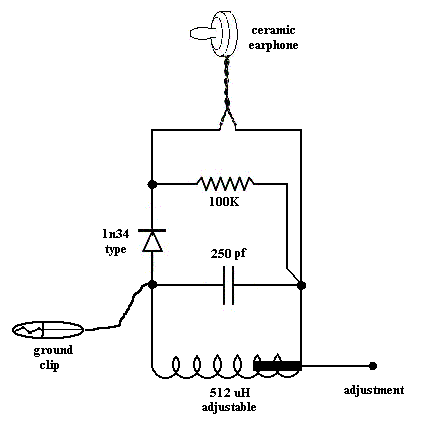
rocket_schematic.GIF


This circuit diagram is very similar, but the design I have does not make use of a resistor.

Any help would be appreciated!

P.S I have an understanding of physics akin to A-Level
 
Physics news on Phys.org
I don't know a simple way to explain it.
Maybe: https://www.midnightscience.com/howxtal.html

How about:
The radio waves act on the circuit like, say, the wind pushing on a child's swing.

But the swing prefers to move at a particular frequency - so it gets it's biggest movement if the wind gusts near that frequency. (You feel this this from pushing the swing yourself.) In general there are lots of wind gusts at all kinds of frequencies - so the properties of the swing will select-out the particular set of gusts that have the right frequency.

The phenomenon is called "resonance", you can look it up for more detail.

Radio waves play the role of the wind gusts - there are lots of different frequency radio waves about all the time, the circuit is sensitive to being "pushed" by a narrow range of them depending on the values of the capacitor and the inductor.

The values of the inductor and the capacitor determine the frequency that the radio is sensitive to.
You change the inductor by (a) changing the number of turns in the coil or (b) changing what is inside it (changing the position of the ferrite is good enough for that, you could also change the whole material to something else).

You change the capacitor by changing the separation between the plates (this is how it is normally done).
Look up "variable capacitor".

That help?
 
I think when you change the position of the rod, the inductance of the coil will be changed which leads to the change of the resonance freuqency of the circuit.

this circuit is like a filter to the received radio waves and the frequency you wanted can be adjusted by the inductance value by changing the position of the rod.
 
athosanian said:
I think when you change the position of the rod, the inductance of the coil will be changed which leads to the change of the resonance freuqency of the circuit.
That is correct.

Sadly begs the question "what is inductance?" from a 12yo.
 
Simon Bridge said:
I don't know a simple way to explain it.
Maybe: https://www.midnightscience.com/howxtal.html

How about:
The radio waves act on the circuit like, say, the wind pushing on a child's swing.

But the swing prefers to move at a particular frequency - so it gets it's biggest movement if the wind gusts near that frequency. (You feel this this from pushing the swing yourself.) In general there are lots of wind gusts at all kinds of frequencies - so the properties of the swing will select-out the particular set of gusts that have the right frequency.

The phenomenon is called "resonance", you can look it up for more detail.

Radio waves play the role of the wind gusts - there are lots of different frequency radio waves about all the time, the circuit is sensitive to being "pushed" by a narrow range of them depending on the values of the capacitor and the inductor.

The values of the inductor and the capacitor determine the frequency that the radio is sensitive to.
You change the inductor by (a) changing the number of turns in the coil or (b) changing what is inside it (changing the position of the ferrite is good enough for that, you could also change the whole material to something else).

You change the capacitor by changing the separation between the plates (this is how it is normally done).
Look up "variable capacitor".

That help?

Thanks a lot, that's a useful analogy.

On the PCB that came with the kit, the symbol for a variable capacitor is printed, but a normal capacitor is provided. I think the same circuit board is used for other kits that this company produces, but suppose I did have a variable capacitor, would this be used instead of varying the core of the inductor?

It's all built now, my brother surprised me with his steady hands when it came to soldering. Just need to wait for the rain to stop and then he'll be going up a tree with the aerial!
 
Simon Bridge said:
That is correct.

Sadly begs the question "what is inductance?" from a 12yo.

My stepdad has a galvanometer buried somewhere in the garage, so I'm going to dig it out and atleast show him the effect, even if it's hard to explain what it is.
 
That's right - it is best to have only one variable component.
I used to run the aerial up one wall in my room ... you don't need all that much, but it can depend on the radio stations near you.
 
Simon Bridge said:
That's right - it is best to have only one variable component.
I used to run the aerial up one wall in my room ... you don't need all that much, but it can depend on the radio stations near you.

There's a ham radio operator in the village, no idea what he broadcasts, but as you drive in you can see some sort of antenna.

Interesting, I thought it would be best outside, but it's obviously more convenient if it works indoors. I shall give it a go.
 
Well - you may have a lot of metal in your walls and roof.
It is usually better outside.
 
  • #10
The missing component in these explanations so far is the term "PTO."

The circuit supplied is a PERMEABILITY TUNED OSCILLATOR. Made famous by Collins Radio in us by US DoD radios during the cold war prior to MASSIVE advances in surface mount device physics. The PTO allowed for vast miniaturization of "lumped tuned" circuit components and standardization of circuit designs over great quantities of the rf spectrum. The accolades being said, PTO's are now a very rare circuit because they are so esoteric (read - extremely finicky and hard to make work correctly in the home experimenters workshop. This is because of the physics of the tuned core. Hey I thought a 12 yo asked this question!)
 
  • #11
BOAS said:
... but suppose I did have a variable capacitor, would this be used instead of varying the core of the inductor?
Yes. It just needs either or both to be variable.

Just need to wait for the rain to stop and then he'll be going up a tree with the aerial!
And here I was poised to explain why you'll need to add provision for connecting to an aerial, seeing your schematic lacks such, and it appears you already have that fitted.

Good luck with your experimenting. In a location with good reception, e.g., the suburbs, merely connecting the alligator clip to the metal frame of a window can be sufficient. Though in strong signal areas it can be difficult to separate stations close together in frequency.
 
  • #12
These days the airwaves (particularly in the Medium Frequency region) are very cluttered and it is difficult to get a clean signal unless you live near an MF transmitter. Nonetheless, it is still very exciting to hear a tiny squeak coming fro the headphones. (Best tried in the daytime when MF interference is much less.) It's on the same level as when you develop a black and white print in a dish of chemicals and you see the image appear out of nowhere. Also, the way an old gramophone record produces sound from a needle moving through the groove is unbelievable.
Modern technology has robbed us of that sort of magic, I'm afraid. The temptation is to take that sort of thing for granted.
 

Similar threads

  • · Replies 37 ·
2
Replies
37
Views
5K
  • · Replies 40 ·
2
Replies
40
Views
10K
  • · Replies 7 ·
Replies
7
Views
4K
  • · Replies 5 ·
Replies
5
Views
2K
  • · Replies 42 ·
2
Replies
42
Views
4K
  • · Replies 3 ·
Replies
3
Views
3K
  • · Replies 5 ·
Replies
5
Views
2K
  • · Replies 11 ·
Replies
11
Views
2K
  • · Replies 4 ·
Replies
4
Views
2K
  • · Replies 6 ·
Replies
6
Views
5K