Cylinder Rolling Down an Incline Without Slipping

Join the discussion
Ask a follow-up here, or get your own question answered by working scientists, mathematicians and engineers — people, not an autocomplete.
Real named experts · corrections over time · the nuance an AI answer skips
7 replies · 4K views
Leo Liu
Messages
353
Reaction score
156
Homework Statement
This is a conceptual question.
Relevant Equations
##\tau = I\alpha##
##F=ma##
##f=\mu F_N##
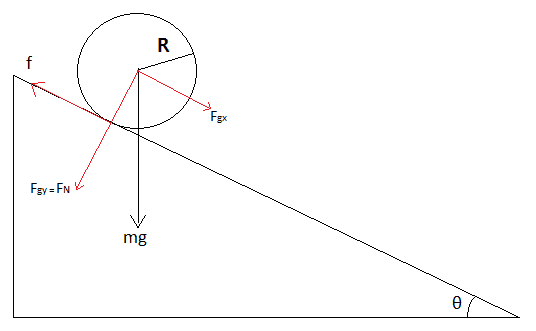
First we let the static friction coefficient of a solid cylinder (rigid) be ##\mu_s## (large) and the cylinder roll down the incline (rigid) without slipping as shown below, where f is the friction force:
1585178156646.png

In this case, ##mg\sin(\theta)## is less than ##F_{max}##, where ##F_{CM,max}## is the maximum force (excludes the friction, yet includes the the x component of the gravity ) can be exerted on the cylinder without causing it to slip.

My questions are:

1. How do we calculate the force of friction? Is it equal to ##mg\ cos(\theta) \mu_s## (which is the same as ##f=\frac{1}{2}ma_{CM,max}##) or ##f=\frac{1}{2}ma_{CM}##? (please note that the ##a## in the latter is a variable)

2. What is the norm of translational acceleration ##a## in this example?

3. If the cylinder does slip when rolling down, how would you find the force of friction? Do you need any additional information?

Derivation of the formula in question 1:
$$\tau = I\alpha$$
$$Rf\sin(90) = \frac{1}{2}mR^2 \frac{d\omega}{dt}$$
$$f=\frac{1}{2}m\frac{d\omega R}{dt}=\frac{1}{2}m\frac{dv_{tan}}{dt}=\frac{1}{2}ma_{tan}=\frac{1}{2}ma_{CM}$$
 
Last edited:
Physics news on Phys.org
Leo Liu said:
Homework Statement:: This is a conceptual question.
Relevant Equations:: ##\tau = I\alpha##
##F=ma##
##f=\mu F_N##

First we let the static friction coefficient of a solid cylinder (rigid) be ##\mu_s## (large) and the cylinder roll down the incline (rigid) without slipping as shown below, where f is the friction force:
https://www.physicsforums.com/attachments/259352
There must exist a force ##F_{max}## pointing down the incline, which ensures that the cylinder rolls without slipping. In this case, ##mg\sin(\theta)## is less than ##F_{max}##.
Why must there be such a force? Complete your free body diagram (FBD).
Leo Liu said:
My questions are:

1. How do we calculate the force of friction? Is it equal to ##mg\ cos(\theta) \mu_s## (which is the same as ##f=\frac{1}{2}ma_{CM,max}##) or ##f=\frac{1}{2}ma_{CM}##? (please note that the ##a## in the latter is a variable)
Complete the FBD and write Newton's 2nd law for translations and rotations, this means 2 separate equations.
Leo Liu said:
2. What is the norm of translational acceleration ##a## in this example?
It is what comes out of the 2 equations.
Leo Liu said:
3. If the cylinder does slip when rolling down, how would you find the force of friction? Do you need any additional information?
You will need the coefficient of kinetic friction.
 
kuruman said:
Why must there be such a force? Complete your free body diagram (FBD).
Hi, I have updated my diagram and improved the clarity of my question.
kuruman said:
this means 2 separate equations.
Sorry, I don't quite understand this point since I think the two types of motion are linked together, would you care to explain?.
My understanding:
$$\because x_{arc} = x_{CM}$$
$$\therefore R \omega = v_{CM}$$
$$\therefore a_{tan} = a_{CM}$$
This is how I got the expression of ##f## in terms of ##a_{CM}##, but I don't know if it is right.
 
Last edited:
Leo Liu said:
Hi, I have updated my diagram and improved the clarity of my question.

Sorry, I don't quite understand this point since I think the two types of motion are linked together, would you care to explain?.
My understanding:
$$\because dx_{arc} = dx_{CM}$$
$$\therefore dv_{tan} = dv_{CM}$$
$$\therefore da_{tan} = da_{CM}$$
This is how I got the expression of ##f## in terms of ##a_{CM}##, but I don't know if it is right.
What do these three equations mean? What happened to Newton's 2nd law? Your FBD is still incorrect. It shows the same force (weight) twice; once as a single vector straight down and then again as its components perpendicular and parallel to the incline.
 
Leo Liu said:
1. How do we calculate the force of friction? Is it equal to ##mg\ cos(\theta) \mu_s##
Only if it is on the verge of slipping. Rolling just means the frictional force does not exceed ##N \mu_s##.
Leo Liu said:
2. What is the norm of translational acceleration a in this example?
"Norm"? I don't understand the question.
 
kuruman said:
What do these three equations mean? What happened to Newton's 2nd law? Your FBD is still incorrect. It shows the same force (weight) twice; once as a single vector straight down and then again as its components perpendicular and parallel to the incline.
I just intended to show that the magnitude of the tangential acceleration at the point where the cylinder touches the slope is equal to the translational acceleration of the cylinder, as its direction is opposite to the latter. In the FBD, I did not want to remove the gravity so I decided to add red colour to its component.
 
haruspex said:
Only if it is on the verge of slipping. Rolling just means the frictional force does not exceed ##N \mu_s##.

"Norm"? I don't understand the question.
Does that mean the magnitude of the force of friction ##f = \frac{1}{2}ma_{CM}##? I meant "magnitude" when saying "norm". Thank you.
Also, @kuruman mentions that kinetic friction will come into play when the cylinder slips. If this is the case, what are the uses of ##\mu_s## other than finding ##F_{max}##?
 
Leo Liu said:
Does that mean the magnitude of the force of friction ##f = \frac{1}{2}ma_{CM}##?
Yes.
Leo Liu said:
Also, @kuruman mentions that kinetic friction will come into play when the cylinder slips. If this is the case, what are the uses of ##\mu_s## other than finding ##F_{max}##?
None.
 
  • Like
Likes   Reactions: Leo Liu