Deriving Special Relativity Formulae Steps

Click For Summary

Discussion Overview

The discussion revolves around the derivation of special relativity formulae, specifically focusing on the steps involved in understanding the relationship between time, distance, and velocity using a light clock diagram. The scope includes mathematical reasoning and technical explanations related to special relativity.

Discussion Character

  • Technical explanation, Mathematical reasoning

Main Points Raised

  • One participant presents a derivation involving a light clock and the relationship between time, distance, and angle, leading to the expression t = d/csinθ.
  • Another participant points out that treating both time (t) and angle (θ) as unknowns complicates the derivation and suggests using the Pythagorean theorem for clarity.
  • A later reply agrees with the suggestion to use the Pythagorean theorem, proposing the equation (ct)² = d² + (vt)² as a more effective approach.
  • Further responses indicate that rearranging this equation and substituting d/c = t₀ can lead to the desired formula, although the exact steps are not fully detailed.

Areas of Agreement / Disagreement

Participants express differing views on the initial approach to the derivation, with some advocating for the use of the Pythagorean theorem while others initially propose a different method. The discussion does not reach a consensus on the best approach to derive the formulae.

Contextual Notes

There are limitations in the discussion regarding the assumptions made about the variables involved, particularly the treatment of t and θ as unknowns. The mathematical steps leading to the final formula are not fully resolved.

Clever Penguin
Messages
74
Reaction score
20
I was bored, so I decided to derive the special relativity formulae.
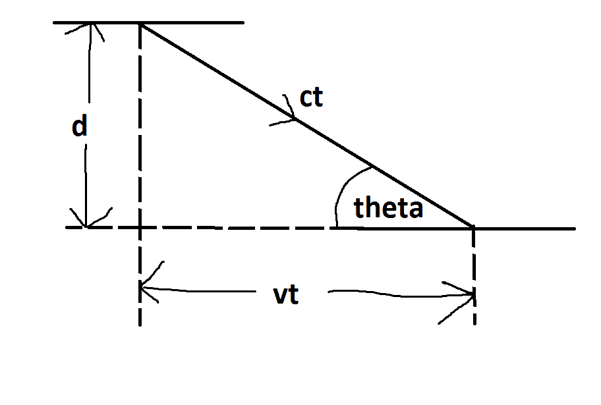
I drew the following diagram of a light clock:
upload_2016-6-8_12-21-46.png

In order to find t, I did sinθ=d/ct
Which gives tsinθ=d/c
Which gives t=d/csinθ

If v = 0, vt = 0, and θ = 90
sin90 = 1
t = d/csinθ = d/c
We call this t0If v is greater than 0, vt is greater than zero, and θ is less than 90
sin90 is less than1
t = d/csinθ is greater than d/c

We use Pythagoras to get t0=t(1- (v2/c2))-1/2

What are the steps involved in getting to this answer?
 

Attachments

  • upload_2016-6-8_12-21-20.png
    upload_2016-6-8_12-21-20.png
    5.4 KB · Views: 716
Physics news on Phys.org
Clever Penguin said:
In order to find t, I did sinθ=d/ct
Usually both t and θ are considered unknowns. So writing one equation in two unknowns doesn't help. You should use the Pythagorean theorem instead to get one equation in one unknown.
 
  • Like
Likes   Reactions: Clever Penguin
Dale said:
Usually both t and θ are considered unknowns. So writing one equation in two unknowns doesn't help. You should use the Pythagorean theorem instead to get one equation in one unknown.

Valid point :wink:

so (ct)2 = d2 + (vt)2
 
Last edited:
Clever Penguin said:
Valid point :wink:

so (ct)2 = d2 + (vt)2
Yes. Then rearranging and using ##d/c=t_0## gives you the desired formula
 
Dale said:
Yes. Then rearranging and using ##d/c=t_0## gives you the desired formula

thanks
 

Similar threads

  • · Replies 1 ·
Replies
1
Views
1K
  • · Replies 6 ·
Replies
6
Views
1K
  • · Replies 3 ·
Replies
3
Views
1K
  • · Replies 33 ·
2
Replies
33
Views
3K
  • · Replies 22 ·
Replies
22
Views
3K
  • · Replies 7 ·
Replies
7
Views
2K
  • · Replies 24 ·
Replies
24
Views
2K
  • · Replies 10 ·
Replies
10
Views
2K
  • · Replies 32 ·
2
Replies
32
Views
3K
  • · Replies 3 ·
Replies
3
Views
1K