Deriving Torricelli's Law: Pressure, Viscosity & More

  • Context: Undergrad 
  • Thread starter Thread starter Lil_Aziz1
  • Start date Start date
  • Tags Tags
    Law Torricelli's law
Click For Summary

Discussion Overview

The discussion centers on the derivation of Torricelli's Law, exploring its relationship with Bernoulli's Equation and addressing various assumptions related to pressure, viscosity, and fluid dynamics. Participants examine the implications of these assumptions in both theoretical and practical contexts.

Discussion Character

  • Exploratory
  • Technical explanation
  • Debate/contested
  • Historical

Main Points Raised

  • One participant questions the assumption that neglecting pressure differences is necessary for deriving Torricelli's Law, noting that sources suggest viscosity is the primary factor neglected.
  • Another participant argues that assuming the velocity at the top of the tank is zero implies that the water flowing out is negligible compared to the tank's volume, leading to a specific interpretation of Torricelli's Law.
  • A later reply acknowledges the importance of pressure at the hole, indicating that it is not simply equal to the hydrostatic pressure at the bottom of the tank.
  • One participant introduces the idea that Bernoulli's equation represents conservation of energy, suggesting that it can be applied without concern for how water exits the container.
  • Another participant clarifies that the pressure at the bottom of the container is influenced by the water's depth, which affects the derivation of Torricelli's Law.
  • One participant highlights the historical context, noting that Torricelli's Law predates Bernoulli's formulation, prompting a discussion about how the law was generalized into Bernoulli's equation.

Areas of Agreement / Disagreement

Participants express differing views on the assumptions necessary for deriving Torricelli's Law, particularly regarding pressure and velocity. The discussion remains unresolved, with multiple competing interpretations presented.

Contextual Notes

Some assumptions regarding the flow conditions, pressure definitions, and the role of viscosity remain unaddressed, leading to potential limitations in the derivation process discussed.

Lil_Aziz1
Messages
21
Reaction score
1
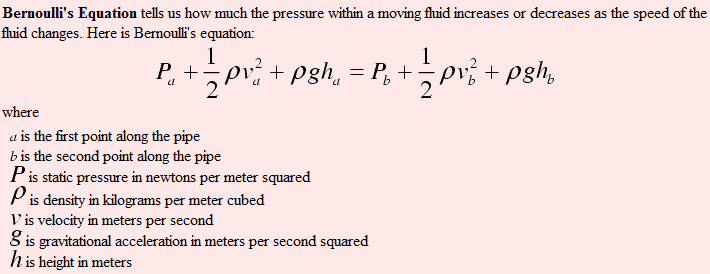
Hey I have a question on the derivation of Torricelli's Law. Bernoulli's Equation states the following:
BernoullisEquation.png


Now let's say that the left side of the equation is the top of the tank and the right side of the equation is the bottom of the tank. The origin is at the bottom of the tank.

We can say that P_a = P_{atm}, v_a \approx 0, h_b = 0

Therefore, our equation becomes

P_{atm} + pgh = P_{bottom of tank} + 1/2pv^2

Now torricelli's law states that v = \sqrt{2gh}, which we only get if we neglect the difference in pressure. Is that true? When I looked up torricelli's law, they said that the only thing neglected was viscosity and nothing about the change in pressure. What am I doing wrong?

Thanks in advance!
 
Physics news on Phys.org
Not that i know much about fluid dynamics, but in assuming that v_a =0 you are also assuming that the amount of water flowing out of the bottom is negligible in comparison to the tank of water. Most of the water at the bottom of the tank in fact has a velocity v_b=0 and then the equation adds up. Torricelli's law is only the speed that a minute amount of water would have if you let some flow out at the bottom, not the actual velocity of all the water at the bottom of the tank.

On a second look you can actually derive Torricellis law from the equation P_{atm} + pgh = P_{bottom of tank} + 1/2pv^2. If you make a small hole in the tank, then the water streaming out of the tank must have a pressure P_{atm} as well, then P_{atm} + pgh = P_{atm} + 1/2pv^2 \Rightarrow pgh = 1/2pv^2 \Rightarrow v = \sqrt{2gh}.
 
Last edited:
Oh wow I didn't think about the fact that if there is a hole, the pressure at the bottom of the tank (more specifically, the small hole) is not P=pgh. Thanks!
 
hi
but
if the pressure at the bottom of the tank is equal to air pressure , it means that the pressure at the top of water and at the hole is equal to air pressure. so water cannot move and flow and must remain static.
this is a paradox,isn't it.
please help me.
thanks
 
Bernoulli's equation is equivalent to conservation of energy. For any given (ideal) volume of water, the equation must hold at all times. This means that one need not be concerned about how the water leaves the container. So, applying the equation with the "a" label referring to a small volume of water at the top of the container and "b" applying to the same volume of water that has just exited the container a distance h below the level of the water, one has Pa=Pb=PAtm, va≈0 (assuming the volume of water in the container is much larger than the flow rate out of the container) hA-hb=h. After some algebra one obtains Toricelli's law. The pressure at the bottom of the container is greater than the atmospheric pressure due to the depth of the water in the container. After the water leaves the container the water in the container is no longer exerting pressure on it, which is why Pa=Pb. Note that if va=Vb=0, then the Bernoulli equation allows one to derive the pressure at a given depth, ha-hb.
 
"After the water leaves the container the water in the container is no longer exerting pressure on it, which is why Pa=Pb."
............
thank you "IsometricPion"
now there is no Paradox.
 
Lil_Aziz1 said:
...derivation of Torricelli's Law. Bernoulli's Equation states..
You should notice that Daniel Bernoulli formulated the equation around hundred years after Torricelli's death - so the right question could be
how the Toricceli's Law got generalised to Bernoulli's equation?
 

Similar threads

  • · Replies 14 ·
Replies
14
Views
2K
  • · Replies 33 ·
2
Replies
33
Views
6K
  • · Replies 67 ·
3
Replies
67
Views
6K
  • · Replies 5 ·
Replies
5
Views
3K
  • · Replies 5 ·
Replies
5
Views
2K
  • · Replies 4 ·
Replies
4
Views
5K
  • · Replies 30 ·
2
Replies
30
Views
3K
  • · Replies 7 ·
Replies
7
Views
4K
  • · Replies 7 ·
Replies
7
Views
1K
  • · Replies 2 ·
Replies
2
Views
2K