Determining correct wiring for an old washing machine motor

Click For Summary

Discussion Overview

The discussion revolves around determining the correct wiring for an old washing machine motor, specifically for repurposing it into a mechanical chicken plucker. Participants are exploring the motor's wiring configuration, resistance measurements, and operational challenges encountered during testing.

Discussion Character

  • Exploratory
  • Technical explanation
  • Debate/contested
  • Mathematical reasoning

Main Points Raised

  • One participant describes their attempts to wire the motor, noting that it spins slowly and suggesting that the motor may have a multispeed configuration with a starter capacitor.
  • Another participant explains the function of the windings in a single-phase induction motor and suggests measuring the resistance of the windings to identify their configuration.
  • A participant shares resistance measurements of the motor's wires, asking for help interpreting the results.
  • Some participants propose that the white wire is likely the common neutral and the green wire is the ground, while others suggest checking for continuity to the motor frame to rule out insulation failure.
  • There are suggestions to apply voltage across the windings to test their functionality and to give the motor shaft a spin to see if it will start running.
  • One participant mentions that there may not be a systematic color code for the wiring and discusses the possibility of a centrifugal switch affecting motor operation.
  • Several participants express uncertainty about the exact wiring configuration and the implications of the resistance measurements, with differing interpretations of the results.

Areas of Agreement / Disagreement

Participants express various hypotheses about the motor's wiring and operation, with no consensus reached on the correct configuration or the interpretation of resistance measurements. Multiple competing views remain regarding the motor's functionality and wiring scheme.

Contextual Notes

Limitations include the lack of a definitive wiring schematic for the motor, uncertainty about the presence of a centrifugal switch, and the potential for grounded windings indicating insulation failure. The discussion also reflects varying interpretations of resistance measurements without a clear resolution.

Who May Find This Useful

Individuals interested in electrical engineering, DIY projects involving motors, or those looking to repurpose old appliances may find this discussion beneficial.

sunergeo
Messages
3
Reaction score
0
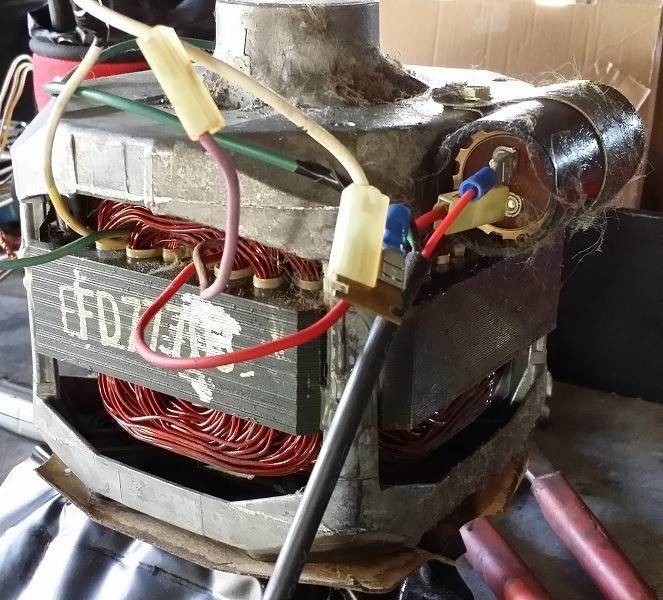
I have an old washing machine that finally bit the dust, so I've decided to attempt several projects with its remains. I want to try to make a mechanical chicken plucker using the tub and motor. I've disassembled and salvaged all the useful parts and scrap metal, but when it got down to trying to make the motor spin, I quickly got stuck. I'm hoping someone can point me in the right direction.

Here are the specs:
Washing machine model: Whirlpool LA7800XP
Motor: c68pxefd-3454

Here are some photos of the motor and wiring:
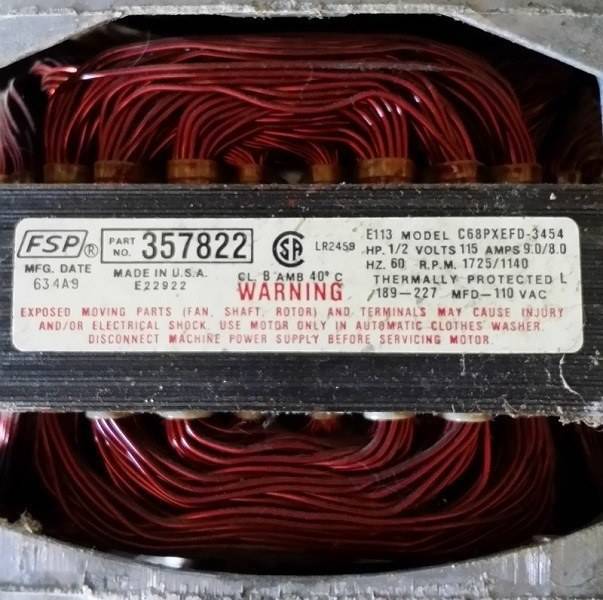
motor_nameplate.jpg
motor_wiring.jpg


I would greatly appreciate any assistance/advice.
 
Engineering news on Phys.org
Hi, Baluncore ... thanks for the response. Yes, I had come across that thread earlier in my research on the net. I followed the suggestions as closely as I could, but my situation's a bit different. I don't have a block on the outside as pictured in the thread, just loose wires. Also, my colors are different. Here's what I've accomplished so far via trial and error:

motor_test_configuration.jpg


With this configuration, I have power coming from my test lead plugged into the power strip, directly into the capacitor. Then, from capacitor to motor via the red wire. White is connected to neutral on my test lead, and ground goes to the motor housing. Now, when I connect the green wire running from inside the motor to neutral, the motor spins. However, it spins very slowly (maybe 100 rpm or so), and after a few seconds slows down even more. Connecting the purple wire to neutral at the same time as the green wire is connected to neutral makes no difference. Connecting the purple wire to neutral without connecting the green wire to neutral produces a hum, but no motion.

Any suggestions what to try next to get this to spin at full speed?
 
As a single phase induction motor it will have at least two windings. They may share a common wire to neutral or each have it's own neutral connection. One of those windings will be connected to active directly, the other winding will be connected to active through the capacitor which provides the necessary phase shift to decide direction.

The direction of rotation is determined by which winding has the series capacitor to active. If the motor has separate windings then reversing the two connections to either winding will reverse the motor.

Measure the resistance of the windings using the low ohms range on a multimeter to identify how many windings there are and how they are connected.
 
Ok, I measured the resistance of all combinations of the four wires. Here are the results:

W R G V
W 0 8.8 1.9 3.0
R 8.9 0 10.5 11.6
G 1.9 10.3 0 3.9
V 3.0 11.5 3.8 0

Can you help me interpret the meaning of these results?
 
sunergeo said:
I have an old washing machine that finally bit the dust, so I've decided to attempt several projects with its remains. I want to try to make a mechanical chicken plucker using the tub and motor. I've disassembled and salvaged all the useful parts and scrap metal, but when it got down to trying to make the motor spin, I quickly got stuck. I'm hoping someone can point me in the right direction.

Here are the specs:
Washing machine model: Whirlpool LA7800XP
Motor: c68pxefd-3454

Here are some photos of the motor and wiring:
View attachment 73492View attachment 73493

I would greatly appreciate any assistance/advice.
sunergeo said:
Ok, I measured the resistance of all combinations of the four wires. Here are the results:

W R G V
W 0 8.8 1.9 3.0
R 8.9 0 10.5 11.6
G 1.9 10.3 0 3.9
V 3.0 11.5 3.8 0

Can you help me interpret the meaning of these results?

sunergeo said:
I have an old washing machine that finally bit the dust, so I've decided to attempt several projects with its remains. I want to try to make a mechanical chicken plucker using the tub and motor. I've disassembled and salvaged all the useful parts and scrap metal, but when it got down to trying to make the motor spin, I quickly got stuck. I'm hoping someone can point me in the right direction.

Here are the specs:
Washing machine model: Whirlpool LA7800XP
Motor: c68pxefd-3454

Here are some photos of the motor and wiring:
View attachment 73492View attachment 73493

I would greatly appreciate any assistance/advice.
Additional advice: Be sure the chickens are dead before you run them through an electric chicken plucker. They tend to strenuously object if they're still alive. (Voice of experience here)
 
I guess you did not measure the G-G, V-V, R-R and W-W values. It would tell us the resistance of the multimeter leads. I guess that would be about 0.65 ohm.

Looks like three connected windings. V to G, then G to W and W to R.

My guess would be;
W is common neutral.
R is connected to active.
V or G is connected through the capacitor to active.
 
from 2012 thread:
https://www.physicsforums.com/threa...-3-wires-into-motor-help.620673/#post-3995969

here's a washing machine motor i recently decoded with an ohm-meter.
?image=http%3A%2F%2Fi232.photobucket.com%2Falbums%2Fee289%2Foldjimh%2FWashingMachineMotorWiring2.jpg

Sadly there seems no systematic color code.

Start winding will be a few ohms, run winding will be fewer.

Isolate start winding.
Apply voltage across run winding and motor will hum but not start.
Give shaft a spin either direction and it'll run that way.
It won't hurt the motor to hum a few seconds but don't let it go on long.
That'll tell you whether the motor is going to be useable.
Note it always starts in high speed.
Centrifugal switch opens the start winding and if low speed is selected, swaps over to it.
Yellow to white-black, and start cap? to blue runs one way, swap to reverse.
Are you sure yours has no centrifugal switch?good luck !
 
Last edited:
The white wire is usually the common and the green wire is almost always the ground wire. There should have been a wiring schematic somewhere within the machine. Sometimes it is on a piece of paper inside of the control panel, others have it pasted on the inside of the back panel.
 
  • #10
First thing is to check that none of the wires read continuity to motor frame. Unless it's obviously bolted there (Green?)
If the windings are grounded the motor has failed insulation. And this sounds like a symptom of that,
However, it spins very slowly (maybe 100 rpm or so), and after a few seconds slows down even more.
Or it could be just from trying to run at two speeds simultaneously.. Does it have that "Burnt Varnish"smell ?

hmmm my guess: (Thanks Balun ! )

R W = ~9 ohms start winding
G W = ~ 2 ohms run fast
V W = ~3 ohms run slow

Voltage across anyone winding should make it hum, but don't leave it stalled that way more than a couple seconds.
Give it a spin by hand either way and it should take off that direction.

That should work for all three windings.

Good luck ! Washing machine motors are real handy for home projects.
But the new ones are 3 phase computer driven marvels of modernity with "Space Vector Field Oriented Control" (see http://www.ti.com/lit/an/sprabq0/sprabq0.pdf),
so get yourself a lifetime supply of the old type while you can. I like to keep a half dozen on hand myself. They're about two to five bucks at metal recycle yards, yours is $116 new at Sears.. old jim
 
  • #11
Also be aware the start winding will work with only one of the speeds, probably high.

have fun.
 
  • #12
Aha ! Finally got my unruly old brain to focus...

If we're right on our wiring guesses
From your post # 3:
I have power coming from my test lead plugged into the power strip, directly into the capacitor. Then, from capacitor to motor via the red wire. White is connected to neutral on my test lead,
That energizes start winding through capacitor. With only that connection it should run but weakly. Try giving it a spin.
Now, when I connect the green wire running from inside the motor to neutral,
That shorts out the run fast winding. It might turn a little, but something should be getting hot.
Connecting the purple wire to neutral at the same time as the green wire is connected to neutral makes no difference.
That shorts the slow run winding too.
Connecting the purple wire to neutral without connecting the green wire to neutral produces a hum, but no motion.
That shorts just the run slow winding. Hmm... one winding is two pole the other is four pole. I don't know what the motor would do.

Try energizing a run winding and give the shaft a spin. Use an outlet strip with an overload breaker, just in case. If you can find a GFCI outlet nearby (kitchen?) i'd use that one.

old jim
 

Similar threads

  • · Replies 19 ·
Replies
19
Views
4K
  • · Replies 6 ·
Replies
6
Views
5K
  • · Replies 4 ·
Replies
4
Views
4K
  • · Replies 4 ·
Replies
4
Views
28K
  • · Replies 4 ·
Replies
4
Views
9K
  • · Replies 80 ·
3
Replies
80
Views
49K
Replies
6
Views
3K
  • · Replies 4 ·
Replies
4
Views
17K
  • · Replies 1 ·
Replies
1
Views
9K
  • · Replies 6 ·
Replies
6
Views
4K