Determining the light intensity in a double convex lens

Click For Summary

Discussion Overview

The discussion revolves around determining the light intensity measured by a lux meter at various locations relative to a double convex lens, with a focus on the relationship between the light intensity of the object and the intensities at different planes (before, at, and after the focal plane). The context includes theoretical considerations and practical applications related to optics and photometry.

Discussion Character

  • Exploratory
  • Technical explanation
  • Debate/contested
  • Homework-related

Main Points Raised

  • One participant proposes that as one moves closer to the focal plane, the intensity of light will increase, suggesting a relationship between intensity and magnification.
  • Another participant points out that while all light from the object passes through the lens, the distribution of light intensity varies across different planes, indicating that some planes may have more spread out light than others.
  • A participant notes that the term "focus" refers to the sharpness of the image on a screen, distinguishing it from the concept of light intensity.
  • Concerns are raised about the use of the term "intensity" versus "irradiance," with one participant clarifying that irradiance is measured in W/cm² and is what lux meters measure, while intensity is defined differently in physics.
  • There is a discussion about the confusion arising from different definitions of intensity found in various sources, particularly in relation to photometric and radiometric measurements.
  • A participant emphasizes the importance of using appropriate definitions and units when discussing measurements taken with a lux meter, suggesting that unit conversion may be necessary.
  • Another participant expresses caution about proceeding with the problem statement without further clarification from the original poster, indicating it may be homework-related.

Areas of Agreement / Disagreement

Participants express differing views on the definitions and implications of intensity versus irradiance, and there is no consensus on how to derive the relationships between the various intensities mentioned. The discussion remains unresolved regarding the best approach to the problem posed by the original poster.

Contextual Notes

There are limitations regarding the assumptions made about the definitions of intensity and irradiance, as well as the potential need for unit conversions. The discussion also highlights the varying interpretations of the problem statement and its context.

01baftb
Messages
1
Reaction score
0
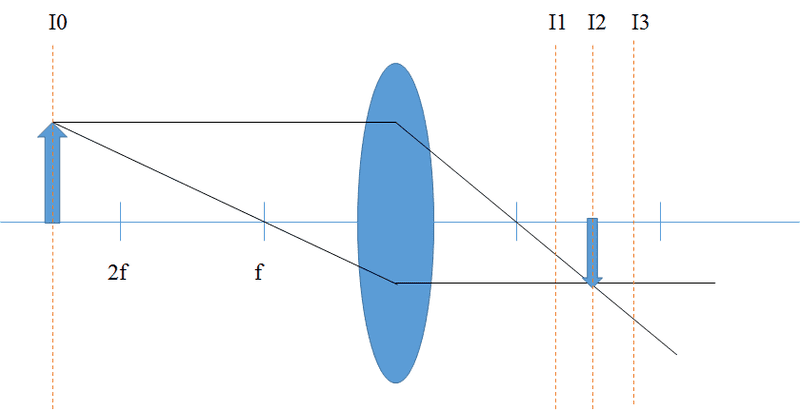
Attached is an illustration of an image being demagnified using a double convex lens.

I want to determine the intensity of the light (mW/cm2) if I were to put a lux meter at various locations after the convex lens given that the object is at a fixed location. The object is a monochromatic light projected by a projection system which goes through demagnification due to the double convex lens.

My assumption would be that be that as you move closer to the focal plane, the intensity will increase. I know that the intensity is inversely related to the the magnification (M = -di/do). Thus, if M = -1/2, then intensity at the focal plane is I2 = I0/M = 2*I0. But what if I put a lux meter before and after the focal plane? How can I determine the intensity of the light which is out of focus?

How can I derive the relationship between the light intensity of the object (I0) and the intensity of the image before the focal plane (I1), at the focal plane (I2), and after the focal plane (I3)?
demag-light-intensity-png.96302.png
 

Attachments

  • demag-light-intensity.png
    demag-light-intensity.png
    9.6 KB · Views: 1,296
Last edited:
Science news on Phys.org
All the light from the object, that passes through the lens, will pass through each plane[*]. But you will notice that the light from the point of the arrow is more spread out through some planes than others. What does that suggest about the intensity?

Notice - it is not the light that is out of focus - "focus" is a word used to describe how sharp the picture formed on a screen would be.
In this context, the picture on the screen is not the same as the "image". When the closer the screen position is to the image position, the sharper the picture. The sharpest picture is said to be "in focus".

[*] ... some light from the object will be scattered, reflected, or absorbed, when it is intercepted by the lens.
 
01baftb said:
Attached is an illustration of an image being demagnified using a double convex lens.

I want to determine the intensity of the light (mW/cm2) if I were to put a lux meter at various locations after the convex lens given that the object is at a fixed location. The object is a monochromatic light projected by a projection system which goes through demagnification due to the double convex lens.

My assumption would be that be that as you move closer to the focal plane, the intensity will increase. I know that the intensity is inversely related to the the magnification (M = -di/do). Thus, if M = -1/2, then intensity at the focal plane is I2 = I0/M = 2*I0. But what if I put a lux meter before and after the focal plane? How can I determine the intensity of the light which is out of focus?

How can I derive the relationship between the light intensity of the object (I0) and the intensity of the image before the focal plane (I1), at the focal plane (I2), and after the focal plane (I3)?

In radiometry and photometry, W/cm2 is irradiance, not intensity. Intensity is W/sr. The irradiance will increase to a maximum at the focal plane, but the intensity will not (AFAIK). Lux meters measure irradiance, and the output should vary accordingly. If you want to calculate the irradiance at arbitrary locations, you need to know the f/# because that tells you how much the light 'diverges' away from focus. Alternatively, if you know the Rayleigh length, that would work as well.
 
lightarrow said:
However it doesn't seem there is much accordance between wiki pages itself:
https://en.wikipedia.org/wiki/Luminous_intensity

Yeah, it can be confusing- there's a steady trickle of folks who post here asking the same basic questions that basically just involve conversion between the various quantities. Apostilbs! skots!
 
Ok, but since the OP was using a 'lux meter', it's not a good idea to assume non-photometric definitions of quantities.
Granted - however, what is not wrong with the problem statement is the choice of units for intensity, whatever units any data may be collected in.

Taking a look at the problem statement:
I want to determine the intensity of the light (mW/cm2) if I were to put a lux meter at various locations after the convex lens given that the object is at a fixed location. The object is a monochromatic light projected by a projection system which goes through demagnification due to the double convex lens.
... now I read that as saying "I want to get intensity in these specific units using a lux meter" ... this would presumably involve a unit conversion.
But there's more:
How can I derive the relationship between the light intensity of the object (I0) and the intensity of the image before the focal plane (I1), at the focal plane (I2), and after the focal plane (I3)?
- and the context is "general physics".
Looks like homework to me so I won't go further without feedback from OP.
 

Similar threads

  • · Replies 10 ·
Replies
10
Views
2K
  • · Replies 58 ·
2
Replies
58
Views
8K
Replies
12
Views
6K
  • · Replies 2 ·
Replies
2
Views
5K
  • · Replies 8 ·
Replies
8
Views
2K
  • · Replies 2 ·
Replies
2
Views
2K
  • · Replies 5 ·
Replies
5
Views
21K
  • · Replies 4 ·
Replies
4
Views
8K
  • · Replies 1 ·
Replies
1
Views
1K
  • · Replies 13 ·
Replies
13
Views
4K