Diffraction - Amplitude and Phase

Click For Summary

Discussion Overview

The discussion revolves around the computation of phase information from diffraction patterns, specifically in the context of a single slit diffraction problem using Fourier transform formalism. Participants explore the relationship between amplitude and phase in the resulting diffraction pattern and the implications for visualizing phase information.

Discussion Character

  • Technical explanation
  • Exploratory
  • Debate/contested

Main Points Raised

  • One participant describes the mathematical formulation of a single slit diffraction pattern, including the amplitude and intensity distributions derived from the Fourier transform.
  • Another participant notes that visualizing phase information is not possible with the human eye, as it is not sensitive to phase differences in light.
  • A different participant explains that taking the absolute value squared to find intensity results in the loss of phase information, and discusses the implications of this in terms of the Wiener-Khinchin theorem and the spatial autocorrelation function.
  • One participant later claims to have found the phase information, stating that since the Fourier transform is real, the phase can be either zero or pi depending on the sign of the amplitude, and provides a method for determining the phase based on the complex representation of the amplitude.
  • Another participant expresses confusion, indicating they misunderstood the original question regarding phase retrieval.

Areas of Agreement / Disagreement

Participants do not reach a consensus on the visibility of phase information in diffraction patterns, with some asserting it cannot be visualized while others discuss methods to infer phase from amplitude. The discussion remains unresolved regarding the broader implications of phase retrieval in diffraction analysis.

Contextual Notes

Participants acknowledge limitations in recovering the aperture function from intensity alone and the complexity involved in deconvolution for more complicated aperture functions.

LmdL
Messages
72
Reaction score
1
Hello,
I'm trying to understand how can I compute a phase graph from diffraction. I will follow here Fourier transform formalism of finding the light distribution on screen after diffraction.
I'm considering a 1D problem. Suppose I have a single slit of width a. This slit can be mathematically written as:
y=Arect\left ( \frac{x}{a} \right )\bigotimes \delta \left ( 0 \right )
i.e it is some amplitude A, multiplied by a rectangular function of width "a" with a convolution with delta function, since it's at origin.
Diffraction pattern is given by a Fourier transform:
Y=Aasinc\left ( \pi ka \right )
So, the amplitude of the resulting diffraction pattern is given above (roughly ~sinc function). Spatial friquency k is:
k=\frac{x}{\lambda D}
Where x is a position on the screen, D is the distance from the slit to the screen and lambda is a wavelength.
The intensity distribution on the screen is then:
I=\left |Y \right |^2=A^2a^2sinc^2\left ( \pi ka \right )

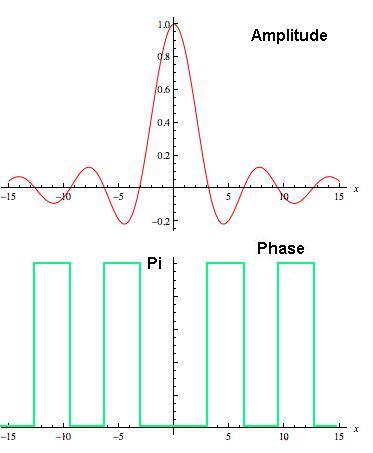
Till now everything is fine. But in order to get the slit image, i.e. performing an inverse Fourier transform, I need both amplitude and phase. Amplitude I have calculated above (~sinc), but what is a phase as a function of x (position on the screen)? Is it zero everywhere? I know that phase in this case will be zero at point where amplitude is positive and pi at points where amplitude is negave:
proxy.php?image=http%3A%2F%2Fi.imgur.com%2Fikr4DwE.jpg


But how do I see the phase vs x from the diffraction pattern distribution?

Thanks!
 
Science news on Phys.org
LmdL said:
how do I see the phase
Do you mean see visually? If yes, you can't, our eyes are not made sensitive to the phase of light.
 
  • Like
Likes   Reactions: LmdL
When you take the absolute value squared to find intensity, you lose all phase information. (In other contexts this quantity is called a power spectrum, and power, like intensity, is purely real and non-negative.) As a result, you cannot recover the aperture function with an inverse Fourier transform (IFT).

If you take the IFT of the intensity, you get the spatial autocorrelation function of the aperture. This operation is called the Wiener-Khinchin theorem. For some simple cases, the aperture can be deduced through a process called deconvolution. In the present case, the autocorrelation function is a triangle that is twice the width of the rectangular aperture, and it is known that a triangle results from the convolution of a rectangle with itself (see a book of Fourier transforms), so you can get to it that way. This isn't easy for complicated aperture functions.
 
  • Like
Likes   Reactions: LmdL
Thanks guys! I already found the answer myself, which is: in the above case, Fourier transform is real (without imaginary part), so if I want to represent the amplitude on the screen I will write:
Y=Aasinc\left ( \pi ka \right )=Re^{i \phi}

since the transform is real, Φ can be either zero or pi. To know if its zero or pi for a particular point I represent the amplitude as complex number Y=x+iy
So in this case:
x=Aasinc\left ( \pi ka \right ),y=0

The phase is the argument of the complex number and is given by (from wiki):
JSDEG0J.png


So in my case y=0 always (no complex part), thus when my sinc function is positive (x positive) - phase is 0, and when it's negative (x negative) - phase is pi.
Thank you both anyway!
 
Oh, I thought you were trying to get it from the intensity. Sorry for answering the wrong question
 

Similar threads

  • · Replies 2 ·
Replies
2
Views
2K
  • · Replies 5 ·
Replies
5
Views
2K
  • · Replies 4 ·
Replies
4
Views
2K
  • · Replies 17 ·
Replies
17
Views
3K
  • · Replies 20 ·
Replies
20
Views
3K
  • · Replies 1 ·
Replies
1
Views
4K
  • · Replies 8 ·
Replies
8
Views
21K
  • · Replies 12 ·
Replies
12
Views
3K
  • · Replies 4 ·
Replies
4
Views
2K
  • · Replies 1 ·
Replies
1
Views
3K