- 19,850
- 10,864
Definition/Summary
Diffraction of a wave is the spreading or reflection or apparent bending when it encounters an aperture, obstruction, or opaque edge.
Diffraction by an evenly-spaced series of apertures (a diffraction grating) causes interference patterns and has the same bending or focussing effect as a lens or prism or mirror.
Bragg diffraction is reflection of X-rays from a crystal (a natural diffraction grating).
Equations
Extended explanation
In a physics curriculum, diffraction primarily arises when studying both optics and quantum mechanics.Common examples
Diffraction effects occur for all waves. Common examples studied are electromagnetic waves, sound waves, water waves, and (in quantum mechanics) matter waves or wavefunctions.
Water waves diffracting through a narrow aperature make for a good classroom demonstration, owing to the relatively slow wave velocity and large wavelengths involved.
For optical and other electromagnetic waves, common situations where diffraction effects arise or are studied are:
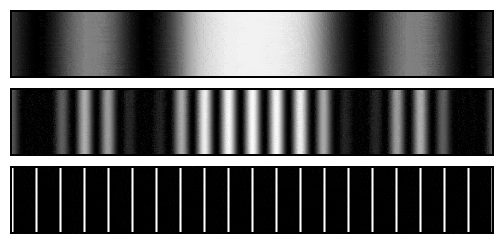
Here are simulations of some common diffraction and interference patterns for visible light:
 Near-field and far-field diffraction
For an opening of characteristic size a (the "source"), we distinguish between the near and far fields. For example, a could be the width of a single slit or the radius of a circular aperture.
At large distances from the source (the far field), the diffraction pattern grows linearly with distance but does not otherwise change shape appreciably. This is Fraunhofer diffraction. The pattern is essentially a function of angle, and the intensity diminishes as the inverse-square of distance from the opening. This happens for distances D where
At closer distances (the near field), the observed diffraction pattern may change shape and size at different distances from the source, but does not grow linearly with distance. This is Fresnel diffraction, and occurs for distances
Diffraction patterns are a function of the wavelength and geometry of the openings or obstructions, and do not depend on the speed of propagation of the wave. We may then order different types of waves by their wavelength, noting that larger wavelengths have more pronounced diffraction effects.
For diffraction to produce a 1 degree (far-field) spread in a beam -- a modest but clearly observable effect for visible light -- an aperture size of approximately 100 wavelengths is required. This is in contrast to a common misconception that the aperture size must be closer in size to the wavelength in order to observe diffraction.
Note that, due to the small wavelengths indicated above, observing diffraction for de Broglie wavelengths is difficult for microscopic objects and impossible (for all practical purposes) for macroscopic objects.
Latin derivation:
"diffraction" comes from the Latin frango frangere fregi fractum, meaning to break: this refers to the breaking of light into fractions, or different colours.
* This entry is from our old Library feature, and was originally created by Redbelly98.
Diffraction of a wave is the spreading or reflection or apparent bending when it encounters an aperture, obstruction, or opaque edge.
Diffraction by an evenly-spaced series of apertures (a diffraction grating) causes interference patterns and has the same bending or focussing effect as a lens or prism or mirror.
Bragg diffraction is reflection of X-rays from a crystal (a natural diffraction grating).
Equations
Extended explanation
In a physics curriculum, diffraction primarily arises when studying both optics and quantum mechanics.Common examples
Diffraction effects occur for all waves. Common examples studied are electromagnetic waves, sound waves, water waves, and (in quantum mechanics) matter waves or wavefunctions.
Water waves diffracting through a narrow aperature make for a good classroom demonstration, owing to the relatively slow wave velocity and large wavelengths involved.
For optical and other electromagnetic waves, common situations where diffraction effects arise or are studied are:
- The single slit
- The double slit
- The circular aperture
- Diffraction gratings
- Bragg diffraction (x-ray diffraction)
- Laser beams, including those with a Gaussian intensity profile.
Here are simulations of some common diffraction and interference patterns for visible light:
Top: diffraction pattern for a single slit
Middle: interference pattern for a double slit (the slit widths are identical to the slit width in the single slit pattern)
Bottom: diffraction grating pattern (the grating spacing is identical to the slit separation in the double slit pattern)
Middle: interference pattern for a double slit (the slit widths are identical to the slit width in the single slit pattern)
Bottom: diffraction grating pattern (the grating spacing is identical to the slit separation in the double slit pattern)
For an opening of characteristic size a (the "source"), we distinguish between the near and far fields. For example, a could be the width of a single slit or the radius of a circular aperture.
At large distances from the source (the far field), the diffraction pattern grows linearly with distance but does not otherwise change shape appreciably. This is Fraunhofer diffraction. The pattern is essentially a function of angle, and the intensity diminishes as the inverse-square of distance from the opening. This happens for distances D where
D » a2/λ
At closer distances (the near field), the observed diffraction pattern may change shape and size at different distances from the source, but does not grow linearly with distance. This is Fresnel diffraction, and occurs for distances
D < a2/λ
Wavelengths of different wave typesDiffraction patterns are a function of the wavelength and geometry of the openings or obstructions, and do not depend on the speed of propagation of the wave. We may then order different types of waves by their wavelength, noting that larger wavelengths have more pronounced diffraction effects.
Wavelength (m), wave type
300, AM radio (1 MHz)
17, Sound in air (20 Hz, low frequency)
3, FM radio (100 MHz)
0.77 , Sound in air (440 Hz, "Concert A" frequency)
0.017, Sound in air (20 kHz, high frequency)
4-7 × 10⁻⁷, Visible light
10-10-10-9, x-rays (10 keV - 1keV)
1 × 10⁻¹⁰, de Broglie wavelength of a 100V electron
3 × 10-11, de Broglie wavelength of air molecules (20 C)
2 × 10-35, de Broglie wavelength of a bowling ball (6 kg, 6 m/s)
300, AM radio (1 MHz)
17, Sound in air (20 Hz, low frequency)
3, FM radio (100 MHz)
0.77 , Sound in air (440 Hz, "Concert A" frequency)
0.017, Sound in air (20 kHz, high frequency)
4-7 × 10⁻⁷, Visible light
10-10-10-9, x-rays (10 keV - 1keV)
1 × 10⁻¹⁰, de Broglie wavelength of a 100V electron
3 × 10-11, de Broglie wavelength of air molecules (20 C)
2 × 10-35, de Broglie wavelength of a bowling ball (6 kg, 6 m/s)
For diffraction to produce a 1 degree (far-field) spread in a beam -- a modest but clearly observable effect for visible light -- an aperture size of approximately 100 wavelengths is required. This is in contrast to a common misconception that the aperture size must be closer in size to the wavelength in order to observe diffraction.
Note that, due to the small wavelengths indicated above, observing diffraction for de Broglie wavelengths is difficult for microscopic objects and impossible (for all practical purposes) for macroscopic objects.
Latin derivation:
"diffraction" comes from the Latin frango frangere fregi fractum, meaning to break: this refers to the breaking of light into fractions, or different colours.
* This entry is from our old Library feature, and was originally created by Redbelly98.
Last edited by a moderator: