Discharging a P-Channel MOSFET quickly

  • Thread starter Thread starter Dextrine
  • Start date Start date
  • Tags Tags
    Mosfet
Click For Summary

Discussion Overview

The discussion revolves around the use of P-Channel MOSFETs, specifically focusing on methods to quickly discharge the gate during turn-off. Participants explore various circuit configurations and components, including the use of NPN transistors and totem pole stages, while also touching on related concepts involving NPN transistors and their operational states.

Discussion Character

  • Technical explanation
  • Exploratory
  • Debate/contested

Main Points Raised

  • One participant seeks guidance on effectively discharging a P-Channel MOSFET during turn-off, expressing challenges with biasing an additional BJT.
  • Another participant suggests using a totem pole stage to provide a low resistance path for discharging the gate capacitance, referencing an application note for further details.
  • A participant warns about the risk of exceeding the maximum gate-to-source voltage, which could shorten the MOSFET's lifespan.
  • There is mention of successfully implementing an extra NPN transistor, but concerns arise regarding output inversion when using a totem pole configuration.
  • Participants share links to resources for analog circuit collections, noting the variability in reliability of the circuits found through searches.
  • A question is raised about a circuit that can invert a signal from a positive to a negative voltage, with a proposed solution involving a PNP transistor configuration.
  • Another participant inquires about the possibility of keeping an NPN transistor in the linear region without saturation, suggesting a specific circuit setup to test this condition.
  • There is a query about the relevance of the NPN transistor question to the MOSFET gate driver discussion, specifically regarding the use of an NPN in a linear state to drive the MOSFET gate.

Areas of Agreement / Disagreement

The discussion contains multiple viewpoints and unresolved questions, particularly regarding the use of NPN transistors in relation to P-Channel MOSFETs and the conditions under which they operate. No consensus is reached on the best approach for driving the MOSFET gate or the implications of using NPN transistors in various configurations.

Contextual Notes

Participants express uncertainty about terminology and circuit behavior, indicating a need for clarity in definitions and operational principles. The discussion also highlights the potential for circuit configurations to behave differently based on component selection and biasing conditions.

Dextrine
Messages
102
Reaction score
7
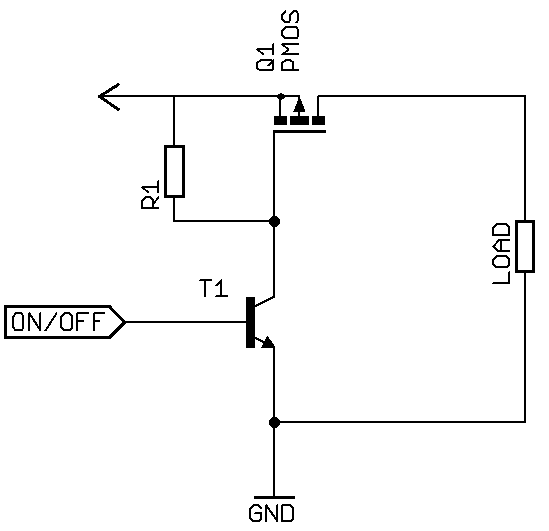
I am using trying to familiarize myself with P-Channel mosfets since I don't have too much experience with them. I am trying to use the FET as a switch, being driven in the typical highside FET manner using an NPN transistor.

Is there some standard way of quickly discharging the FET during turn off? I am trying to use maybe another BJT but can't seem to bias it correctly during turn off.

Pretty much just like this.
8PxZ6.png
thanks in advance for the help.
 
Engineering news on Phys.org
  • Like
Likes   Reactions: Dextrine
Thanks a lot Tom. I sometimes struggle finding information due to not knowing the terminology, I'll be sure to remember this though. Thanks again.
 
You are welcome. Have Fun!
Oh, and I almost forgot:
Be careful you don't exceed the maximum Gate-to-Source voltage in the ON condition. The circuit you show puts the full supply voltage on the Gate. Unless it is a really low supply voltage, that generally leads to a very short life of the FET.
 
  • Like
Likes   Reactions: Dextrine
I made it work with an extra NPN transistor. Apparently just adding the totem pole will invert the output. Thanks again though, is there some document that lists common circuits in analog and power along with their name?
 
About 7 780 000 hits: Just be aware that not all of the circuits actually work.
https://www.google.com/search?site=...rcuit+collection&oq=analog+circuit+collection

About 4 390 000 hits: Much more reliable results than the above search.
https://www.google.com/search?q=analog+circuit+design+design+note+collection

After you get tired of those, with the search field still showing the search string, click in the field again. You will receive more search suggestions.

(Should keep you busy for a little while, at least until your hair turns gray.)
 
Wow, thanks! This definitely will keep me busy for quite a while. I had been looking up "List of analog circuits" with much poorer results.
 
Tom.G said:
About 7 780 000 hits: Just be aware that not all of the circuits actually work.
https://www.google.com/search?site=...rcuit+collection&oq=analog+circuit+collection

About 4 390 000 hits: Much more reliable results than the above search.
https://www.google.com/search?q=analog+circuit+design+design+note+collection

After you get tired of those, with the search field still showing the search string, click in the field again. You will receive more search suggestions.

(Should keep you busy for a little while, at least until your hair turns gray.)
Quick question Tom, is there some circuit that can take a pulse that goes from, say 0 to +V and makes it go from. -V to V? to ? I'll be looking through the analog circuit indexes but thought you might know the name of such a circuit off hand.

Thanks in advance
 
PNP transistor
Emitter to +V
input to Base
Collector to resistor to -V

(Get the biasing right.)
(Note that it does invert the signal.)
 
  • #10
Tom.G said:
PNP transistor
Emitter to +V
input to Base
Collector to resistor to -V

(Get the biasing right.)
(Note that it does invert the signal.)
Thanks again for the input Tom. I had another question more from a theoretical vs. applied point of view:

Is it possible to have an NPN transistor be in the linear region, never saturated, if the emitter is connected to ground, the base to a resistor (which goes to your signal or something), and the collector to another resistor that goes to some high rail?

In other words, can the following circuit, in real life, ever NOT be saturated?

rokCu.gif
 
  • #11
Dextrine said:
...ever NOT be saturated?
Sure. Just restrict VB so the transistor is always operating in its linear range.
It's a simple enough circuit you can build it even without a breadboard. Use a potentiometer (pot) across VCC and take VB from the wiper. Measure the voltage on the Collector while you adjust the pot.
 
  • #12
IS this NPN Transistor question completely unrelated to the MOSFET gate driver situation? Is there a case when you would want to drive the MOSFET gate using the NPN transistor in linear?
 

Similar threads

  • · Replies 1 ·
Replies
1
Views
2K
Replies
39
Views
6K
  • · Replies 28 ·
Replies
28
Views
6K
  • · Replies 8 ·
Replies
8
Views
3K
  • · Replies 7 ·
Replies
7
Views
8K
  • · Replies 49 ·
2
Replies
49
Views
5K
  • · Replies 12 ·
Replies
12
Views
4K
Replies
8
Views
4K
  • · Replies 14 ·
Replies
14
Views
4K
Replies
7
Views
3K