Discussing the Convergence of a Series: Get My Opinion!

Join the discussion
Registration is free. Ask a follow-up in this thread, or start your own.
4 replies · 2K views
Amaelle
Messages
318
Reaction score
55
Homework Statement
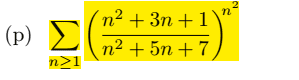
studying the convergence of a serie (look at the image)
Relevant Equations
geometric serie, convergence
Good day
I want to study the connvergence of this serie
1612182366542.png

I already have the solution but I want to discuss my approach and get your opinion about it
it s clear that n^2+5n+7>n^2+3n+1 so 0<(n^2+3n+1)/(n^2+5n+7)<1 so we can consider this as a geometric serie that converge?
many thanks in advance
 
Last edited by a moderator:
Physics news on Phys.org
You can't compare to a geometric series; you have a function of [itex]n[/itex] raised to a power which depends on [itex]n[/itex]. That is similar to [tex] \left(1 - \frac 1n\right)^{n} \to e^{-1} > 0.[/tex] For that reason [itex]\sum_{n=1}^\infty \left(1 - \frac1n\right)^n[/itex] does not converge.

I would write [tex] \frac{n^2 + 3n + 1}{n^2 + 5n +7} = 1 - \frac{2n + 6}{n^2 + 5n +7}[/tex] and take logs.
 
Amaelle said:
Homework Statement:: studying the convergence of a serie (look at the image)
Relevant Equations:: geometric serie, convergence

Good day
I want to study the connvergence of this serie

View attachment 277247
I already have the solution but I want to discuss my approach and get your opinion about it
it s clear that n^2+5n+7>n^2+3n+1 so 0<(n^2+3n+1)/(n^2+5n+7)<1 so we can consider this as a geometric serie that converge?
many thanks in advance
If you can establish the fact that ##\lim_{n \to \infty}\left( \frac{n^2 + 3n + 1}{n^2 + 5n + 7}\right)^{n^2} \ne 0##, then you can conclude that the series diverges. This limit has the indeterminate form ##[1^\infty]##, so the best way of determining the limit is by the use of logarithms, and getting it to a form in which L'Hopital's Rule can be applied.
 
pasmith said:
You can't compare to a geometric series; you have a function of [itex]n[/itex] raised to a power which depends on [itex]n[/itex]. That is similar to [tex] \left(1 - \frac 1n\right)^{n} \to e^{-1} > 0.[/tex] For that reason [itex]\sum_{n=1}^\infty \left(1 - \frac1n\right)^n[/itex] does not converge.

I would write [tex] \frac{n^2 + 3n + 1}{n^2 + 5n +7} = 1 - \frac{2n + 6}{n^2 + 5n +7}[/tex] and take logs.
thanks you so much!
 
Mark44 said:
If you can establish the fact that ##\lim_{n \to \infty}\left( \frac{n^2 + 3n + 1}{n^2 + 5n + 7}\right)^{n^2} \ne 0##, then you can conclude that the series diverges. This limit has the indeterminate form ##[1^\infty]##, so the best way of determining the limit is by the use of logarithms, and getting it to a form in which L'Hopital's Rule can be applied.
thanks so much!