159753x
- 17
- 0
Hi! This is simple mesh analysis. I wanted to try to solve the problem with nodal analysis.
1. Homework Statement
V = IR
We are supposed to use mesh analysis or node analysis.
[/B]
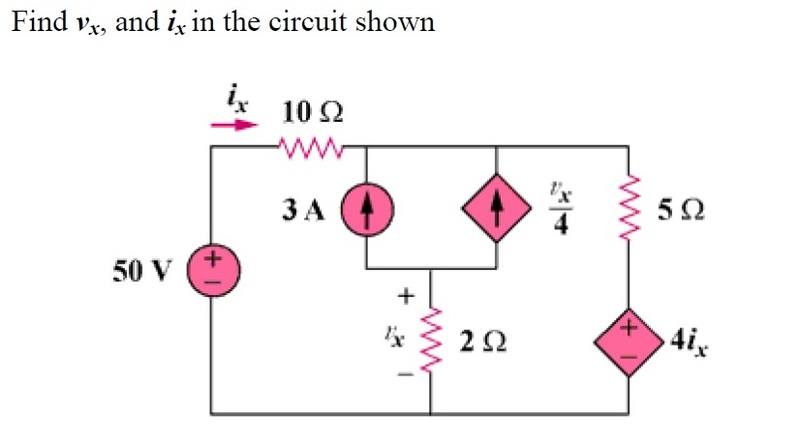
First step: the two current sources (independent and dependent) in the middle branch are in parallel. Therefore, they can be replaced with a single current source with current I = 3 + v(x)/4.
Second: according to Ohm's law, v(x) = I * 2. But since the 2-ohm resistor is in series with the current source I = 3 + v(x)/4, that is the current running through it.
Third: simply solving for v(x), I do the following -->
v(x) = I * 2
I = 3 + v(x)/4
v(x) = (3 + v(x)/4) * 2
v(x) = 6 + v(x)/2
v(x)/2 = 6
v(x) = 12
v(x) = -12 V because the current is going up the branch.
It seems correct to me. However, the answer in the solutions manual is -4V. They get this from mesh analysis.
Also, to get i(x), we would use node analysis with only one node (the top of the circuit). From there, we can easily solve for the voltage at the node and get i(x) from that.
I was a little hesitant to us mesh analysis because that would involve removing the resistor in the middle branch. I know you can remove the current sources if they are between branches, but if there is a resistor attached, can you still do it?
Can someone point out where I have made an error? Thanks!
1. Homework Statement
Homework Equations
V = IR
We are supposed to use mesh analysis or node analysis.
The Attempt at a Solution
[/B]
First step: the two current sources (independent and dependent) in the middle branch are in parallel. Therefore, they can be replaced with a single current source with current I = 3 + v(x)/4.
Second: according to Ohm's law, v(x) = I * 2. But since the 2-ohm resistor is in series with the current source I = 3 + v(x)/4, that is the current running through it.
Third: simply solving for v(x), I do the following -->
v(x) = I * 2
I = 3 + v(x)/4
v(x) = (3 + v(x)/4) * 2
v(x) = 6 + v(x)/2
v(x)/2 = 6
v(x) = 12
v(x) = -12 V because the current is going up the branch.
It seems correct to me. However, the answer in the solutions manual is -4V. They get this from mesh analysis.
Also, to get i(x), we would use node analysis with only one node (the top of the circuit). From there, we can easily solve for the voltage at the node and get i(x) from that.
I was a little hesitant to us mesh analysis because that would involve removing the resistor in the middle branch. I know you can remove the current sources if they are between branches, but if there is a resistor attached, can you still do it?
Can someone point out where I have made an error? Thanks!