Electric Flux through Cylindrical Surface

Click For Summary
SUMMARY

The discussion centers on calculating electric flux through a cylindrical surface surrounding an infinite line of charge with a charge density of λ1 = -5 μC/cm. Participants confirm the application of Gauss' Law, emphasizing the need to calculate the total enclosed charge and divide by the permittivity of free space (ε0). The importance of unit conversions is highlighted as a common source of error. A step-by-step approach to setting up the equations is requested and provided, leading to successful problem resolution.

PREREQUISITES
  • Understanding of Gauss' Law in electrostatics
  • Knowledge of electric flux concepts
  • Familiarity with charge density and its units
  • Basic skills in unit conversion and dimensional analysis
NEXT STEPS
  • Study the derivation and applications of Gauss' Law
  • Learn about electric flux calculations for different geometries
  • Explore unit conversion techniques in physics problems
  • Practice solving problems involving infinite line charges
USEFUL FOR

Students and educators in physics, particularly those focusing on electromagnetism and electrostatics, as well as anyone seeking to improve their problem-solving skills in electric field calculations.

dcco
Messages
2
Reaction score
0
An infinite line of charge with charge density λ1 = -5 μC/cm is aligned with the y-axis as shown.
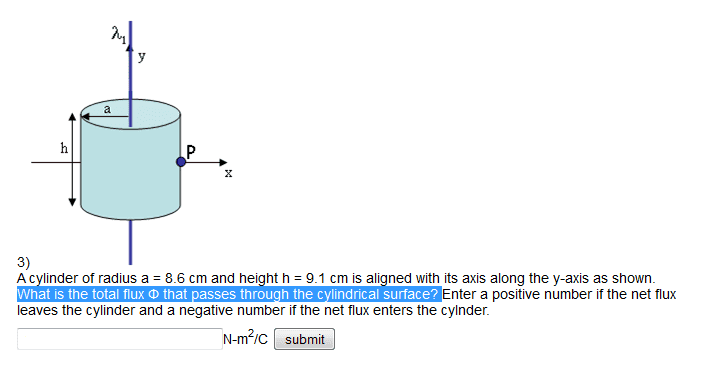
dsB0K.png


I am pretty sure you are supposed to use Gauss' Law so I tried just calculating the total enclosed charge and dividing it by epsilon naught, but it's not working. I think maybe I have to use the LHS in some way, but I really have no clue how.

If someone could give a step-by-step explanation as to how to set up the equations in a general way I would be very happy. I don't need exact numbers I just need to know how to solve this (because I have a lot of other problems that I need to solve as well and I can't seem to set any of them up properly).
 
Physics news on Phys.org
dcco said:
An infinite line of charge with charge density λ1 = -5 μC/cm is aligned with the y-axis as shown.

dsB0K.png


I am pretty sure you are supposed to use Gauss' Law so I tried just calculating the total enclosed charge and dividing it by epsilon naught, but it's not working. I think maybe I have to use the LHS in some way, but I really have no clue how.
Well, that's the correct way to solve the problem. You might just be messing up the unit conversions.
If someone could give a step-by-step explanation as to how to set up the equations in a general way I would be very happy. I don't need exact numbers I just need to know how to solve this (because I have a lot of other problems that I need to solve as well and I can't seem to set any of them up properly).
 
Oh I see, I messed up my calculations but now I fixed it and it worked this time. Thank you for your help!
 

Similar threads

  • · Replies 9 ·
Replies
9
Views
2K
  • · Replies 2 ·
Replies
2
Views
3K
  • · Replies 4 ·
Replies
4
Views
1K
  • · Replies 2 ·
Replies
2
Views
2K
  • · Replies 14 ·
Replies
14
Views
1K
Replies
9
Views
2K
  • · Replies 2 ·
Replies
2
Views
1K
  • · Replies 7 ·
Replies
7
Views
2K
Replies
26
Views
2K
  • · Replies 2 ·
Replies
2
Views
4K