Electromagnetic radiation pressure

Click For Summary
SUMMARY

The discussion centers on the concept of electromagnetic radiation pressure, specifically the formula for pressure produced by a reflected ray of light with intensity I and incident angle θ, expressed as 2Icos²(θ)/c. Participants clarify the change in momentum during reflection, leading to the formula 2Icos(θ)/c, and address confusion regarding the cosine factor. Additionally, the topic of polarization is explored, defining unpolarized light as having incoherent and random oscillation directions, despite the presence of a sinusoidal wave pattern.

PREREQUISITES
  • Understanding of electromagnetic radiation principles
  • Familiarity with momentum change calculations
  • Knowledge of light polarization concepts
  • Basic grasp of wave mechanics and sinusoidal functions
NEXT STEPS
  • Research the derivation of radiation pressure formulas in optics
  • Study the principles of light polarization and its effects on intensity
  • Learn about the differences between polarized and unpolarized light
  • Explore applications of electromagnetic radiation pressure in engineering
USEFUL FOR

Physicists, optical engineers, and students studying electromagnetism and wave mechanics will benefit from this discussion, particularly those interested in the nuances of radiation pressure and light polarization.

Small bugs
Messages
10
Reaction score
1
I am confused with the fact of radiation pressure on Wiki and my homework solution. They are both arguing that the pressure produced by a ray of light to be reflected with incident angle θ and intensity I is:
$$\frac{2I\cos^2(\theta)}{c}$$
My thinking
We know that:
$$Ft=\Delta p$$
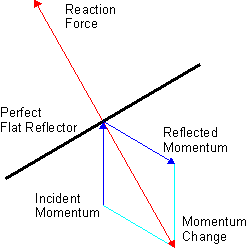
We see the situation where the ray is reflected:
Sail-Force1.gif

The change of momentum is
$$2\cos\theta\frac{h}{\lambda}$$
And also with other equalities then we get (also I got)
\frac{2I\cos(\theta)}{c}
Rather that cos2... Why?
The second question is about polarisation. Does polarisation direction mean the direction from the peak and perpendicular to the axis so it is just the direction of the E-or H-field?? What is unpolarized light? But as long as the sinusoid wave is spreading and oscillating, then it must have a direction of oscillation, so how can we say it is UNpolarized?
 
Physics news on Phys.org
In addition to the smaller momentum change, your intensity gets reduced by another cosine factor.
Small bugs said:
Does polarisation direction mean the direction from the peak and perpendicular to the axis so it is just the direction of the E-or H-field?
The E-field.
Small bugs said:
What is unpolarized light? But as long as the sinusoid wave is spreading and oscillating, then it must have a direction of oscillation, so how can we say it is UNpolarized?
The direction can change incoherently and randomly.
 

Similar threads

  • · Replies 1 ·
Replies
1
Views
2K
  • · Replies 9 ·
Replies
9
Views
2K
  • · Replies 6 ·
Replies
6
Views
3K
  • · Replies 3 ·
Replies
3
Views
2K
  • · Replies 9 ·
Replies
9
Views
3K
  • · Replies 3 ·
Replies
3
Views
1K
  • · Replies 17 ·
Replies
17
Views
23K
  • · Replies 3 ·
Replies
3
Views
2K
  • · Replies 3 ·
Replies
3
Views
5K
  • · Replies 1 ·
Replies
1
Views
2K