Ellipse from 2 arbitrary points, tangent at P1 and focus

Click For Summary

Homework Help Overview

The discussion revolves around determining the properties of an ellipse defined by two arbitrary points, with a focus on the semi-major axis and its orientation. The context includes elements related to planetary motion and the application of Kepler's laws.

Discussion Character

  • Exploratory, Assumption checking, Conceptual clarification

Approaches and Questions Raised

  • Participants explore the relationship between the two points and the properties of the ellipse, questioning the implications of known elements such as direction and velocity at one point. There is a discussion about the use of Kepler's laws and the challenges faced when one point is no longer on the surface of the planet.

Discussion Status

Some participants suggest that the problem is solvable with the given information and propose that at least two independent equations can be derived. There is ongoing exploration of the definitions and assumptions regarding the tangent at one of the points, with no explicit consensus reached yet.

Contextual Notes

Participants are working under the assumption that the planet is much more massive than the orbiting object, which simplifies the analysis. The discussion also highlights the need for clarity regarding the velocity and direction of the object at the specified point.

silkms
Messages
9
Reaction score
0
MENTOR Note: Moved this thread from a math forum hence no template

Is it possible to find this? Really only need the semi major axis or even it's orientation.

In the image below, elements in red are known.
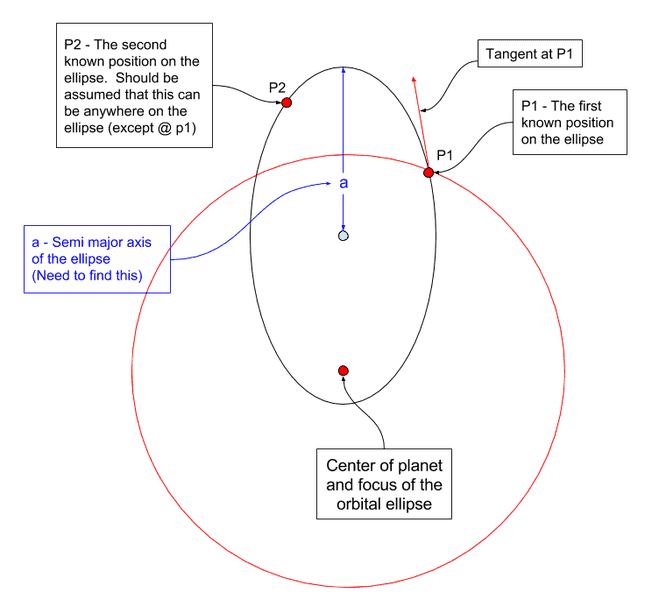
Orbital_Ellipse.png
 
Last edited by a moderator:
Physics news on Phys.org
Have you looked at Kepler's laws for planetary motion?
 
jedishrfu said:
Have you looked at Kepler's laws for planetary motion?

Yup. I am using them to find the velocity for a projectile at p1, when both p1 and p2 are on the surface of the planet, but unfortunately my technique for finding the true anomaly (the angle between p1 and the periapsis), breaks when one of the points leaves the surface and is no longer mirrored across the axis of the ellipse.

A technique for finding the true anomaly for a more general case would also allow me to solve this!

I expect that there is a solution to this using Kepler's laws, but I am struggling to get there and hoping someone here will have some insight.
 
Seems solvable. You only need two numbers to specify the ellipse, and it looks like with the information given, you should be able to come up with at least two independent equations. (I take it we can assume the planet is much more massive than the orbiting object and therefore remains at rest.)

When you say, "tangent at P1," do you mean you know the velocity of the object at P1 or just its direction?
 
vela said:
Seems solvable. You only need two numbers to specify the ellipse, and it looks like with the information given, you should be able to come up with at least two independent equations. (I take it we can assume the planet is much more massive than the orbiting object and therefore remains at rest.)

When you say, "tangent at P1," do you mean you know the velocity of the object at P1 or just its direction?

Just it's direction. Actually hoping to find it's velocity.
 

Similar threads

  • · Replies 11 ·
Replies
11
Views
3K
  • · Replies 2 ·
Replies
2
Views
3K
  • · Replies 6 ·
Replies
6
Views
3K
  • · Replies 1 ·
Replies
1
Views
5K
  • · Replies 27 ·
Replies
27
Views
6K
Replies
12
Views
2K
  • · Replies 4 ·
Replies
4
Views
2K
  • · Replies 8 ·
Replies
8
Views
4K
  • · Replies 4 ·
Replies
4
Views
3K
  • · Replies 1 ·
Replies
1
Views
7K