Discussion Overview
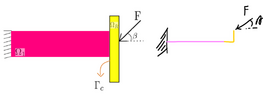
The discussion revolves around the equilibrium equations of an elastic body connected to a rigid body, focusing on the conditions necessary for equilibrium when a force is applied at an angle. Participants explore the implications of the setup in both 2D and 3D contexts, considering the complexities of continuous mechanics and numerical methods for solving the problem.
Discussion Character
- Exploratory
- Technical explanation
- Debate/contested
- Mathematical reasoning
Main Points Raised
- One participant describes the setup involving an elastic deformable body and a rigid body, asking for confirmation on the correctness of their equilibrium equations.
- Another participant suggests using beam equations for a simpler analysis, noting that the elastic body can be treated as a 1D body and emphasizing the importance of considering forces and torques at the joint where the two bodies meet.
- Some participants express uncertainty about the correctness of the balance equations mentioned, with one stating they do not think they are correct.
- There is a discussion about the feasibility of determining stress in the elastic body given only the force magnitude and angle, with some suggesting that knowing boundary conditions is crucial for numerical methods.
- Concerns are raised about the complexity of the problem, with one participant advising to focus on textbook problems before tackling more complex scenarios.
- Participants mention the use of numerical software (FEM) for solving the problem, highlighting the importance of correctly defining boundary conditions.
- One participant reflects on their feelings of confusion and inadequacy regarding the topic, suggesting that it may not be as standard as previously thought.
Areas of Agreement / Disagreement
Participants express varying levels of confidence in the correctness of the equilibrium equations, with some agreeing that the problem is complex and others questioning the validity of the proposed equations. There is no consensus on the best approach to solve the problem, with multiple competing views on the use of analytical versus numerical methods.
Contextual Notes
Participants note that the problem may become significantly more complicated if approached through General 3D Elasticity, and that analytical solutions may not be available. There are also references to specific software tools that could aid in solving the problem, indicating a reliance on numerical methods for practical applications.
Who May Find This Useful
This discussion may be useful for students and professionals interested in elasticity, structural analysis, and numerical methods in engineering, particularly those grappling with the complexities of equilibrium in elastic and rigid body interactions.