Evaluating indication of the wattmeter in three-phase system

  • Thread starter Thread starter pizzico85
  • Start date Start date
  • Tags Tags
    System Three-phase
Click For Summary

Discussion Overview

The discussion revolves around evaluating the indication of a wattmeter in a three-phase electrical system. Participants are exploring the calculations necessary to determine the wattmeter reading based on given parameters, including voltage, resistance, and reactive power. The conversation includes theoretical and practical aspects of electrical engineering, particularly focusing on power measurement in balanced and unbalanced loads.

Discussion Character

  • Exploratory
  • Technical explanation
  • Mathematical reasoning
  • Homework-related

Main Points Raised

  • One participant introduces the problem and requests assistance in understanding the process to evaluate the wattmeter reading.
  • Another participant notes the presence of five energy sinks, including three identical resistors and a fourth resistor with a specified power factor and reactive power, suggesting that the wattmeter measures power in R' and one phase of a balanced load.
  • A participant expresses confusion about calculating the voltage and current, indicating a need for step-by-step guidance.
  • One participant suggests that knowing the voltage allows for the calculation of line current entering the system.
  • A participant calculates the line current based on the reactive power and voltage, assuming a balanced load, and seeks confirmation of their approach.
  • Another participant advises that once the line current is known, the voltage across the resistors can be determined and suggests using a phasor diagram for further analysis.
  • Participants discuss the necessity of drawing a phasor diagram to visualize the problem and clarify the relationships between voltages and currents in the system.
  • Some participants express frustration about the lack of assistance and seek further clarification on drawing phasor diagrams.

Areas of Agreement / Disagreement

Participants generally agree on the need to calculate line current and the importance of using a phasor diagram, but there is no consensus on the correctness of the calculations or the next steps to take. Several participants express confusion and seek further clarification, indicating that the discussion remains unresolved.

Contextual Notes

Participants have not fully resolved the calculations for voltage and current, and there are assumptions about the balance of loads and the application of Kirchhoff's laws that remain unverified. The discussion reflects varying levels of understanding and uncertainty regarding the application of phasor diagrams.
pizzico85
Messages
6
Reaction score
0
Member warned about posting without the HW template
Hi all, I am new to this forum and I hope you can help me.

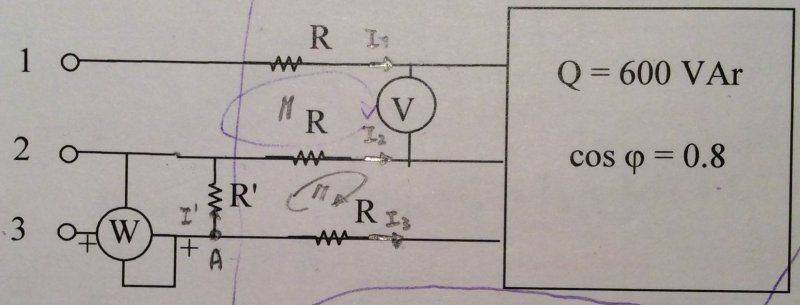
I have the following three-phase system where I have to evaluate the indication of the wattmeter W. Available data is: V = 380 V, R = 12 Ohm, R' = 120 Ohm.

IMG_0087.jpg


Can you make me understand the process for obtaining W?
 
Physics news on Phys.org
You have 5 energy sinks here. Three identical resistors, one in each phase---that's fortunate, it maintains balance! There's a fourth resistor, and a 0.8pf load of Q=600VAr .

It looks like the wattmeter measures the power in R', in addition to the power in one phase of a balanced load.

What are your thoughts?
 
My thoughts are that I don't know how to calculate V' or I'.

I am completely in trouble.

I would like to understand how to proceed step by step to solve the problem.
 
Last edited:
Since you know V, you should be able to calculate the line current going into that box on the right.
 
NascentOxygen said:
Since you know V, you should be able to calculate the line current going into that box on the right.

OK, the line current going into the box should be the following:

Since
Q = sqrt(3) * V * I * sin(phi)
cos(phi)
= 0,8 => phi = 36,87°

Then
I = Q / ( sqrt(3) * V * sin(phi) ) = 1,52

I = I1 = I2 = I3 because the load is balanced without considering R'.

Is it correct? If so, how should I proceed?
 
Once line current is known, you can determine the voltage across R. You'll need to start drawing a phasor diagram.
 
NascentOxygen said:
Once line current is known, you can determine the voltage across R. You'll need to start drawing a phasor diagram.
OK, maybe voltage across R should be the following:

Since
R = R1 = R2 = R3
I = I1 = I2 = I3


Then
Vr = V1 = V2 = V3 = R * I = 12 Ohm * 1,52 A = 18,24 V

Now I should be able to use Kirchhoff for tensions in the mesh where the voltmeter V is present, this way (V12 refers to the voltage of the three-phase system):

V12 - V1 - V + V2 = 0

Since V1 and V2 are equal:
V12 = V => V12 = 380 V
and since the three-phase system is symmetrical:
V12 = V23 = V31 = 380 V

Is it correct? If so, how should I proceed?
 
Time to start putting this on a phasor diagram, I think.
 
No too much help.
 
  • #10
pizzico85 said:
No too much help.
Are you able to draw a phasor diagram? Decide which phasor you will use as a reference, then draw others in relation to it. This is the type of problem where a phasor diagram is essential, IMO.

Can you explain in words how you will go about finishing this problem?

If you have not learned about phasor diagrams, I expect you will ask further questions.
 

Similar threads

  • · Replies 10 ·
Replies
10
Views
2K
Replies
23
Views
6K
  • · Replies 2 ·
Replies
2
Views
6K
  • · Replies 11 ·
Replies
11
Views
2K
Replies
3
Views
2K
Replies
3
Views
2K
Replies
3
Views
3K
  • · Replies 1 ·
Replies
1
Views
2K
  • · Replies 5 ·
Replies
5
Views
2K
  • · Replies 3 ·
Replies
3
Views
3K