Experimenting with Current Flow in Different Geometries
- Thread starter PhiowPhi
- Start date
-
- Tags
- Current Current flow Direction Flow
Join the discussion
Registration is free. Start your own thread to ask a follow-up.
44 replies · 7K views
Engineering news on Phys.org
PhiowPhi
- 203
- 8
Well, a lot of problems I've studied, I'm obligated to state the direction current... so bear with me here. The following diagrams are they correct in-terms of their direction?

And,
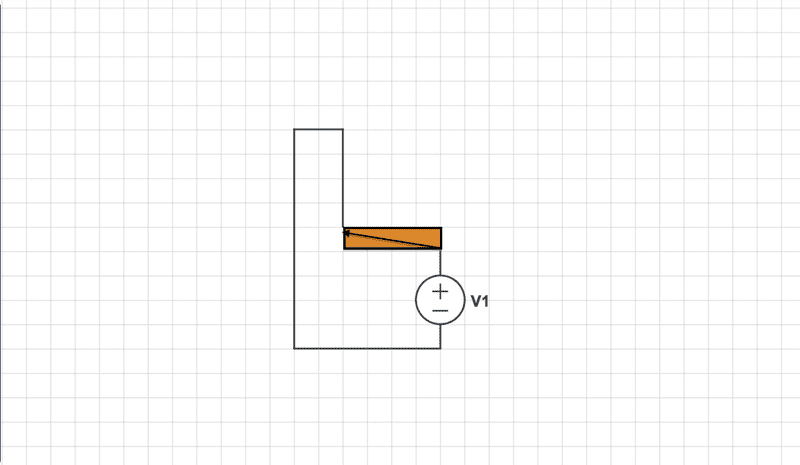
I wasn't sure If I'm right or wrong here...
And,
I wasn't sure If I'm right or wrong here...
Science Advisor
Homework Helper
Dearly Missed
- 9,864
- 4,896
just be aware current isn't constrained to straight lines
recall a conversation about equipotential lines with flow perpendicular..
a diagonal line from lower left to upper right corner will be at potential halfway between other two cornershttps://www.physicsforums.com/attachments/78006
recall a conversation about equipotential lines with flow perpendicular..
a diagonal line from lower left to upper right corner will be at potential halfway between other two cornershttps://www.physicsforums.com/attachments/78006
Attachments

Science Advisor
Homework Helper
- 30,613
- 7,551
I think this thread says more about the complexities and classes of Vectors, rather than the 'direction' of current which is highly relevant in so many instances. So, when an engineer meets current and it's going in a particular direction, he will treat it like a vector or his motor could go the wrong way or worse. When a Mathematician meets current, he sees a different beast and feels the need to find out what sort of 'Vector' it is. I'm sure that the vector nature of electric current must be very relevant in Electron Optics but I expect it would be treated as a bunch of charges moving around with a set of velocity vectors and that's how they will still be able to say it still ain't a proper vector.
- 24,488
- 15,064
I don't understand this statement. The quantities have a very clear meaning in classical electrodynamics, and I've explained them in my postings above. Perhaps engineers are used to different conventions, but the physics is pretty clear! I owe only one German book for electric engineers, which is K. Simonyi, Theoretische Elektrotechnik. There the only difference to the usual physics convention is that he uses j for the imaginary unit while physicists user i :-) and the other sign in the exponential of the Fourier transformations. All this doesn't change the physics used in science and engineering, of course!
Science Advisor
Homework Helper
- 30,613
- 7,551
My point was that you can usually treat I as a vector, when you are using wires. Ampere's Law works that way. If current in wires needs to be treated differently form current when it's flowing in 3D then that's fair enough. In that case, you, perhaps can't be as cavalier about what you are doing and need to talk in terms of Flux and Area vectors. The reason for the confusion seems obvious to me. It should be taken as a salutary lesson for us glib engineers, I guess.
I spent many years studying and designing antennae. That's a pretty well known topic but it's basically a bit of fudge, relying on the idea of Reciprocity etc,. But it does get antennae built and working as expected - near enough.
I spent many years studying and designing antennae. That's a pretty well known topic but it's basically a bit of fudge, relying on the idea of Reciprocity etc,. But it does get antennae built and working as expected - near enough.
Science Advisor
Homework Helper
Dearly Missed
- 9,864
- 4,896
sophiecentaur said:The reason for the confusion seems obvious to me. It should be taken as a salutary lesson for us glib engineers, I guess.
Long ago i said to Sophie: "I exist at a level appropriate to maintenance of electrical equipment."
vanhees71 said:Perhaps engineers are used to different conventions, but the physics is pretty clear!
Myself i think more in pictures than in equations, figuring out as i go why the equations work. I consider it a handicap but that's how i was wired.
Go back to that hyperphysics image in post # 26:
it's located at
http://hyperphysics.phy-astr.gsu.edu/hbase/electric/miccur.html#c1
Add a B field going into the page
The Lorentz force on any individual charge is Q vd cross B, down the page
and the total force on all the charges would be ρ X volume X (Q vd cross B), assuming uniform drift velocity
which would be ρ X length of wire X cross sectional area of wire X (Q vd cross B)
which would resolve to a force of magnitude B X length of wire X current in the wire
with direction same as (Q vd cross B), down the page.
hence the familiar formula for force on a wire
If we allow the wire to acquire a motion down the page,
the new(Q vdown cross B) pushes charges to right, opposing current,
and that's why a motor has counter EMF.
now, just where in the process of multiplication the product logically lost its vector property is not clear to me, for it still has magnitude and direction;;;;
but i can see that it arises from definitions ,
and i can accept that as a fine point of vector calculus of which i must remain aware.
I doubt i ever appreciated it before just now.
And i hold it open for further refinement.
Thanks, guys
old jim
Last edited:
PhiowPhi
- 203
- 8
jim hardy said:just be aware current isn't constrained to straight lines
recall a conversation about equipotential lines with flow perpendicular..
a diagonal line from lower left to upper right corner will be at potential halfway between other two cornershttps://www.physicsforums.com/attachments/78006
Well that is true and something I should consider. But when considering concepts like the Lorentz force(if placed in a magnetic field)in which it's important to know the direction of current, I believe the way I diagramed it would be proper. I am aware that current isn't constrained, but if required figure the direction of Lorentz force , when assuming the direction of current to be like the diagram, I think I have a good start.
Science Advisor
Gold Member
- 4,458
- 3,266
I can't resist the opportunity to post pictures for why current isn't a vector.jim hardy said:Myself i think more in pictures than in equations, figuring out as i go why the equations work. I consider it a handicap but that's how i was wired.

from http://physics.stackexchange.com/questions/90995/why-is-current-a-scalar-quantity
current from Kirchhoff's law:
current as a vector quantity:
- 24,488
- 15,064
The figure in #38 is nice, but one should really label everything clearly. The velocity-flow field ##\vec{v}_d(t,\vec{x})## is, of course a vector field. It gives the velocity of the conduction electrons relative to the wire at time ##t## located at ##\vec{x}##. The number density of these electrons is ##n(t,\vec{x})##, which is the number of electrons at time ##t## per unit volume around the position ##\vec{x}## within the wire.
The current density, ##\vec{j}(t,\vec{x})=-e n(t,\vec{x}) \vec{v}(t,\vec{x})##. Here ##-e## is the charge of one electron. Now consider an area element ##\mathrm{d}^2 \vec{f}##, where the vector points to one of two possible directions perpendicular to the surface element and has a magnitude given by the area of the area element. Which direction you choose is arbitrary, but you must keep this direction once and for all in your calculation. Then the charge per unit time that flows through the surface element is a SCALAR whose SIGN (NOT DIRECTION!) is given by the choice of the direction of the area surface elements along the area. If the wire punches through the area ##A##, then the total current is given by
$$I(t)=\int_{A} \mathrm{d}^2 \vec{f} \cdot \vec{j}(t,\vec{x}),$$
and again, it's a SCALAR. It has no direction!
The current density, ##\vec{j}(t,\vec{x})=-e n(t,\vec{x}) \vec{v}(t,\vec{x})##. Here ##-e## is the charge of one electron. Now consider an area element ##\mathrm{d}^2 \vec{f}##, where the vector points to one of two possible directions perpendicular to the surface element and has a magnitude given by the area of the area element. Which direction you choose is arbitrary, but you must keep this direction once and for all in your calculation. Then the charge per unit time that flows through the surface element is a SCALAR whose SIGN (NOT DIRECTION!) is given by the choice of the direction of the area surface elements along the area. If the wire punches through the area ##A##, then the total current is given by
$$I(t)=\int_{A} \mathrm{d}^2 \vec{f} \cdot \vec{j}(t,\vec{x}),$$
and again, it's a SCALAR. It has no direction!
PhiowPhi
- 203
- 8
I'd actually like to experiment this and see, get the piece of copper that I need, then place the terminals as I diagramed them and see what's going on, is there a simple non-expensive way of doing this?
Science Advisor
Homework Helper
Dearly Missed
- 9,864
- 4,896
vanhees71 said:Now consider an area element d2f⃗ \mathrm{d}^2 \vec{f}, where the vector points to one of two possible directions perpendicular to the surface element and has a magnitude given by the area of the area element.
Thanks vanhees - i was stymied by notation d2f, unsure what was the d2 .
Vector calculus was in 1967 and I'm rustier than the Tin Man .
Just an area of vector of magnitude incremental distance d squared , f denotes it has a direction ?
Now i can accept that integral .
And i do understand that a dot product gives a scalar, and that's "where in the process" it lost its vector property.
Thank you for your effort and patience .
@dlgoff thanks why didnt i think of that ?
thanks guys
Science Advisor
Homework Helper
Dearly Missed
- 9,864
- 4,896
PhiowPhi said:I'd actually like to experiment this and see, get the piece of copper that I need, then place the terminals as I diagramed them and see what's going on, is there a simple non-expensive way of doing this?
Copper sheet is a little hard to find.
An aluminum cookie sheet would work but you'll have to bolt your connections for it's hard to solder aluminum.
Kitchen aluminum foil glued to something flat might work. You'll want it as big as practical to maximize path length hence resistance.
Any good auto parts or industrial hardware store should have brass shim stock and you can solder to that , just clean it with steel wool and soap first. You'll want it thin, 0.010" or less (<¼mm) , 0.001" if they have it.It may be tricky to get enough voltage to measure
You'll need considerable current through it and you'll measure only millivolts across it.
A car battery charger is a safe source of several amps DC.
An old headlamp in series will allow ~ 3 amps, twice that if you use both high and low beam filaments.
Get creative - we don't know what you have on hand.
This might be an excuse to build yourself a millivoltmeter
http://www.next.gr/meter-counter/checker-circuits/dc-millivoltmeter-l14200.html
I hope you post photos of your setup, along with results.
Last edited:
Similar threads
- Mangoes
- · Replies 10 ·
- Mechanical Engineering
- Replies
- 10
- diegzumillo
- · Replies 12 ·
- Differential Geometry
- Replies
- 12
Undergrad
Triangles in different geometries
- GeometryIsHARD
- · Replies 1 ·
- Differential Geometry
- Replies
- 1
- seang
- · Replies 3 ·
- Electrical Engineering
- Replies
- 3
- Devang Marvania
- · Replies 2 ·
- Mechanical Engineering
- Replies
- 2
- Ryder S
- · Replies 1 ·
- Mechanics
- Replies
- 1
- Ryker
- · Replies 6 ·
- Introductory Physics Homework Help
- Replies
- 6
- thshen34
- · Replies 4 ·
- Mechanical Engineering
- Replies
- 4