Finding acceleration and displacement on a velocity vs time graph

Click For Summary

Homework Help Overview

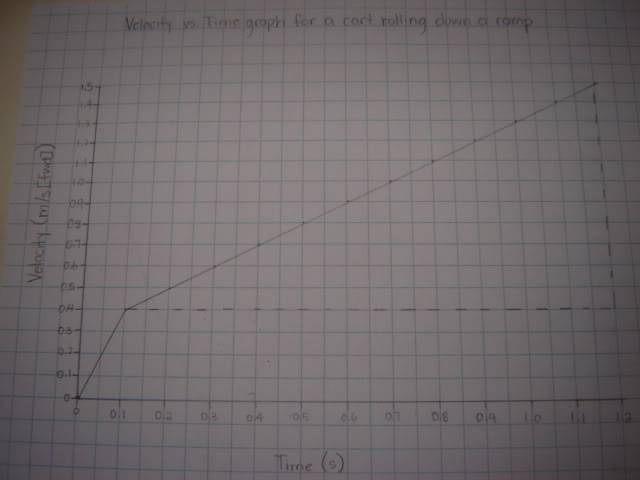
The discussion revolves around analyzing a velocity vs. time graph derived from a motion lab involving a cart rolling down a ramp. The original poster expresses confusion about calculating acceleration and displacement from the graph, particularly due to its non-linear nature.

Discussion Character

  • Exploratory, Conceptual clarification, Assumption checking

Approaches and Questions Raised

  • The original poster considers using the slope of a drawn line and the area under the graph to determine acceleration and displacement. Other participants suggest calculating multiple slopes and the total area under the graph. There is also discussion about the validity of different approaches to calculating acceleration based on the graph's characteristics.

Discussion Status

The conversation is ongoing, with participants exploring various methods for calculating acceleration and displacement. Some guidance has been offered regarding different approaches to presenting results, but no consensus has been reached on a single method or answer.

Contextual Notes

Participants note potential errors in the data collection process and the impact of timing on the graph's accuracy. There is uncertainty about the professor's expectations regarding the presentation of results.

xCanx
Messages
44
Reaction score
0
I have a problem, I did a motion lab in class and we had to observe a cart rolling down a ramp. We did it using the ticker tape. I calculated the average velocity and I got a graph like this.
DSC00905.jpg


It's not straight, so I'm confused on how to calculate the acceleration and displacement using this velocity vs. time graph.

If you see that dotted line a drew, I was planning to use that slope for the accel. and the area under neath for displacement. Would this work?

I know there are errors, but I can't change the data.
 
Physics news on Phys.org
Should I just calculate two different slopes and find the total area underneath the entire graph?
 
It seems like you know the physics, but you're unsure of what your professor wants, and that you're expecting a single answer for the acceleration, but you're confused because that's not quite what you got.

There are three things you could do:
  • Give the accelerations for both before and after t=0.1.
  • Give the average acceleration, which would be the change in velocity over the entire run divided by the change in time.
  • Give just one of the two, probably the second one, if you think this would be more scientifically valid for what you're trying to do, and present your reasons. Let's say, for example, that you're trying to figure out the acceleration due to gravity. In this experiment, we'll say someone puts the car up on the top of the ramp, and someone else starts a stopwatch. If someone started the stopwatch about 0.3 seconds late, and you just assumed the cart was at x=0 when the stopwatch was at t=0, that would throw into doubt the first part of the graph, but the rest of the graph would remain scientifically valid, in which case I'd present the second value. On the other hand, if the first part of the track were frictionless and someone had spilled honey on the rest of the track, then the first part would be most valid.

If you know what went wrong, go with answer #3. If you don't know what went wrong, I'd recommend you go with answer #1, which gives the most complete answer, unless your professor specifically wants a single number.
 
Thank you so much :) Ya, I do know the physics, but I wasn't sure if the way I was doing it would be right (I was going to use #1 intially).
 

Similar threads

  • · Replies 9 ·
Replies
9
Views
1K
  • · Replies 6 ·
Replies
6
Views
1K
  • · Replies 2 ·
Replies
2
Views
5K
Replies
6
Views
2K
  • · Replies 30 ·
2
Replies
30
Views
4K
  • · Replies 11 ·
Replies
11
Views
3K
  • · Replies 5 ·
Replies
5
Views
3K
Replies
25
Views
3K
  • · Replies 13 ·
Replies
13
Views
4K
  • · Replies 7 ·
Replies
7
Views
2K