Finding the Maximum Value of f(x)=x(1-x)^n in [0,1]: A Calculus Problem

  • Thread starter Thread starter help
  • Start date Start date
  • Tags Tags
    Differentiate
Click For Summary

Homework Help Overview

The discussion revolves around finding the maximum value of the function f(x)=x(1-x)^n, where n is a positive integer, within the interval [0,1]. Participants are exploring the implications of setting the derivative f'(x) to zero to identify critical points and potential maximum values.

Discussion Character

  • Exploratory, Conceptual clarification, Mathematical reasoning, Problem interpretation

Approaches and Questions Raised

  • Participants discuss solving the equation f'(x)=0 and question the correctness of their findings regarding critical points. There is uncertainty about whether the maximum occurs at x=1 or at other points within the interval.

Discussion Status

The conversation is ongoing, with some participants suggesting the use of the product rule for differentiation and emphasizing the need to consider both critical points and endpoints when determining the maximum value. There is no clear consensus yet on the correct approach or interpretation of the results.

Contextual Notes

Participants are operating under the constraints of homework guidelines, which may limit the types of assistance they can provide. There is also a mention of plotting the function for various values of n to gain insights into its behavior.

help
Messages
14
Reaction score
0
Homework Statement
help with my work
Relevant Equations
derivative and integral
Hello, good afternoon guys. I need a little help from you: D

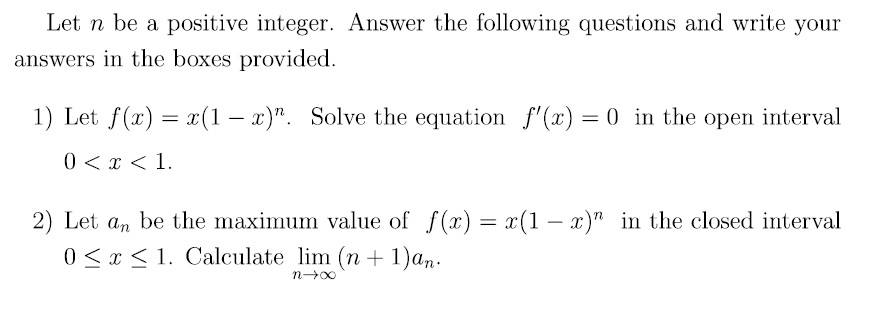
1)n a positive integer.
f(x)=x(1-x)^n
Solve the equation f'(x)=0 in 0<x<1

this question I asked and found x = 1 / (x + 1) ok

2)An be the maximum value of f(x)=x(1-x)^n in [0,1]
Calculate lim (n+1)an
n tending to infinity

the maximum value would not be making the derivative equal to zero? would it be x = 1? I did not understand
1.jpg
 
Last edited by a moderator:
Physics news on Phys.org
help said:
Homework Statement:: help with my work
Relevant Equations:: derivative and integral

Hello, good afternoon guys. I need a little help from you: D

1)n a positive integer.
f(x)=x(1-x)^n
Solve the equation f'(x)=0 in 0<x<1

this question I asked and found x = 1 / (x + 1) ok

2)An be the maximum value of f(x)=x(1-x)^n in [0,1]
Calculate lim (n+1)an
n tending to infinity

the maximum value would not be making the derivative equal to zero? would it be x = 1? I did not understand View attachment 264068
You did not do the first part correctly.

What is the derivative f'(x)?
 
  • Like
Likes   Reactions: Delta2 and member 587159
Help, you could use the product rule, then set it equal to zero.
 
help said:
Homework Statement:: help with my work
Relevant Equations:: derivative and integral

the maximum value would not be making the derivative equal to zero? would it be x = 1? I did not understand
The maximum value might be attained at a critical point or at the endpoints of the closed interval.

Try plotting the function for a few values of ##n## to get an idea of what you should get.
 

Similar threads

  • · Replies 3 ·
Replies
3
Views
1K
  • · Replies 6 ·
Replies
6
Views
2K
  • · Replies 4 ·
Replies
4
Views
2K
  • · Replies 1 ·
Replies
1
Views
2K
Replies
7
Views
2K
  • · Replies 7 ·
Replies
7
Views
2K
  • · Replies 6 ·
Replies
6
Views
2K
  • · Replies 6 ·
Replies
6
Views
2K
  • · Replies 2 ·
Replies
2
Views
2K
Replies
1
Views
2K