Fluctuating XRD Sapphire Intensity

  • Context: Graduate 
  • Thread starter Thread starter maxxlr8
  • Start date Start date
  • Tags Tags
    Intensity Xrd
Click For Summary
SUMMARY

The discussion centers on the fluctuating intensity of sapphire peaks during XRD phase analysis, attributed to the orientation of the sapphire substrate relative to the phi axis. The user performed a symmetric scan at a 2-theta angle of ~68.3 degrees and noted significant intensity variations at specific phi ranges. The conversation highlights the importance of precise alignment in azimuth scans and introduces the UB matrix, which is crucial for understanding crystal orientation and diffraction patterns. The UB matrix is defined as the product of two matrices, U and B, essential for transforming HKL coordinates into reciprocal space.

PREREQUISITES
  • X-ray Diffraction (XRD) principles
  • Understanding of azimuth scans in crystallography
  • Knowledge of the UB matrix and its components (U and B)
  • Familiarity with sapphire and its diffraction characteristics
NEXT STEPS
  • Study the UB matrix and its application in X-ray diffraction analysis
  • Learn about azimuth scans and their impact on diffraction intensity
  • Research methods for aligning sapphire substrates in XRD experiments
  • Examine the original article by Busing and Levy on angle calculations for X-ray diffractometers
USEFUL FOR

Researchers, crystallographers, and materials scientists involved in X-ray diffraction studies, particularly those working with sapphire substrates and seeking to optimize peak intensity in phase analysis.

maxxlr8
Messages
12
Reaction score
0
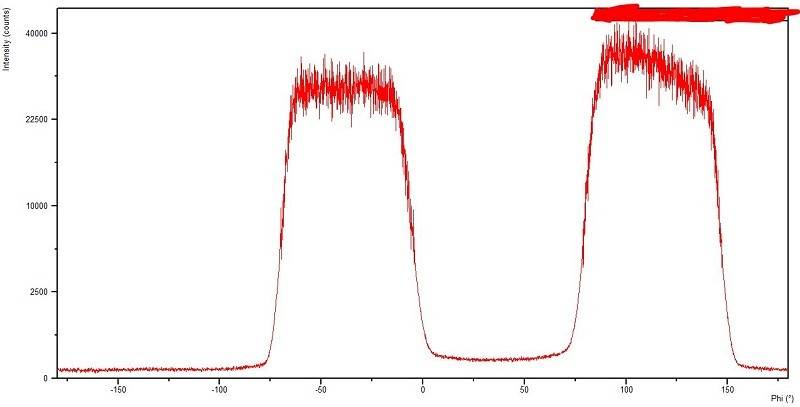
A few months back my colleagues and I are facing a problem where the intensity of our sapphire peak fluctuates every time an XRD phase analysis was done, even when the scan was done on the same sample.

By accident, I found that the orientation of the sapphire substrate with respect to phi axis somehow plays a part in the situation.

So, I decided to do a scan following the procedure below:
  1. Moved the 2-theta to the diffraction angle of (30-30) plane of my sapphire substrate, which is ~68.3 degrees
  2. As this is a symmetric scan, omega has been rotated to ~34.2 degrees
  3. Shutter was opened, and the phi axis has been rotated 360 degrees

Below is the result:
asdf.JPG


It can be seen that although 2-theta has been placed at the diffraction angle of the sapphire substrate, diffraction only occurs at two main regions in phi, which are approximately:
  1. -63 to -12 degrees
  2. 85 to 140 degrees

For now, only samples with sapphire substrates have this kind of problem. It is not known if other samples involving silicon or GaAs substrates have the same issue.

Can anyone help explain the theory behind this observation?

Thank you
 
Physics news on Phys.org
Sapphire peaks are very sharp, so even a slight misalignment will kill your intensity. It looks as if you tried to perform an azimuth scan, i.e. rotate the crystal about the Bragg planes while keeping the Bragg peak aligned. This will work only if the reciprocal lattice vector is aligned *exactly* along the phi axis of rotation. In practice that is a bit difficult to achieve. If there is some misalignment, then phi couples to the Bragg angle and you combine a rocking curve scan and an azimuth scan. If you carefully examine your UB matrix you can probably determine the angle of misalignment.

You might try to step phi in, say, steps of 5 degrees and perform a rocking curve scan at each value of phi. The integrated intensity of the rocking curve scans should not very - at least not strongly.
 
M Quack said:
Sapphire peaks are very sharp, so even a slight misalignment will kill your intensity. It looks as if you tried to perform an azimuth scan, i.e. rotate the crystal about the Bragg planes while keeping the Bragg peak aligned. This will work only if the reciprocal lattice vector is aligned *exactly* along the phi axis of rotation. In practice that is a bit difficult to achieve. If there is some misalignment, then phi couples to the Bragg angle and you combine a rocking curve scan and an azimuth scan. If you carefully examine your UB matrix you can probably determine the angle of misalignment.

You might try to step phi in, say, steps of 5 degrees and perform a rocking curve scan at each value of phi. The integrated intensity of the rocking curve scans should not very - at least not strongly.

Million thanks for the reply and explanation.
  1. I did not realize that this is an azimuth scan.
  2. Since this result, we have always align the phi axis to the angle with the best intensity before performing phase analysis scans.
  3. I am sorry, M Quack, but can you explain the term UB matrix? Thank you.
 
The UB matrix is actually the product of two matrices, U and B.

B performs the transformation from HKL coordinates to an orthonormal coordinate system of reciprocal space with the c-axis along z. For cubic crystals B is just (2pi/a, 0,0; 0, 2pi/a, 0; 0,0,2pi/a). For hexagonal it is not diagonal because the angle between the a* and b* axes is not 90 deg, and so on. It depends only on the lattice parameters a,b,c and lattice angles alpha, beta, gamma.

U is a rotation matrix that describes how the crystal is oriented relative to the innermost rotation axis of your diffractometer. If your sample is mounted on a goniometer head on the phi axis, then tweaking the goniometer head tilts will modify the matrix U.

This is described in most books about x-ray diffraction, but I highly recommend reading the original article by Busing and Levy:

Acta Cryst. (1967). 22, 457-464 [ doi:10.1107/S0365110X67000970 ]
Angle calculations for 3- and 4-circle X-ray and neutron diffractometers
W. R. Busing and H. A. Levy

http://scripts.iucr.org/cgi-bin/paper?a05492
 
M Quack said:
The UB matrix is actually the product of two matrices, U and B.

B performs the transformation from HKL coordinates to an orthonormal coordinate system of reciprocal space with the c-axis along z. For cubic crystals B is just (2pi/a, 0,0; 0, 2pi/a, 0; 0,0,2pi/a). For hexagonal it is not diagonal because the angle between the a* and b* axes is not 90 deg, and so on. It depends only on the lattice parameters a,b,c and lattice angles alpha, beta, gamma.

U is a rotation matrix that describes how the crystal is oriented relative to the innermost rotation axis of your diffractometer. If your sample is mounted on a goniometer head on the phi axis, then tweaking the goniometer head tilts will modify the matrix U.

This is described in most books about x-ray diffraction, but I highly recommend reading the original article by Busing and Levy:

Acta Cryst. (1967). 22, 457-464 [ doi:10.1107/S0365110X67000970 ]
Angle calculations for 3- and 4-circle X-ray and neutron diffractometers
W. R. Busing and H. A. Levy

http://scripts.iucr.org/cgi-bin/paper?a05492

Thank you for introducing the UB matrix. Somehow I am not aware of this.

The literature is very interesting, although I may have to digest the contents slowly.
 

Similar threads

  • · Replies 2 ·
Replies
2
Views
14K
Replies
4
Views
8K
  • · Replies 2 ·
Replies
2
Views
2K
  • · Replies 20 ·
Replies
20
Views
3K
  • · Replies 1 ·
Replies
1
Views
2K
  • · Replies 8 ·
Replies
8
Views
4K
  • · Replies 12 ·
Replies
12
Views
3K
  • · Replies 8 ·
Replies
8
Views
963
  • · Replies 5 ·
Replies
5
Views
2K
  • · Replies 2 ·
Replies
2
Views
2K