Fluid flow across a cylinder at an angle

Click For Summary

Discussion Overview

The discussion revolves around the fluid flow across a cylinder positioned at an angle to the vertical. Participants explore the forces and moments acting on the cylinder as a function of the angle and flow velocity, seeking relevant research and methodologies for determining drag and lift forces.

Discussion Character

  • Exploratory
  • Technical explanation
  • Debate/contested

Main Points Raised

  • One participant seeks assistance in finding research on drag and lift forces acting on a cylinder at an angle, expressing difficulty in locating relevant papers.
  • Another participant mentions that research has been conducted on similar geometries, particularly in the context of submerged pipelines and historical flight studies.
  • A suggestion is made to explore advanced hydrodynamics texts rather than basic fluid mechanics for more comprehensive insights.
  • It is noted that experimental data may be necessary to determine forces due to complexities like vortex shedding and boundary-layer transitions.
  • A reference to the "Falkner-Skan-Cooke boundary layer" is provided as a potential area of interest for boundary layer solutions over the geometry.
  • One participant proposes that the cylinder's diagonal orientation effectively shortens its length and alters its cross-section to an ellipse, suggesting a search for the drag coefficient of an ellipse.
  • Another participant counters this by stating that despite the elliptical appearance, the flow characteristics over a swept cylinder differ significantly due to three-dimensional flow effects.

Areas of Agreement / Disagreement

Participants express differing views on the applicability of elliptical drag coefficients to the problem, indicating a lack of consensus on this aspect. There is also no agreement on the best approach to finding the necessary research or analytical methods.

Contextual Notes

Participants highlight the complexity of the problem, including the influence of vortex shedding and boundary-layer transitions, which may complicate analytical approaches. The discussion also notes the potential need for access to subscription-based research materials.

Qwerty nm7
Messages
1
Reaction score
0
Hello,

I need some help with a problem in fluid mechanics. Consider a situation where a cylinder ( of a given radius and length) is kept at an angle theta to the vertical, and a fluid flows across this cylinder. I need to determine the forces and moments acting on this cylinder, for different values of the angle and the flow velocity. I wanted to know if any research has been done in this regard. I tried to find research papers, but couldn't find any paper that would help be get the values of the drag and lift forces as a function of the angle and the flow velocity. I'm not an expert at fluid mechanics, so I think I'm not searching at the right place or with the right keywords, and surely there must be some research done on this and subsequently papers which could give me the value of these forces. As of now, even if I don't get the moment values but only the variation of the drag and lift forces, even that will do.

Would be really glad if someone could help. Thanks :)
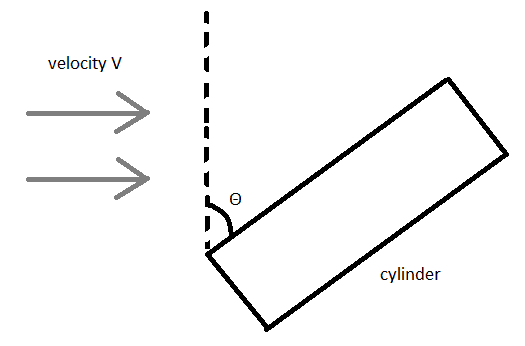
Untitled.png
 
Engineering news on Phys.org
Absolutely, research has been done on this question.

In particular, current flow across submerged pipelines and cables comes to mind directly.

I also recall that in the early days of flight, it was found that the wires which helped brace biplane wings together were found to create a relatively large amount of drag due to their circular cross section. Wires with more aerodynamic shape were developed which cut down on the amount of drag produced.

This type of flow is also studied because the passage of fluid around the cylinder can also set up vibratory forces, which can cause fatigue in the material of the cylinder.
 
Qwerty nm7 said:
I wanted to know if any research has been done in this regard. I tried to find research papers, but couldn't find any paper that would help be get the values of the drag and lift forces as a function of the angle and the flow velocity.

There has been a lot of research on this type of geometry. To find the forces, you will probably have to find someone who has done experiments on the geometry, as there won't be any good analytical way to determine that. There are a number of phenomena that will complicated finding such forces any way other than through experiments, including the effect of vortex shedding and the effect of boundary-layer transition on the surface.

Interestingly enough, though, there exists a similarity solution for the boundary layer over this geometry. If you are at all interested in that, the relevant term to search would be "Falkner-Skan-Cooke boundary layer". That may be a little outside your scope here, though.

Qwerty nm7 said:
I'm not an expert at fluid mechanics, so I think I'm not searching at the right place or with the right keywords, and surely there must be some research done on this and subsequently papers which could give me the value of these forces.

You might try searching Google scholar for things such as "swept cylinder" or "yawed cylinder" with whatever other keywords you want (e.g. "drag on a swept cylinder"). Those are the most common terms you will find in the literature for this geometry. The problem is that you will need a subscription for most things that will pop up since most of it will be behind a pay wall.
 
Being diagonal to the flow, the length of the cylinder will be effectively shortened.
The section of the cylinder will appear to the fluid as an ellipse.
google ' drag coefficient of ellipse '
 
Baluncore said:
Being diagonal to the flow, the length of the cylinder will be effectively shortened.
The section of the cylinder will appear to the fluid as an ellipse.
google ' drag coefficient of ellipse '

That's not a good idea. Despite the fact that the cross section would be an ellipse, the flow over the swept cylinder would not be all that similar to an ellipse due to the fact that the pressure gradient creates a three-dimensional flow. It's pretty substantially different.
 

Similar threads

Replies
0
Views
2K
  • · Replies 4 ·
Replies
4
Views
2K
Replies
9
Views
3K
  • · Replies 21 ·
Replies
21
Views
2K
  • · Replies 45 ·
2
Replies
45
Views
7K
  • · Replies 3 ·
Replies
3
Views
2K
Replies
5
Views
4K
Replies
2
Views
3K
Replies
7
Views
4K
  • · Replies 11 ·
Replies
11
Views
4K