Fluid Mechanics: Incompressible flow and pressure

Click For Summary
SUMMARY

The discussion centers on the assumptions surrounding incompressible fluid flow and the relationship between pressure and density as described by the equation p = c_s^2ρ. Participants clarify that while many liquids can be approximated as incompressible due to negligible density variations, this assumption complicates the interpretation of pressure changes in Bernoulli's equation. The speed of sound, c_s, is critical in understanding these dynamics, and the equation p = c_s^2ρ is deemed incorrect without considering integration constants. The conversation emphasizes the importance of recognizing the limitations of mathematical models in fluid mechanics.

PREREQUISITES
  • Understanding of Bernoulli's equation and its implications in fluid dynamics
  • Familiarity with the concept of compressibility in fluids
  • Knowledge of the speed of sound in fluids and its relation to pressure and density
  • Basic principles of fluid mechanics as outlined in Frank White's "Fluid Mechanics"
NEXT STEPS
  • Study the derivation and applications of Bernoulli's equation in various fluid flow scenarios
  • Explore the implications of compressibility in fluid dynamics, particularly in high-speed flows
  • Investigate the role of integration constants in fluid mechanics equations
  • Review advanced fluid mechanics texts for deeper insights into pressure-density relationships
USEFUL FOR

Students and professionals in fluid mechanics, engineers working on fluid systems, and researchers analyzing fluid behavior in various applications will benefit from this discussion.

Niles
Messages
1,834
Reaction score
0
Most liquids can be assumed to be incompressible, since the Mach-number is much smaller than 1. That means that the density variations are negligible and from the relation between pressure p and density ρ,
<br /> p=c_s^2 \rho<br />
we see that the pressure in constant as well. Now, say that I look at a pipe with the following geometry:
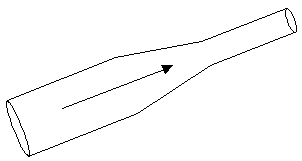
fig22.gif


From Bernoulli's equation we get that the pressure and velocity will be different between the large-radius part of the pipe and the small-radius part. How does this varying pressure conform with the constant pressure/density obtained from the equation of state?
 
Physics news on Phys.org
The relation ##p = c_s^2\rho## is only meaningful for compressible fluids. In an incompressible fluid (which doesn't exist, but it is a useful approximation), the speed of sound ##c_s## would be "infinitely fast".

If you rewrite your formula as ##c_s^2 = \frac {\partial p}{\partial \rho}##, you can't differentiate with respect to ##\rho## if ##\rho## is constant.
 
Last edited:
Liquids are not incompressible btw
 
My book (Frank White, Fluid Mechanics) says that most liquids can be assumed to be incompressible since their speed-of-sound is much larger than usual flow velocities. So I agree that the speed of sound can be assumed to be "infinite"/very large, but I believe my question is still valid
 
Niles said:
My book (Frank White, Fluid Mechanics) says that most liquids can be assumed to be incompressible since their speed-of-sound is much larger than usual flow velocities.

The important word in that quote is assumed. A better word would be approximated. If you try to make inconsistent approximations, you tie your self in knots. If you want to assume the density is constant, then you can't talk about the speed of sound.

So I agree that the speed of sound can be assumed to be "infinite"/very large, but I believe my question is still valid

Believe what you like, but remember Bertrand Russell's definition: "belief is that for which there is no evidence". It's not a useful concept for doing science.
 
AlephZero said:
The important word in that quote is assumed. A better word would be approximated.
Believe what you like, but remember Bertrand Russell's definition: "belief is that for which there is no evidence". It's not a useful concept for doing science.

I have seen several papers on arXiv that use that relation for incompressible flows.

Thanks for your input
 
Assuming the fluid is incompressible is often very useful, but you need to be careful what your quote actually means.

A longer version: If the flow velocity in a compressible fluid is much smaller than the speed of sound in the compressible fluid, then we can assume the fluid is incompressible.

Note that the above says nothing about "the speed of sound in an incompressible fluid" which is how you were wrongly interpreting it in your OP.
 
AlephZero said:
Assuming the fluid is incompressible is often very useful, but you need to be careful what your quote actually means.

A longer version: If the flow velocity in a compressible fluid is much smaller than the speed of sound in the compressible fluid, then we can assume the fluid is incompressible.

Note that the above says nothing about "the speed of sound in an incompressible fluid" which is how you were wrongly interpreting it in your OP.

I see, I was being not very accurate in my OP, I admit that. OK, so starting all over again:

We can approximate many fluids as being incompressible, i.e. their density ρ is constant throughout the fluid. For our fluid we have the relation p = cs2ρ, where cs is the speed of sound in the fluid. Knowing this constant relation between ρ and p, how should I interpret the pressure changes that occur in Bernoulli's equation?

Now that has to be a valid question.
 
It's not only pressure which is changing in the flow. The velocities will be different at different points in the flow if the pressures are different.

All the Bernoulli relation is saying is that under certain assumptions, the total energy in the flow is constant from point to point. If pressure drops, then velocity must increase to maintain constant energy in the flow stream.
 
  • Like
Likes   Reactions: 1 person
  • #10
SteamKing said:
It's not only pressure which is changing in the flow. The velocities will be different at different points in the flow if the pressures are different.

All the Bernoulli relation is saying is that under certain assumptions, the total energy in the flow is constant from point to point. If pressure drops, then velocity must increase to maintain constant energy in the flow stream.

Thanks. But in my book (Frank White, Fluid Mechanics page 231) he says that the pressure changes Δp are roughly related to density changes Δρ as Δp=Δρ*cs2, where cs2 is the speed of sound squared. Knowing that density changes are negligible, this means pressure changes should be negligible too.

But this contradicts the Bernoulli equation and your post, basically. Where is my reasoning wrong?
 
Last edited:
  • #11
The real fluid is compressible. Therefore it has a finite speed of sound.

A mathematical model that says the fluid is incompressible is approximate. If you have an approximate model, some of its predictions will be wrong.

The math of the incompressible model can not tell you the speed of sound in the fluid. Your attempt to get the speed of sound from the math is like asking "if ##y = 4x^2##, what is ##\frac{\partial y}{\partial 4}##"? If your model assumes that ##\rho## is a constant, then ##\frac{\partial p}{\partial\rho}## is meaningless.

The fact that a model is "wrong" doesn't make it useless. Every math model in every branch of physics is "wrong" to some extent. But you always have to remember that "the map is not the territory," and not try to use a model for things that it can't do.
 
  • Like
Likes   Reactions: 1 person
  • #12
I see a lot of nitpicking in this thread about whether or not liquids are truly incompressible (and thus whether the sound speed is infinite), and honestly, it's not really relevant in this case. I'm more curious where the equation P = cs2ρ came from. That equation is not generally true for any fluid, since it implies the pressure is purely a function of the sound speed and the density of the fluid, which is clearly incorrect. Obviously, for a completely incompressible fluid, cs is infinite, making the relation even more irrelevant, but that's not the real problem here. Where did you get that relation from?
 
  • #13
  • #14
That's not the same equation though - cs2 = dP/dρ is correct, but P = cs2ρ is not correct. Yes, you can integrate the former to get the latter, but you have to remember the integration constant as well (so P = cs2ρ + c is fine, but the + c means that the pressure can be pretty much anything, since that constant can be pretty much anything). As a result, the whole premise is incorrect - the pressure is not constant in an incompressible fluid.
 
  • #15
Also don't forget that's a partial derivative, so in general that integration constant is not actually a constant but an unknown function of other variables.
 
  • Like
Likes   Reactions: 1 person
  • #16
cjl said:
That's not the same equation though - cs2 = dP/dρ is correct, but P = cs2ρ is not correct.

I don't have White's book, but this could be just a matter of notation. For small amplitude waves in a fluid (for example in acoustics) you typically write ##P(x,y,z,t) = P_0(x,y,z) + p(x,y,z,t)## and similarly for the density. ##p## and ##\rho## are small changes from the steady state conditions. In that case, assuming the fluid is incompressible is the same as assuming ##\rho_0## is constant, and ##\rho = 0##.

I don't know how many times we need to repeat this till the OP "gets the point", but the derivation in http://www.sjsu.edu/faculty/watkins/sound.htm assumes that the fluid is compressible.
 
  • #17
AlephZero said:
I don't know how many times we need to repeat this till the OP "gets the point", but the derivation in http://www.sjsu.edu/faculty/watkins/sound.htm assumes that the fluid is compressible.

I do get the point now. If the fluid itself is not compressible, the derivation doesn't make sense.
 
  • #18
When you start learning physics in high school, it's easy to get the wrong idea that empirical "laws" like Hooke's law of elasticity or Coulomb's law of friction are in some sense "true". They are only approximately true, in some situations. But while you are learning how to use them to solve problems, that fact can disappear under the radar.

"Classical" Fluid mechanics (i.e. most models of fluid behavior which lead to equations that you actually solve using algebra and calculus) is rather different, in that almost all the models ignore things that are critical to the way fluids behave in the real world - such as compressibility and viscosity. Or they include those things as "fudges" that only work in particular situations, like boundary layer theory.

Getting insight into what simplified models work in what circumstances is a big part of the learning process in fluid mechanics (or at least it should be, IMO). The good news is, you just took one important step along that road!
 
  • Like
Likes   Reactions: 1 person
  • #19
Hi all

Please take a look at this paper, on the second page equation (5). There they state that p=c_s^2\rho.

I agree with everything said in this thread and that the above relation is clearly missing an integration shift, which depends on some other variable (e.g. spatial, such that Bernoulli's equation in not conflicted).

However, I wanted you to know that the relation is being used in various papers without this shift -- and that it seems there are some details we haven't touched upon here.
 
  • #20
Niles said:
Most liquids can be assumed to be incompressible, since the Mach-number is much smaller than 1. That means that the density variations are negligible and from the relation between pressure p and density ρ,
<br /> p=c_s^2 \rho<br />
we see that the pressure in constant as well. Now, say that I look at a pipe with the following geometry:
fig22.gif


From Bernoulli's equation we get that the pressure and velocity will be different between the large-radius part of the pipe and the small-radius part. How does this varying pressure conform with the constant pressure/density obtained from the equation of state?

Bernoulli's principal says that the SUM of all types of pressure is constant

bernoul.gif


when the speed grows, static pressure drops.
But the SUM of pressures is always the same.
 
Last edited:
  • #21
Yes, but p=c_s^2\rho is a local expression, it doesn't refer to a sum of pressures. That's what makes this strange
 
  • #22
Niles said:
Yes, but p=c_s^2\rho is a local expression, it doesn't refer to a sum of pressures. That's what makes this strange

Change in speed, depends on change in pressure/density ratio
The pressure is constant(it is not mentioned what kind of pressure because it is the total pressure)
so there is no change in speed, or pressure or density.

c = (dp / dρ)1/2 (1)

where

c = sound velocity (m/s, ft/s)

dp = change in pressure (Pa, psi)

dρ = change in density (kg/m3, lb/ft3)

http://www.engineeringtoolbox.com/speed-sound-d_82.html
 
  • #23
First, thanks for helping, I really appreciate having someone to talk to about this.


Malverin said:
Change in speed, depends on change in pressure/density ratio
The pressure is constant(it is not mentioned what kind of pressure because it is the total pressure)
so there is no change in speed, or pressure or density.

c = (dp / dρ)1/2 (1)

where

c = sound velocity (m/s, ft/s)

dp = change in pressure (Pa, psi)

dρ = change in density (kg/m3, lb/ft3)

http://www.engineeringtoolbox.com/speed-sound-d_82.html

The pressure p is the same that goes into the Navier-Stokes equations as a gradient, ∇p. This is in equation (24) of the paper I attached.

To my knowledge the pressure p in the Navier-Stokes equations does not refer to the total pressure.
 
  • #24
http://en.wikipedia.org/wiki/Navier%E2%80%93Stokes_equations
Niles said:
First, thanks for helping, I really appreciate having someone to talk to about this.


The pressure p is the same that goes into the Navier-Stokes equations as a gradient, ∇p. This is in equation (24) of the paper I attached.

To my knowledge the pressure p in the Navier-Stokes equations does not refer to the total pressure.

4fef570fa684173cbc6e70a904dd5e66.png


where v is the flow velocity, ρ is the fluid density, p is the pressure, T is the (deviatoric) component of the total stress tensor, which has the order two, and f represents body forces (per unit volume) acting on the fluid and ∇ is the del operator.

http://en.wikipedia.org/wiki/Navier%E2%80%93Stokes_equations

So why do you think it is not the total pressure?
 
  • #25
Malverin said:


The Bernoulli equation refers to the total pressure energy across the cross section @ a specific point on a streamline. We know that is constant.

In the Navier-Stokes equation the p only refers to the "local" pressure, i.e. the first term p in the Bernoulli equation. Otherwise, if it really did refer to the total pressure, we would never be able to have a nonzero gradient ∇p, since the total pressure is constant.
 
  • #26
Malverin said:
So why do you think it is not the total pressure?

Because he is right. The pressure in the N-S equations is static pressure.
 
  • #27
boneh3ad said:
Because he is right. The pressure in the N-S equations is static pressure.

So you agree with me, there really is an inconsistency somewhere, right?
 
  • #28
Niles said:
The Bernoulli equation refers to the total pressure energy across the cross section @ a specific point on a streamline. We know that is constant.

In the Navier-Stokes equation the p only refers to the "local" pressure, i.e. the first term p in the Bernoulli equation. Otherwise, if it really did refer to the total pressure, we would never be able to have a nonzero gradient ∇p, since the total pressure is constant.

Yes. You are right.
Here p is the static pressure
48c88ec1a44dce97a23ceff09ee668b2.png


The left side of the equation describes acceleration, and may be composed of time dependent or convective effects (also the effects of non-inertial coordinates if present). The right side of the equation is in effect a summation of body forces (such as gravity) and divergence of stress (pressure and shear stress).

But that does not explain why do you think that is the same pressure as here

84a5886681c0fb4eb2ed90ba427e579e.png
 
  • #29
Malverin said:
But that does not explain why do you think that is the same pressure as here

84a5886681c0fb4eb2ed90ba427e579e.png

I believe the p in the definition of the speed of sound is the same pressure the one in Bernoulli's law (first pressure term).
 
  • #30
Niles said:
I believe the p in the definition of the speed of sound is the same pressure the one in Bernoulli's law (first pressure term).

Underwater acoustic propagation depends on many factors. The direction of sound propagation is determined by the sound speed gradients in the water. In the sea the vertical gradients are generally much larger than the horizontal ones. Combining this with a tendency towards increasing sound speed at increasing depth, due to the increasing pressure in the deep sea

Hydrostatic pressure increases with depth.
Static pressure is atmospheric pressure at the water surface and dynamic pressure is zero if water does not move
So when you go deeper total pressure increases, but static(the first one) remains the same

bernoul.gif


http://en.wikipedia.org/wiki/Underwater_acoustics
 
Last edited:

Similar threads

  • · Replies 48 ·
2
Replies
48
Views
6K
  • · Replies 73 ·
3
Replies
73
Views
16K
  • · Replies 5 ·
Replies
5
Views
2K
  • · Replies 2 ·
Replies
2
Views
3K
  • · Replies 18 ·
Replies
18
Views
2K
  • · Replies 2 ·
Replies
2
Views
2K
  • · Replies 9 ·
Replies
9
Views
4K
Replies
0
Views
2K
  • · Replies 21 ·
Replies
21
Views
19K
  • · Replies 17 ·
Replies
17
Views
4K