Griffiths Introduction to Electrodynamics (Stokes Theorem Corollary)

Click For Summary

Homework Help Overview

The discussion revolves around the application of Stokes' Theorem as presented in Griffiths' Introduction to Electrodynamics, specifically addressing a question related to a line integral and its evaluation in the context of a closed rectangle shape.

Discussion Character

  • Conceptual clarification, Assumption checking

Approaches and Questions Raised

  • Participants explore the definition of closed surfaces versus shapes with boundaries, questioning the application of Stokes' Theorem in this context. There is a focus on the implications of integrating over a rectangle and the nature of boundaries in mathematical definitions.

Discussion Status

The conversation is ongoing, with participants providing insights into the definitions and implications of closed surfaces and boundaries. Some participants challenge the assumptions made about the nature of the rectangle and its relevance to Stokes' Theorem.

Contextual Notes

There is a noted confusion regarding the dimensionality of objects and their boundaries, particularly in relation to the definitions used in physics and mathematics. The discussion reflects a mix of interpretations about the corollary's application in physical contexts.

cemtu
Messages
99
Reaction score
7
Homework Statement
Electrodynamics, Stokes Theorem
Relevant Equations
No Equations needed
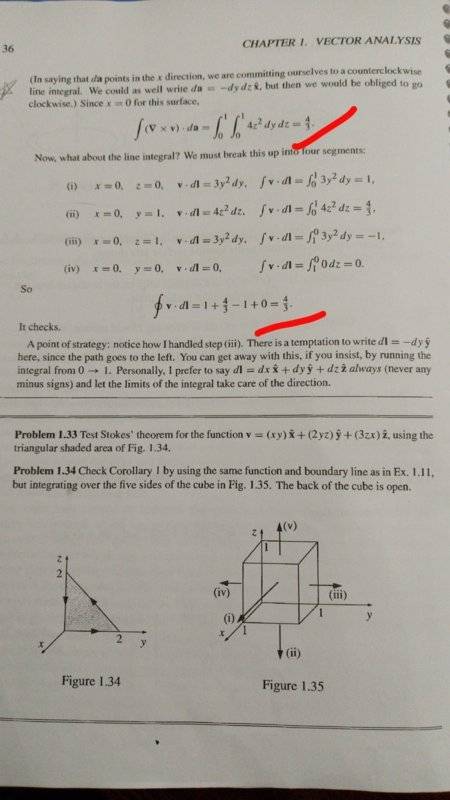
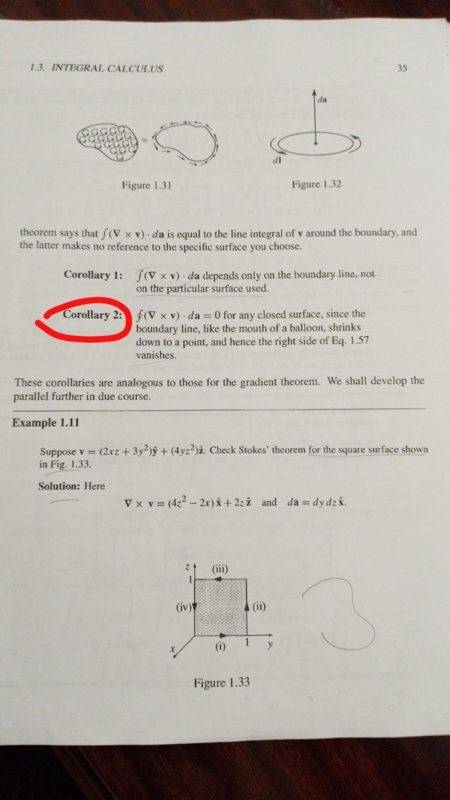
Although Stokes Theorem says that the line integral of a closed surface equals to zero why do we get a non-zero value out of this question 1.11 (and figure 1.33) in the Griffits Introduction to Eletrodynamics Book?
373a0125-a510-4a2e-a118-aed36bf5c00a.jpg
799c9e83-7cf2-45a4-91e9-4286748035b1.jpg
 
Physics news on Phys.org
It is not an integration over a closed surface.
 
Orodruin said:
It is not an integration over a closed surface.
It is an integration over a closed rectangle shape
 
cemtu said:
It is an integration over a closed rectangle shape
The rectangle is not a closed surface. The definition of a closed surface is that it has no boundary. The rectangle clearly has a boundary - the four straight lines that form its border.
 
Orodruin said:
The rectangle is not a closed surface. The definition of a closed surface is that it has no boundary. The rectangle clearly has a boundary - the four straight lines that form its border.
sir there is nothing without boundaries and borders, so how exactly this second corollary of stokes theorem has a proper use in physics?
 
cemtu said:
sir there is nothing without boundaries and borders, so how exactly this second corollary of stokes theorem has a proper use in physics?
This is wrong. For example, the two-dimensional sphere has no boundary curve.
 
Orodruin said:
This is wrong. For example, the two-dimensional sphere has no boundary curve.
sir, spheres are three-dimensional objects.
 
cemtu said:
sir, spheres are three-dimensional objects.
You are thinking of a ball or the fact that the sphere is embedded in three-dimensional space. The sphere is the two-dimensional boundary of a three-dimensional ball. The boundary of an n-dimensional object is (n-1)-dimensional. In order to know where you are on a sphere you need two coordinates (eg, longitude and latitude), this makes the sphere two-dimensional.
 

Similar threads

  • · Replies 1 ·
Replies
1
Views
1K
  • · Replies 7 ·
Replies
7
Views
2K
  • · Replies 17 ·
Replies
17
Views
9K
  • · Replies 11 ·
Replies
11
Views
3K
  • · Replies 30 ·
2
Replies
30
Views
4K
  • · Replies 2 ·
Replies
2
Views
8K
  • · Replies 3 ·
Replies
3
Views
945
  • · Replies 6 ·
Replies
6
Views
2K
  • · Replies 1 ·
Replies
1
Views
2K
  • · Replies 4 ·
Replies
4
Views
2K