Heat Exchanger Effectiveness and Outlet Temperature Question

Click For Summary
SUMMARY

The discussion focuses on calculating the effectiveness and outlet temperatures of a counterflow heat exchanger using the NTU method. Key equations mentioned include Q=mc*Cpc*(Tc2-Tc1), NTU=(UA*A)/(mc*Cpc), and LMTD=(Outlet temp - inlet temp)/(In(outlet temp/inlet temp)). The user seeks to determine the specific heats (Cpc for cold fluid and Cph for hot fluid) from a given mean specific heat value of 2.22 KJ/Kg K. The conversation emphasizes the importance of understanding the properties of fluids involved, specifically water and oil.

PREREQUISITES
  • Understanding of counterflow heat exchanger principles
  • Familiarity with the NTU method for heat exchanger analysis
  • Knowledge of specific heat capacity and its significance in thermal calculations
  • Ability to interpret and apply heat transfer equations
NEXT STEPS
  • Research the NTU method for heat exchanger effectiveness calculations
  • Learn how to obtain specific heat values from tables for various fluids
  • Study the concept of Log Mean Temperature Difference (LMTD) in heat exchangers
  • Explore the relationship between mass flow rates and heat transfer in fluid systems
USEFUL FOR

Engineers, thermal system designers, and students studying heat transfer who are looking to deepen their understanding of heat exchanger performance and calculations.

recreated
Messages
45
Reaction score
1
Dear All,

I am having trouble getting the effectiveness and outlet temperature for counter flow heat exchanger which is described in the attachment below.

I already have the answers but do not know what equations to use to get them. I have equations for the effectives and for the outlet temperatures, but there arn't enough variables from the question to put into them to get the correct answers.

Any advice on where to start would be great, thank you.
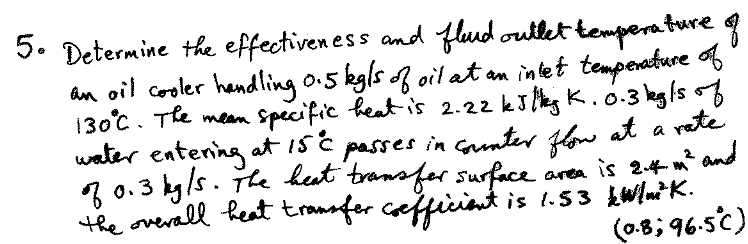
Q5 Heat Exchangers Tutorial.PNG


Answers to the question are shown on bottom right corner of attached picture. thanks for looking
 
Physics news on Phys.org
Well, would you mind sharing these equations?
 
Not at all.
When I said 'I have equations' i meant i have a hand out of derived equations which might not be useful in their current form but i will try my best to give the ones i think are 'meant' to be used.
I will give the ones I wrote down on my note pad in class when i was clearly lost as to what was going on in that class:

Q=mc*Cpc*(Tc2-Tc1);

LMTD= (Outlet temp - inlet temp)/ (In(outlet temp/inlet temp));

mh*Cph > mc*Cpc;

NTU= (UA*A)/(mc*Cpc);

E =
E.PNG
where:

mc = 0.3 kg/s (mass flow rate of cold fluid)
Cpc = specific heat of cold fluid?
Tc1= 15 degs C (Cold fluid inlet temp)
Tc2 = cold fluid outlet temp?

mh= 0.5 kg/s (mass flow rate hot fluid: oil)
Th1= 130 degs C (hot fluid inlet temp)
UA= 1.53 KW/ m^2 (overal heat transfer coefficient)
A= 2.4 m^2 (heat transfer surf. area)
Cp mean = 2.22 KJ/Kg KHope i haven't confused you more because i think i am.
(The handout was wrote by my teacher! The handout from the Heat Exchanger lecture is attached; Question 5 can be found on the last pg.)
 

Attachments

Last edited:
You know the inlet temps. of the oil and the cooling water, but you have to find the outlet temps. This can be done by trial-and-error, or by using the so-called NTU method, which I believe you are supposed to use.

The following describes the NTU method:

http://www-unix.ecs.umass.edu/~rlaurenc/Courses/che333/lectures/Heat%20Transfer/Lecture21.pdf

BTW

LMTD = log mean temp. diff. = (To - Ti) / [log (To/Ti)], where 'log' is the natural logarithm
 
Thank you very much. That has moved me a lot closer to solving.

I have all required variables to solve using NTU method except Cph and Cpc.

Is it possible to calculate this from the 'Cp mean' value of 2.22 KJ/Kg K?
 
If i can somehow get Cph and Cpc, I must be able to complete the other equations as these are the missing values.
 
Cph is going to be the spec. heat of the oil (Cph = spec. heat of the hot fluid)

Cpc is going to be the spec. heat of the cooling water (Cpc = spec.heat of the cold fluid)
 
Thank you but I don't have the values for Cpc and Cph.

I have a 'Cp mean' value.

Can I get the unknown values of Cpc and Cph by using the given 'Cp mean' value?
 
recreated said:
Thank you but I don't have the values for Cpc and Cph.

I have a 'Cp mean' value.

Can I get the unknown values of Cpc and Cph by using the given 'Cp mean' value?

Re-read Post #7 very carefully.

The mean Cp value for the oil is all you have for the 'hot' fluid.

You know that the 'cold' fluid is water. Don't you think the Cp of water can be obtained from a table of specific heats for various fluids?
 
  • #10
Thank you very much, I can solve the problem now.

I am still confused about terminology:
In the question it says to find 'fluid outlet T' (Tc2), and at first I obtained the oil outlet T (Th2), but realized that 'Fluid temperature' refers to the water T.
Is this just a convention in these questions? As oil is obviously a fluid as well.

Also, where it says 'mean specific heat of the fluid', how do I know it only refers to the Cp of the oil and not the water? Cph oppose to Cpc?
 
  • #11
Different oils can have different spec. heats. Water, on the other hand, is the most common fluid on earth. There are tables of the properties of water readily available. IMO, you are supposed to determine the outlet temps. of both the water and the oil, since both are unknown.
 
  • Like
Likes   Reactions: 1 person

Similar threads

Replies
22
Views
4K
Replies
10
Views
2K
  • · Replies 56 ·
2
Replies
56
Views
6K
Replies
12
Views
4K
Replies
14
Views
3K
  • · Replies 3 ·
Replies
3
Views
2K
Replies
5
Views
3K
  • · Replies 3 ·
Replies
3
Views
3K
Replies
9
Views
3K
Replies
1
Views
1K