Understanding Convection Heat Transfer in a Convection Heat Exchanger

Click For Summary

Discussion Overview

The discussion revolves around convection heat transfer in a convection heat exchanger, specifically addressing the temperature differences used in heat transfer equations and the assumptions related to transient heat transfer. Participants explore the relationship between the heat transfer coefficient, temperature differences, and the dynamics of fluid heating within the chamber.

Discussion Character

  • Technical explanation
  • Debate/contested
  • Mathematical reasoning

Main Points Raised

  • One participant questions the temperature difference used in the convection equation, suggesting it should be based on the average temperature inside the chamber rather than the inlet and outlet temperatures.
  • Another participant asserts that the overall heat transfer coefficient is denoted as h and relates to the temperature difference between the hot wall and the outlet temperature.
  • There is a discussion about the assumptions made regarding the well-mixed condition of the chamber and how it affects the average temperature.
  • Some participants express confusion over the derivation of equations related to transient heat transfer and the role of enthalpy in the energy balance.
  • Participants debate whether certain temperatures can be considered constants in the context of the problem, particularly the inlet temperature versus the outlet temperature, which changes over time.
  • Clarifications are made regarding the rate of change of internal energy in the chamber and the implications of using steady-state versus transient analysis.

Areas of Agreement / Disagreement

Participants exhibit disagreement regarding the appropriate temperature differences to use in the heat transfer equations and the assumptions about the system's behavior over time. The discussion remains unresolved, with multiple competing views on the correct approach to the problem.

Contextual Notes

Participants highlight limitations in their understanding of transient heat transfer and the assumptions regarding temperature constancy. There are unresolved mathematical steps related to the derivation of energy balance equations.

Joshua Pham
Messages
14
Reaction score
0
Homework posted in wrong forum, so no template
Hello guys, in the question attached, my understanding is that there is a heat transfer
339a7ea1123c7d027bb9a44be76b977d.png
that heats the fluid from an initial
475b78897f974bc7658f55655285a0ff.png
at the input, to
14e1fbd7b83da4c8661e1a3cd6eb846a.png
at the output. This heat transfer is via convection from walls of temperature
0432bd149aa64859b8197adf82771c1e.png
.
Firstly,
a5bb7f6d16f185bd4f72574231a6acf7.png
.

Because the walls are
0432bd149aa64859b8197adf82771c1e.png
and the fluid is of a lower temperature, this heat transfer is via convection from the walls. The correct answer says that

8cf623ee5c8aa7edfe5b03d954f888d2.png
. Why is this? Why not
115e5a6d452a38cf8cbadeb342525e80.png
? or
fc3a9454825054c0d380685d171d2f05.png
. The fluid next to the wall is heated and changes until it reaches
14e1fbd7b83da4c8661e1a3cd6eb846a.png
at the outlet, so how do we know which temperature to use in the convection equation where heat is being transferred from the walls to the fluid?
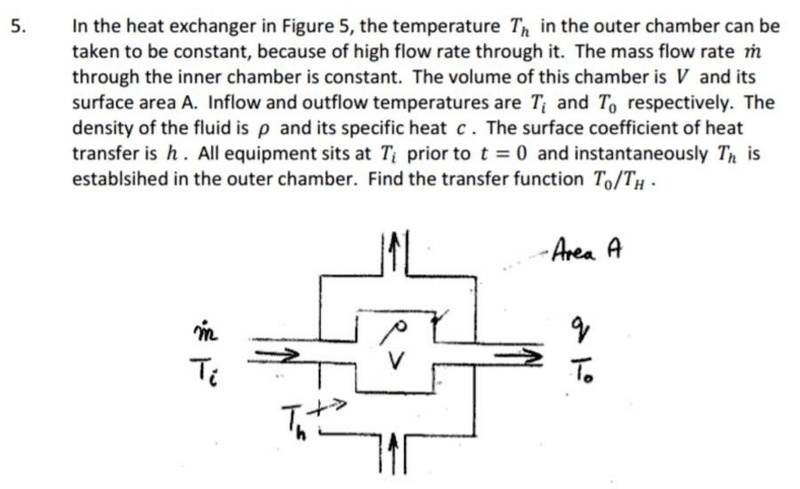
Capture.PNG
 
Physics news on Phys.org
They expect you to assume that the overall heat transfer coefficient is h.
 
  • Like
Likes   Reactions: Joshua Pham
Hello Chestermiller; really apologise I didn't fill out the homework template. What does the over heat transfer coefficient ##h_c## have anything to do with the temperature difference being ##T_h - T_o##? I would argue that the temperature difference used in ##q = h_c A \Delta T## should be ##T_h - T_{average\ inside}##?
 
Chestermiller said:
The heat flux is equal to the overall heat transfer coefficient times ##(T_h-T_0)## (i.e., the overall temperature difference).

I'm still not quite convinced. Why would ##T_h - T_0## be the overall temperature difference?? Would the "overall" temperature difference be the average temperature difference? Which is $$T_h - \frac{T_0 - T_i}{2}$$ ?
 
Oh. I see what you are getting at. It goes like this:
$$\rho V c\frac{dT_0}{dt}=\dot{m}c(T_i-T_o)+hA(T_h-T_0)$$
This assumes that the chamber is well-mixed so that the average temperature in the chamber ##T_0## is always equal to the outlet temperature. So this is a transient heat transfer problem, in which you are solving for the average/outlet temperature as a function of time. So, at any given time, ##T_0## is assumed to be the temperature thorughout the chamber.
 
  • Like
Likes   Reactions: BvU and Joshua Pham
Ah! Thanks so much!
 
Hey Chestermiller, could you provide more insight into how you derived that equation? Reading online I've only seen the expression $$Ah(T-T_{\infty}) = -\rho Vc \frac{dT}{dt}$$ after googling transient heat convection transfers.
 
Joshua Pham said:
Hey Chestermiller, could you provide more insight into how you derived that equation? Reading online I've only seen the expression $$Ah(T-T_{\infty}) = -\rho Vc \frac{dT}{dt}$$ after googling transient heat convection transfers.
This is the same as the equation I wrote, except for the term involving flow into and out of the chamber (which was not a feature of the problem in your reference).
 
Chestermiller said:
This is the same as the equation I wrote, except for the term involving flow into and out of the chamber (which was not a feature of the problem in your reference).

Thanks Chestermiller.
The way I derived your expression is,
$$\dot{Q_{in}} - \dot{Q_{out}} = \frac{d(mc(T_o - T_i))}{dt}$$
but there is no ##\dot{Q_{out}}## if you consider the inner chamber as the system and there is no heat loss to the surroundings. So,
$$\dot{Q_{in}} = \frac{d(mc(T_o - T_i))}{dt}$$
Next, this heat transfer rate can only come from convection of heat from the walls interfacing the inner and outer chambers which is given by,
$$ q = h_cA(T_h - T_o)$$
These must equal and thus,
$$ \frac{d(mc(T_o - T_i))}{dt} = h_c A(T_h - T_o)$$
Now to obtain your expression, you need to subject the left term to the product rule. But why?? Aren't ##T_i## and ##T_o## constants? When I did a thermodynamics course, that left term would just turn into, $$\dot{m}c(T_o - T_i)$$
 
  • #10
Joshua Pham said:
Thanks Chestermiller.
The way I derived your expression is,
$$\dot{Q_{in}} - \dot{Q_{out}} = \frac{d(mc(T_o - T_i))}{dt}$$
but there is no ##\dot{Q_{out}}## if you consider the inner chamber as the system and there is no heat loss to the surroundings. So,
$$\dot{Q_{in}} = \frac{d(mc(T_o - T_i))}{dt}$$
Next, this heat transfer rate can only come from convection of heat from the walls interfacing the inner and outer chambers which is given by,
$$ q = h_cA(T_h - T_o)$$
These must equal and thus,
$$ \frac{d(mc(T_o - T_i))}{dt} = h_c A(T_h - T_o)$$
Now to obtain your expression, you need to subject the left term to the product rule. But why?? Aren't ##T_i## and ##T_o## constants? When I did a thermodynamics course, that left term would just turn into, $$\dot{m}c(T_o - T_i)$$
You must have forgotten a lot from your thermo course. For the material in the tank, m and c are constants, as is ##T_i## (but not ##T_0##, of course, which is a function of time). You left out the terms for enthalpy flowing into and out of the tank.

Do you remember the open system (control volume) version of the 1st law of thermodynamics (that you must have learned in your thermodynamics course)? If so, please write it down for me.

Chet
 
  • #11
Chestermiller said:
You must have forgotten a lot from your thermo course. For the material in the tank, m and c are constants, as is ##T_i## (but not ##T_0##, of course, which is a function of time). You left out the terms for enthalpy flowing into and out of the tank.

Do you remember the open system (control volume) version of the 1st law of thermodynamics (that you must have learned in your thermodynamics course)? If so, please write it down for me.

Chet

$$\dot{Q} - \dot{W} = \sum_{out} \dot{m} (h+ke+pe) -\sum_{in} \dot{m} (h+ke+pe) $$
Hence,
$$\dot{Q} = \sum_{out} \dot{m} h -\sum_{in} \dot{m} h $$

So for convection,
$$hA_c(T_h - T_o) = \dot{m}(h_2-h_1) = \dot{m}c_p(T_o-T_i)$$?

Why would ##T_i## be a constant but not ##T_o##??
 
  • #12
Joshua Pham said:
$$\dot{Q} - \dot{W} = \sum_{out} \dot{m} (h+ke+pe) -\sum_{in} \dot{m} (h+ke+pe) $$
Hence,
$$\dot{Q} = \sum_{out} \dot{m} h -\sum_{in} \dot{m} h $$

So for convection,
$$hA_c(T_h - T_o) = \dot{m}(h_2-h_1) = \dot{m}c_p(T_o-T_i)$$?
This is the steady state version. You are dealing with a transient problem. So you have to include the rate of change of internal energy within the control volume (chamber).
 
  • #13
Chestermiller said:
This is the steady state version. You are dealing with a transient problem. So you have to include the rate of change of internal energy within the control volume (chamber).

Ah! Sorry

Here goes,
$$\dot{Q} + \dot{m}(h_1 - h_2) = \dot{m}(u_2 - u_1)$$

Heat is from convection so,
$$hA_c(T_h-T_o) = \dot{m}(c_p + c_v)(T_o-T_i)$$

Is that correct?
Why would ##T_i## be a constant but not ##T_o##?
 
  • #14
Joshua Pham said:
Ah! Sorry

Here goes,
$$\dot{Q} + \dot{m}(h_1 - h_2) = \dot{m}(u_2 - u_1)$$

Heat is from convection so,
$$hA_c(T_h-T_o) = \dot{m}(c_p + c_v)(T_o-T_i)$$

Is that correct?
No. The rate of change in internal energy for the chamber is incorrect. It is $$\rho V\frac{du}{dt}=\rho Vc\frac{dT_0}{dt}$$
Also note that, for an incompressible liquid, the heat capacities at constant volume and pressure are the same, and are equal to the parameter c in your problem statement.
Why would ##T_i## be a constant but not ##T_o##?
##T_i## is the initial temperature, and also the temperature of the inlet stream to the chamber which, according to the problem statement is constant. ##T_0## is the temperature of the liquid inside of the chamber, and also the temperature of the liquid coming out of the chamber. The liquid is being heated, so its temperature is getting higher.
 
  • Like
Likes   Reactions: Joshua Pham
  • #15
Chestermiller said:
No. The rate of change in internal energy for the chamber is incorrect. It is $$\rho V\frac{du}{dt}=\rho Vc\frac{dT_0}{dt}$$
Also note that, for an incompressible liquid, the heat capacities at constant volume and pressure are the same, and are equal to the parameter c in your problem statement.

##T_i## is the initial temperature, and also the temperature of the inlet stream to the chamber which, according to the problem statement is constant. ##T_0## is the temperature of the liquid inside of the chamber, and also the temperature of the liquid coming out of the chamber. The liquid is being heated, so its temperature is getting higher.
Thank you for that! I understand it much better now! In my thermo course, I think we just used steam tables for pure substances and the ideal gas equation for air. So I'd never dealt with a situation where the temperature was a function of time. I'm doing a second course later this year which will cover that. This is from a linear systems course.
 

Similar threads

  • · Replies 1 ·
Replies
1
Views
4K
Replies
22
Views
4K
  • · Replies 1 ·
Replies
1
Views
2K
  • · Replies 13 ·
Replies
13
Views
3K
  • · Replies 6 ·
Replies
6
Views
3K
  • · Replies 4 ·
Replies
4
Views
3K
Replies
7
Views
2K
  • · Replies 1 ·
Replies
1
Views
2K
  • · Replies 1 ·
Replies
1
Views
4K
  • · Replies 3 ·
Replies
3
Views
3K