Help finding instantaneous velocity graphically

Click For Summary

Homework Help Overview

The discussion revolves around finding the instantaneous velocity of a particle moving along the x-axis using a position versus time graph. Participants are tasked with determining the instantaneous velocity at specific time intervals based on the graphical representation.

Discussion Character

  • Exploratory, Assumption checking, Problem interpretation

Approaches and Questions Raised

  • The original poster attempts to find the instantaneous velocities at given times but struggles with drawing tangent lines and understanding how to calculate slopes. Some participants suggest using the slope of the entire line segment instead of just two points.

Discussion Status

Participants are actively engaging with the problem, with some providing guidance on how to approach the calculation of instantaneous velocity by considering the slope of the entire segment of the graph. There is acknowledgment of the original poster's confusion and a collaborative effort to clarify the method.

Contextual Notes

There are indications of potential inaccuracies in reading the graph, as well as a discussion about the nature of average versus instantaneous velocity in the context of the problem.

murrayk91
Messages
2
Reaction score
0
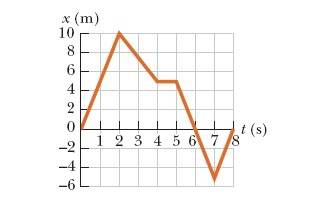
A graph of position versus time for a certain particle moving along the x-axis is shown in the figure below. Find the instantaneous velocity at the following instants.
Untitled22.jpg


(a) t = 1.00 s

(b) t = 3.00 s

(c) t = 4.50 s

(d) t = 7.50 s

I know that a) is 5 m/s and c) is 0 m/s, but I need help figuring out b) and d). I don't understand how to draw the tangent line to find the instantaneous velocity.

For 3.00 s the answers I've come up with are wrong. I though using the slope of two points on the line, (7-10)/(3-2) should give me the answer. Any help?
 
Last edited:
Physics news on Phys.org
murrayk91 said:
A graph of position versus time for a certain particle moving along the x-axis is shown in the figure below. Find the instantaneous velocity at the following instants.
Untitled22.jpg


(a) t = 1.00 s

(b) t = 3.00 s

(c) t = 4.50 s

(d) t = 7.50 s

I know that a) is 5 m/s and c) is 0 m/s, but I need help figuring out b) and d). I don't understand how to draw the tangent line to find the instantaneous velocity.

For 3.00 s the answers I've come up with are wrong. I though using the slope of two points on the line, (7-10)/(3-2) should give me the answer. Any help?
Since each of those times corresponds to a position at which the graph is a straight-line segment, and not where two segments meet, the slope of the tangent line is equal to the slope of the line segment.

You have the right idea with (7-10)/(3-2), it's just that the position at t = 3 s, is a bit in excess of 7 m. Use the whole segment from t = 2s to t = 4 s.
 
When the average velocity doesn't change over a certain period of time, the instantaneous velocity is going to be the same.

It's like trying to find the average grade of five students who all got a 95 on the test
 
Thanks so much! I didn't realize I should take the slope of the whole line. I worked them out and they're correct.
 
Good!

If you use the slope you got and go back to find what x is at t=3s, I think you'll find that x = 7.5m. It's hard to read the graph that accurately.
 

Similar threads

  • · Replies 9 ·
Replies
9
Views
1K
Replies
5
Views
2K
Replies
7
Views
3K
  • · Replies 23 ·
Replies
23
Views
5K
  • · Replies 20 ·
Replies
20
Views
4K
  • · Replies 15 ·
Replies
15
Views
3K
  • · Replies 5 ·
Replies
5
Views
3K
  • · Replies 6 ·
Replies
6
Views
1K
  • · Replies 8 ·
Replies
8
Views
6K
  • · Replies 16 ·
Replies
16
Views
2K