Engineering Why Does Line Current Equal Effective Current in Polyphase Circuits?

  • Thread starter Thread starter Imposta
  • Start date Start date
  • Tags Tags
    Circuit
Click For Summary
In polyphase circuits, line current equals effective current (I(eff)) due to the relationship between line and phase voltages, which simplifies calculations. The confusion arises when considering the impact of wire resistance on apparent power, as this can lead to miscalculations of line current. The equation V(an) = V(aA) + V(AN) reflects the vector addition of voltages in a balanced system. It is crucial to account for the total wire resistance when calculating line current, as neglecting it can lead to significant errors. Understanding these relationships is essential for accurate analysis in polyphase systems.
Imposta
Messages
3
Reaction score
0
I'm having some trouble understanding some parts of this question
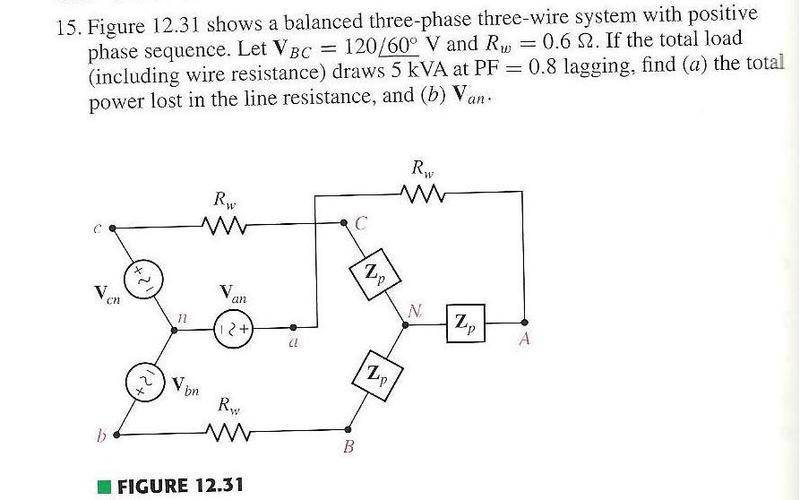
attachment.php?attachmentid=24365&stc=1&d=1268534658.jpg


This is what I've been doing but I'm not quite sure why it works:
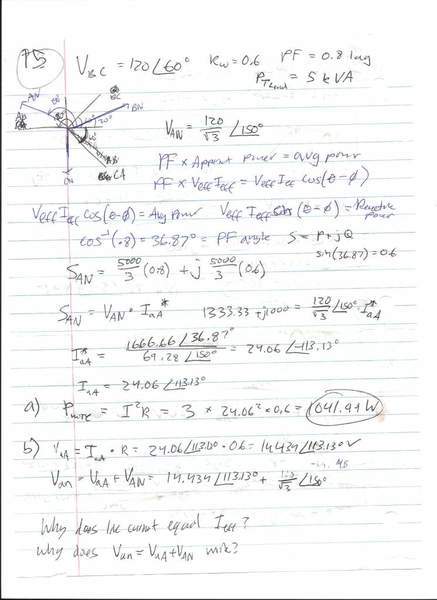
attachment.php?attachmentid=24366&stc=1&d=1268534658.jpg


I have some similar problems and have been getting the same problems with them. I don't know why the line current equals I(eff) and line voltage equals V(eff). Also why does V(an) = V(aA)+V(AN).
 

Attachments

  • question.jpg
    question.jpg
    37.7 KB · Views: 431
  • Picture 002.jpg
    Picture 002.jpg
    30.1 KB · Views: 464
Physics news on Phys.org
Am I missing something, or is this problem impossible? You're given the line to line voltage at a point after the wire resistance, and the power given includes the load and the wire resistance. After you convert your line to line voltage to a line to neutral voltage, you have a voltage over the load, but you cannot use it to find the line current because of the inclusion of the line resistance in that apparent power given.

For example, you use S_{AN} when the given was actually S_{AN} + S_{aA}

Just think about it: you found the total wire resistance dissipated 1kW of energy, but you are ignoring its effects (which seem to be massive) when you found the line current by assuming it accounted for none of the total load's apparent power.

it would actually be:
1333 + j1000 = (V_{AN} + V_{aA}) I^*

and we don't know VaA...
 

Similar threads

  • · Replies 2 ·
Replies
2
Views
401
  • · Replies 1 ·
Replies
1
Views
1K
Replies
15
Views
2K
  • · Replies 12 ·
Replies
12
Views
2K
  • · Replies 4 ·
Replies
4
Views
3K
Replies
3
Views
3K
  • · Replies 8 ·
Replies
8
Views
2K
  • · Replies 7 ·
Replies
7
Views
3K
  • · Replies 13 ·
Replies
13
Views
2K
  • · Replies 2 ·
Replies
2
Views
3K