Hi i want to calculate the Rinput and Routput of this Active Filter.

  • Thread starter Thread starter Fovakis
  • Start date Start date
  • Tags Tags
    Filter Hi
Click For Summary

Discussion Overview

The discussion revolves around calculating the input and output resistances (Rinput and Routput) of an active filter used in a signal processing application. Participants explore the theoretical and practical aspects of determining these values, particularly in the context of an audio frequency range from DC to 17 kHz.

Discussion Character

  • Exploratory
  • Technical explanation
  • Debate/contested
  • Mathematical reasoning

Main Points Raised

  • One participant seeks guidance on calculating the input and output impedances (Zin and Zout) of an active filter.
  • Another participant suggests measuring the impedances using a simulator and inquires about the frequency range of operation.
  • It is noted that Zout can be determined from the output impedance of the operational amplifier (OPA2608) and the capacitor's impedance.
  • A practical method for finding Zin is proposed, which involves disconnecting the filter input, shorting the output, and measuring input current with an ideal voltage source.
  • Concerns are raised about the frequency-dependent nature of Zin and the complexity of its calculation.
  • Participants discuss the implications of using capacitors in the circuit and the potential need for modifications to ensure the filter passes DC.
  • There is mention of using simulation software to measure input impedance across various frequencies.
  • One participant expresses a desire for simpler explanations due to their beginner status in the topic.

Areas of Agreement / Disagreement

Participants express varying opinions on the best approach to calculate or measure Zin and Zout, with no consensus reached on a single method. There is also disagreement regarding the implications of the circuit design on DC signal handling.

Contextual Notes

Participants acknowledge that the input impedance is not a fixed value and varies with frequency, complicating the calculations. The discussion includes references to specific components and their characteristics, which may influence the overall circuit behavior.

Who May Find This Useful

This discussion may be useful for individuals interested in circuit design, particularly those working with active filters in audio applications or those seeking to understand impedance calculations in signal processing.

Fovakis
Messages
47
Reaction score
0
Hi! i want to calculate the Rinput and Routput of this Active Filter.

How can i do that?
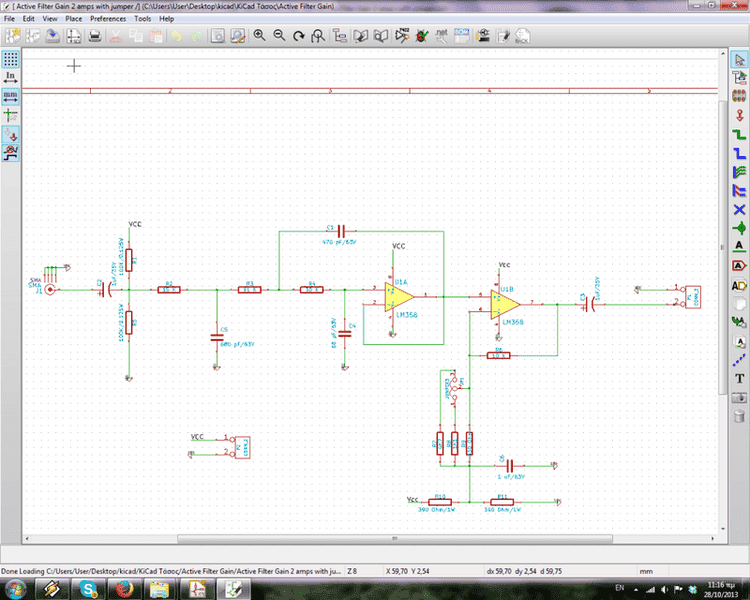
Circuit_zpsb91f9e29.png
"]
Circuit_zpsb91f9e29.png
[/URL]
 
Engineering news on Phys.org
I believe you mean Zin and Zout, right? :smile:

Do you want to calculate those impedances, or measure them with your simulator? What frequency range do you want this circuit to operate over?
 
berkeman said:
I believe you mean Zin and Zout, right? :smile:

Do you want to calculate those impedances, or measure them with your simulator? What frequency range do you want this circuit to operate over?

yeah exactly this ! :)

Hi and many thanks for your reply! I will give more information about my question on the schematic.

So the frequency bandwidth is DC to 17khz (audio)! Before this filter there is a double balanced ring diode mixer that downconvert a signal of 30MHz to a baseband DC to 17khz. The mixer's output (ideally) is 50ohm.

RF front...---Mixer-----Active Filter--Demodulator (DSP). I want to calculate the total gain of the stages of receiver but in the filter i don't know the Zinput and Zoutput to convert the voltage gain=20log(Vout/Vin) to power gain. I need to know what is the Zout and Zin. After the Active filter there is a DSP kit i think it's Zinput is about 10k maybe not sure...
 
Fovakis said:
yeah exactly this ! :)

Hi and many thanks for your reply! I will give more information about my question on the schematic.

So the frequency bandwidth is DC to 17khz (audio)! Before this filter there is a double balanced ring diode mixer that downconvert a signal of 30MHz to a baseband DC to 17khz. The mixer's output (ideally) is 50ohm.

RF front...---Mixer-----Active Filter--Demodulator (DSP). I want to calculate the total gain of the stages of receiver but in the filter i don't know the Zinput and Zoutput to convert the voltage gain=20log(Vout/Vin) to power gain. I need to know what is the Zout and Zin. After the Active filter there is a DSP kit i think it's Zinput is about 10k maybe not sure...

Well Zout is easier to find, since it is dominated by the low output impedance of the LM358, along with the series cap. Look in the LM358 datasheet for Zout numbers.

For the Zin, use the "virtual ground" property of the first opamp, and ground the input circuit component at the opamp's - terminal. Connect the right side of C5 to ground through the equivalent output impedance of that first opamp. That should give you a mixed RC circuit that you can analyze with KCL.
 
A practical way to find Zin (which will be frequency-dependent, in general) is:

1. Disconnect the filter input from the rest of the circuit
2. Short circuit the filter output
3. Connect an ideal voltage source (i.e. a sine wave) ito the input and measure the input current.

If the output of the filter is the output of an op-amp (U1B in your diagram?) then for practical purposes the output impedance is the same as the op-amp output impedance, unless the filter's feedback loop has a very low impedance for some strange reason. Check the op-amp datasheet if you really need the value, but unless the filter is driving a low impedance input (which is probably a bad design idea anyway) the exact value isn't important.

EDIT: or do what Berkeman said - the two posts had exactly the same time stamp before I edited this one!
 
Great minds think alike! :smile:
 
AlephZero said:
A practical way to find Zin (which will be frequency-dependent, in general) is:

1. Disconnect the filter input from the rest of the circuit
2. Short circuit the filter output
3. Connect an ideal voltage source (i.e. a sine wave) ito the input and measure the input current.

If the output of the filter is the output of an op-amp (U1B in your diagram?) then for practical purposes the output impedance is the same as the op-amp output impedance, unless the filter's feedback loop has a very low impedance for some strange reason. Check the op-amp datasheet if you really need the value, but unless the filter is driving a low impedance input (which is probably a bad design idea anyway) the exact value isn't important.

EDIT: or do what Berkeman said - the two posts had exactly the same time stamp before I edited this one!

Hi AlephZero ! thanks! i am a begginer so please more simple the explanations if you can :(

First of all i understand that Zout is Zoutput of Operation Amplifier + pluse Zof capacitor=1/jωC where C=10^(-6)Farad. (basically i have a dual fet OPA2608 not the LM358 that is at the schematic).

What do you mean the filter input? what components consisting that?
 
Fovakis said:
Hi AlephZero ! thanks! i am a begginer so please more simple the explanations if you can :(

First of all i understand that Zout is Zoutput of Operation Amplifier + pluse Zof capacitor=1/jωC where C=10^(-6)Farad. (basically i have a dual fet OPA2608 not the LM358 that is at the schematic).

What do you mean the filter input? what components consisting that?

The input to the filter is the SMA connector on the left...
 
berkeman said:
The input to the filter is the SMA connector on the left...

can i have more help please..
 
  • #10
@Fovakis. The input impedance is not a fixed value, it varies with frequency following a complicated equation. What do you need to know about it? What is the important consideration? Instead of trying to calculate it, it would be much easier to ask your simulator to "measure" the input impedance at various frequencies to allow you to plot a graph of impedance over the range of frequencies of interest. Are you sure that the component values on your schematic will give the filter response that you need? Have you asked your software to plot the passband?

@berkeman. I see no virtual Earth's in this schematic.
 
  • #11
NascentOxygen said:
@Fovakis. The input impedance is not a fixed value, it varies with frequency following a complicated equation. What do you need to know about it? What is the important consideration? It would be much easier to ask your simulator to "measure" the input impedance at various frequencies to allow you to plot a graph of impedance over the range of frequencies of interest.

yes you right about that. what simulator can i use for that? Is there any tool or toturial to find out?

Also, if i want to calculate the Zin for f=20khz. it would be much better to do the maths i guess.


I am starting, first a Capacitor with Zc=1/j2πfC1..8/j Farads. Is it right to do with capacitors? then i must add this with the voltage diviver ? i will have a complex number for Zin right?
 
  • #12
BTW, you won't get any DC through this filter with those 3uF caps in the way. Are you wanting its passband to extend right down to DC (i.e., are you wanting a low-pass filter)?
 
  • #13
NascentOxygen said:
BTW, you won't get any DC through this filter with those 3uF caps in the way. Are you wanting its passband to extend right down to DC (i.e., are you wanting a low-pass filter)?

Yes it is a low pass filter the first stage. the second is an amp. :-p
 
  • #14
Fovakis said:
yes you right about that. what simulator can i use for that?
I presumed the KiCad that you drew the schematic on? :smile:

You'll have to ask others for recommendations, otherwise. I can't offer advice on PC software.

Also, if i want to calculate the Zin for f=20khz. it would be much better to do the maths i guess.
I had concluded that it was beyond your ability, at this stage.

I am starting, first a Capacitor with Zc=1/j2πfC1..8/j Farads. Is it right to do with capacitors? then i must add this with the voltage diviver ? i will have a complex number for Zin right?
Zin will be a different complex number for every frequency. The equation is very complicated.
 
  • #15
Fovakis said:
Yes it is a low pass filter the first stage. the second is an amp. :-p
So what modifications are you going to make to it, to turn it into a filter that passes DC? It has just ratcheted up a notch in complexity, because the circuit is shown operating off a single power supply. It won't do well preserving the DC component of the input.

http://physicsforums.bernhardtmediall.netdna-cdn.com/images/icons/icon2.gif You need to get it clear from the start: do you need its response to include DC?
 
Last edited by a moderator:
  • #16
NascentOxygen said:
So what modifications are you going to make to it, to turn it into a filter that passes DC? It has just ratcheted up a notch in complexity, because the circuit is shown operating off a single power supply. It won't do well preserving the DC component of the input.

http://i1284.photobucket.com/albums/a578/fovos1/SISOFILTE_zps56bc4977.png

I don't want this filter to PASS any dc signal , because at the next stage there is a demodulator. So i need to cut the dc signal that maybe leakage from other stages to the input of my active filter. My circuit is operating with a single power supply (DC). I use the single power supply to operate my operational amplifiers. please check my photo above. this is the right filter. thanks for your patience
 
Last edited by a moderator:
  • #17
As you already have the filter constructed (and I presume, tested) it should be a simple matter to use a signal generator and a couple of probes to take measurements to determine the input impedance vs frequency graph?
 
  • #18
NascentOxygen said:
@berkeman. I see no virtual Earth's in this schematic.

Yes, you are correct. I misspoke.
 

Similar threads

  • · Replies 0 ·
Replies
0
Views
2K
  • · Replies 39 ·
2
Replies
39
Views
5K
Replies
3
Views
2K
  • · Replies 46 ·
2
Replies
46
Views
4K
  • · Replies 3 ·
Replies
3
Views
2K
  • · Replies 23 ·
Replies
23
Views
5K
Replies
2
Views
3K
Replies
17
Views
3K
Replies
3
Views
2K
  • · Replies 15 ·
Replies
15
Views
7K